Your Body Wakes at 6. Your Brain Wakes at 7:30. Sound Alarms Can't Bridge the Gap.
Standing up isn't waking up. The 90 minutes between motor wake and brain online is the gap your alarm was never designed to close. Here's the mechanism, and why founders pay the highest tax on it.
April 25, 2026
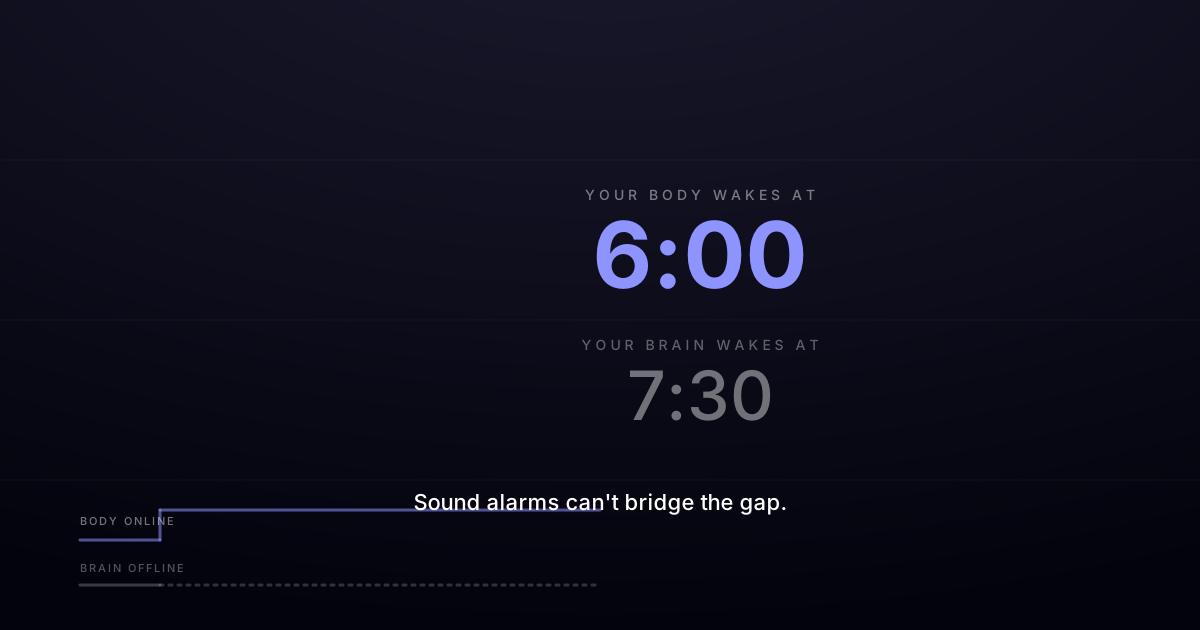
Your Body Wakes at 6. Your Brain Wakes at 7:30. Sound Alarms Can't Bridge the Gap.
A few weeks ago I caught myself standing in the kitchen at 6:14 AM, kettle on, mug out, no recollection of crossing the hallway. I'd been "up" for nine minutes. My alarm had stopped at 6:05. I have no memory of dismissing it.
That isn't a fun anecdote about being tired. That's the gap.
Your body wakes up. Your brain doesn't. There's a window, sometimes minutes, sometimes 90, where you're walking around as a polite zombie and the part of you that runs your business is still loading.
Sound alarms can't close that window. Not louder ones, not "smart" ones, not even the math-puzzle ones. They were never designed to.
I started building Rouse because I burned the first two hours of every founder day to that gap and refused to keep doing it. The post that ended up on r/productivity last month told me I wasn't alone. u/[OP] put it cleaner than I could have:
"I have realized that most wake up early advice doesn't really work for me. Alarms, multiple alarms, putting my phone across the room. I can still go back to sleep pretty easily. It feels like my body wakes up, but my brain does not fully engage. The only times I get up properly are when something forces me to think or respond immediately." (r/productivity, 343 upvotes, 0.99 ratio, 283 comments)
Top comment, 54 upvotes, said the quiet part out loud:
"There is no consciousness for some of us. I can get out of bed and turn off the alarm in the other room and go back to bed without ever waking up. Zombie body. Brain is 100% offline."
This post is about why sound is the wrong instrument for that gap, why even the "harder" alarms (math, photo of the toothbrush, scan a barcode) fail inside a week, and what a forcing function that actually wakes a brain looks like.
In this post, you'll learn:
- Why the brain has two wake states (motor online, cortex offline) and why sound only triggers one
- Why even "task-based" alarms (Alarmy, Awake, mimic, math, photo) habituate the same way sound does, just slower
- The one property a forcing function needs to keep working past day 7
- Why founders pay the highest tax on this gap (and why a 9 AM team standup is the only thing that ever fixed it for me)
7 min read.
The two wake-ups your alarm only delivers half of
Sleep researchers have a clean name for what's happening in that hallway-to-kitchen blur. It's called sleep inertia.
Tassi & Muzet's 2000 review in Sleep Medicine Reviews is the canonical reference. After waking, your prefrontal cortex (planning, judgment, working memory, the entire executive-function stack) takes 15 to 30 minutes to come fully online, and in bad cases up to two hours, while your motor cortex and brainstem are already up and walking around. The "thinking" parts wake last. Hilditch and McHill expanded this in 2019: sleep inertia is real, measurable, costly, and has nothing to do with how disciplined you are. It's a hardware boot sequence. PFC boots last.
Vallat et al. 2018 imaged the actual mechanism. The default-mode and dorsal-attention networks that hold "you" together are still negotiating their handshake at wake, which is why you can stand, pour water, and unlock your phone before you can do anything that requires an actual decision.
So when your alarm goes off, two things happen on completely different schedules. Motor wake: instant. Cortex wake: slow, sometimes 90 minutes slow. Sound only triggers the first one.
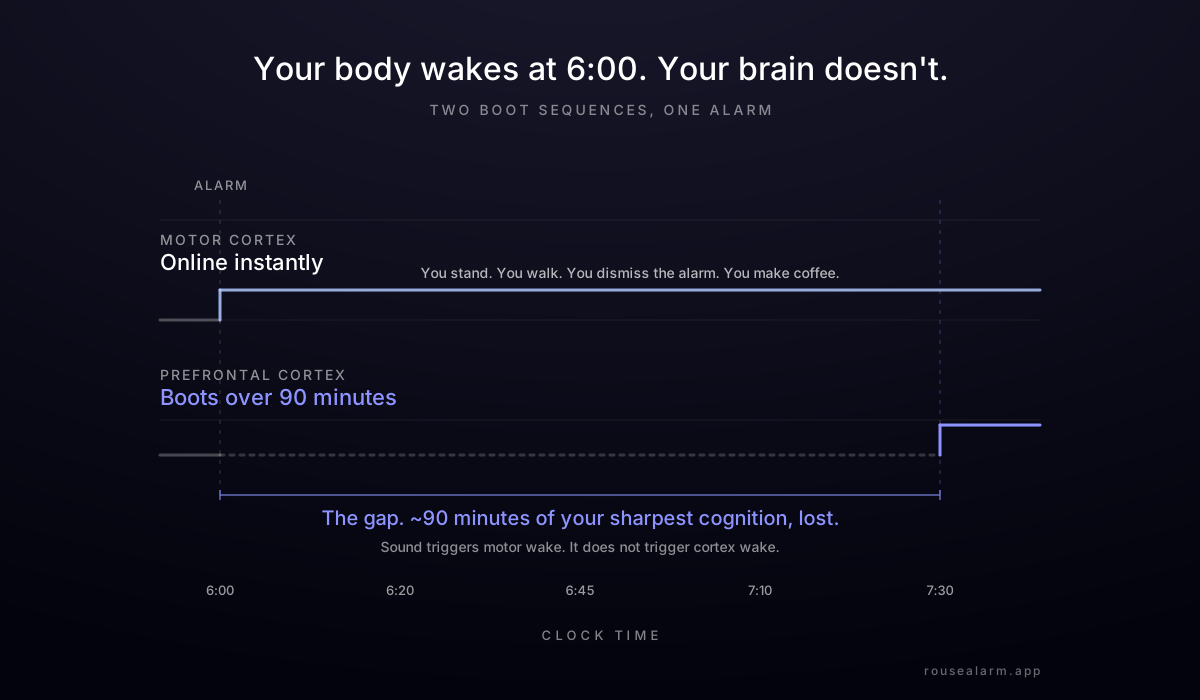
The part that took me a year to internalize is that your motor brain does not need executive function to dismiss an alarm. It can do it on procedural memory alone, the same way you brush your teeth without thinking, the same way u/Plane-Map3172 walks across the apartment, taps the alarm off, and goes back to bed without ever loading consciousness.
Sound never asked the cortex to participate. So the cortex didn't.
Why every "harder" alarm fails by day 7
The intuition behind "smarter" alarms is reasonable. If a sound isn't enough, give the brain a task. Solve a math problem. Take a photo of the kitchen sink. Mimic a facial expression. Walk over to scan a barcode. Apps like Alarmy, Awake, Mimicker, Challenges Alarm Clock, and I Can't Wake Up all run this playbook, and they all hit the same wall at roughly the same point in the second week.
The wall has a name. Fitts and Posner described it in 1967 as the three-stage model of skill acquisition: cognitive → associative → autonomous. The first time you do a thing, you're processing every step. By the tenth time, parts have automated. By the hundredth, the whole task runs on procedural memory and you can do it while functionally asleep.
That's exactly what the math-puzzle alarm becomes. The first morning, your brain has to actually solve "7 + 13." The seventh morning, it's a reflex. The fortieth, you don't even remember solving it. The challenge has migrated from "executive function required" to "motor cortex sufficient."
The orienting response, Sokolov 1963, gives the same diagnosis from a different angle: the brain models repeating stimuli, and after enough repetitions with no consequence, it just predicts and moves on. Static challenges are repeating stimuli. They're slightly more orienting than a tone, so they buy you a few extra days. Then habituation eats them too. This is the same loop I went deep on in the habituation post.
I've watched myself solve a 4-digit Alarmy puzzle, set the phone down, and slide back under the duvet with no memory of either action. The alarm thought I was awake. My motor cortex thought I was awake. My PFC was still booting.
The one property a real forcing function needs
Three properties separate "stimulus that wakes a body" from "stimulus that wakes a brain":
- Novel content each morning. The brain can't model what it can't predict. Same trigger time is fine. Same device is fine. The content of the interaction has to differ enough that yesterday's response doesn't apply.
- Requires a generated response, not a recognized one. Recognition (tap the green button, solve a known equation) runs on procedural memory; generation (forming a coherent sentence, answering a question you haven't heard before) requires executive function by definition, and you can't generate a novel reply with a sleeping cortex.
- Can't be auto-completed. A static challenge ends the moment you "produce." A real forcing function only ends when the other side is satisfied with your level of engagement.
A sound alarm passes none. A math-puzzle alarm passes (3) by accident, until you memorize the route. A "photo of the bathroom sink" alarm passes (3) until you take the same photo every day.
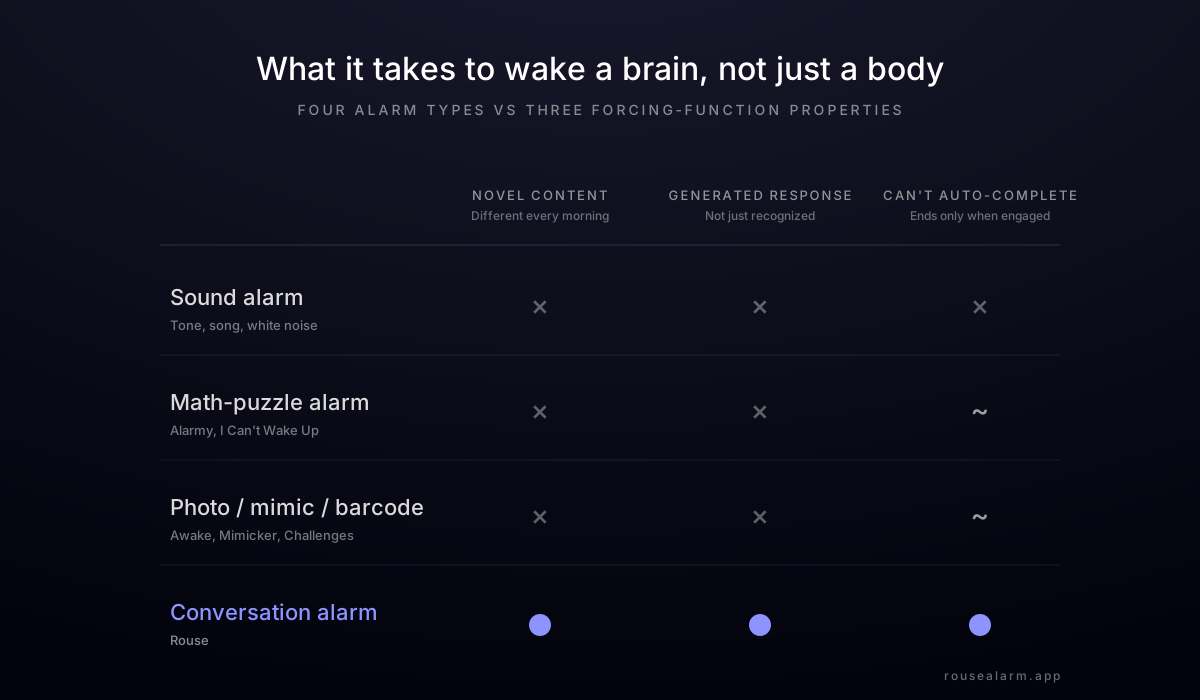
You know what passes all three? People do.
The reason a 9 AM client call wakes me up properly when an alarm doesn't isn't that the call is "important." It's that the call satisfies all three properties by construction. The other person says something I haven't heard before, I have to generate a coherent reply, and I can't end the interaction unilaterally by mumbling.
It's also the answer u/StayPuzzleheaded1958 gave on r/getdisciplined (119 upvotes, 160 comments):
"I got a dog, when he wakes me up at 6am there is no mercy. I have to be out that door in 3min or he'll be shitting and pissing down the apartment."
What everyone in those comments converged on (dogs, kids, partners, oncall pages) is the same mechanism in different costumes. Something that requires response, that won't take the same response twice, and that won't quit until you've engaged. That's the forcing function.
Why founders pay the highest tax on this gap
If you work at a real company, your morning has a built-in forcing function whether you noticed or not. The 9 AM standup. The commute. The colleague who pings you on Slack at 8:50 to confirm a deck. The email from your manager you have to triage before you sit down. None of those are alarms, but all of them require generated response, and all of them load executive function within minutes of motor wake.
Then you quit your job to go solo, or you start a consultancy, or you go indie hacker, and you fire that morning forcing function without realizing what you did. (I wrote about this from a different angle in "you fired your alarm clock when you quit your job.")
Now there's no standup. No commute. Nobody who'll notice if you're at the desk at 9 or 10:30 or 11. The alarm goes off, the motor cortex stands you up, and the PFC has nothing to do for 90 minutes so it doesn't bother coming online until something happens to require it. Often that something is your first scroll-induced shame spike around 9:45.
You haven't "lost discipline." You've removed every external generator of cognitive load from your morning, and now you're trying to bridge a 90-minute brain-boot window with an alarm tone. The instrument is wrong for the job.
The most-upvoted comment on a r/getdisciplined thread asking why some people seem to have so much energy (679 upvotes, u/Ok-Swimmer-627):
"A lot of the time, people do not have some giant extra reserve of energy. They have fewer hidden leaks."
The 90-minute brain-offline window is one of the biggest hidden leaks a solo founder has. It's invisible because nobody else can see it.
Where Rouse fits (and where it doesn't)
The design constraint I was staring at when I started Rouse was this: build something that satisfies all three properties of a real forcing function, on the bedside table, without requiring another human.
That's why the alarm is a conversation, not a sound and not a puzzle.
The LLM speaks first. You speak back, out loud, in actual sentences. The content differs every morning (it references your evening notes, asks about today's first task, doesn't repeat yesterday's prompts), so you can't tap-to-dismiss and you can't memorize a route through it. The alarm only ends when the conversation reaches a state where the AI is satisfied you're actually awake, and "actually awake" is operationalized as "able to generate coherent multi-sentence responses," which by the Tassi & Muzet definition is the same thing as "your PFC is online."
It isn't magic. It's the only stimulus shape I could think of that doesn't habituate.
I'll be honest about what it isn't. It's not a substitute for sleep, stimulus control, or the right chronotype-aware schedule. What it does is bridge the body-awake / brain-offline window with the one stimulus that doesn't habituate: novel, response-required, can't-be-auto-completed conversation.
When I switched from Alarmy to Rouse on my own phone last summer, the first thing I noticed wasn't that I woke up faster. It was that I stopped losing the first 90 minutes. By 6:08 I was in the kitchen with the actual lights on in my head, not the polite zombie version. That window was the founder tax I was paying, and I just hadn't named it yet.
What to actually do tomorrow morning
Don't trust me. Run the diagnostic.
For the next seven mornings, write down two times in a phone note: the moment your motor cortex says "I'm up" (you stand, you walk), and the moment you do something that genuinely requires executive function (a real decision, a written sentence, a generated reply to a person). The gap is your tax.
If it's under 15 minutes, you're either a true morning person or you have an external forcing function (kid, dog, commute, partner) loading cognition for you. Don't change anything. If it's 30 to 90 minutes, you're paying half to two full hours of your sharpest possible thinking window every day to a known mechanism with a known fix, and the fix isn't a louder alarm or a harder puzzle. It's a stimulus shape your brain can't categorize as "background noise" by Friday.
If you've already tried the louder, smarter, harder versions and the gap keeps showing up, set Rouse for tomorrow morning. Talk to it. See if your kitchen at 6:15 looks different. I'd love to know if it lands.
FAQ
My body wakes up but my brain doesn't. Is that normal? Yes, mechanically. Sleep inertia (the lag between motor wake and PFC wake) is documented in Tassi & Muzet 2000 and Hilditch & McHill 2019. The window is typically 15 to 30 minutes, sometimes up to two hours. What's not normal is paying that tax every day without anything in your morning designed to close the gap.
Why don't math-puzzle alarms work long-term? Once you've solved "7 + 13" forty mornings in a row, your brain has migrated the task from executive function to procedural memory (Fitts & Posner 1967). The challenge has stopped requiring the brain region you were trying to wake. Same wall every static-task alarm hits, just on a slightly later day.
Is "your brain doesn't wake up" the same thing as ADHD morning paralysis? Adjacent but not identical. ADHD adds an arousal-regulation deficit on top of normal sleep inertia, which makes the gap longer and meaner. I went deeper on the ADHD version here. The mechanism in this post applies to every brain. ADHD just intensifies it.
Why did my old alarm work for the first week and then quit? Habituation. The longer version is here. Your brain models repeating stimuli and stops orienting to them. Sound is the easiest stimulus to model. Static challenges last a week or two. Novel conversation has no model to converge on.
Does this mean I have to talk to an alarm at 6 AM? That sounds annoying. That's actually the point. If it weren't annoying enough to require a real response, it would join the queue of things your sleeping cortex auto-dismisses. After about a week the friction becomes the cheapest 90 minutes of recovered cognition you've ever bought.
Kuba builds Rouse, an iOS alarm that wakes you up by holding a real conversation with you until you're actually awake. If you've already tried the louder, smarter, harder versions and your brain still spends the first 90 minutes catching up to your body, set Rouse for tomorrow morning and tell me how it goes.