You Fired Your Alarm Clock When You Quit Your Job (and Didn't Realize It)
Solo founders blame willpower. The real reason mornings broke when you quit: you deleted the only thing that ever made the alarm work.
April 20, 2026
You Fired Your Alarm Clock When You Quit Your Job (and Didn't Realize It)
The week I quit my job to build Rouse full-time, my alarm stopped working.
Same alarm. Same phone. Same sleep schedule. For two years I had been getting up at 6:30 without a fight, and now I was not.
I thought my brain had picked a strange week to break.
It turns out the alarm was never really doing the job.
In this post, you'll learn
- Why your old 6 AM wake-up was powered by a 9 AM meeting, not the alarm itself
- The behavioral-science mechanism behind "no boss, no morning" (social contingency plus sleep inertia)
- Why fake structure works for three days and collapses by day fourteen
- What a synthetic witness looks like, and why it is the only thing that re-installs the consequence you just erased
- One thing to try tomorrow morning if you quit your job in the last six months and are quietly losing this battle
(7 min read.)
The alarm was a prop. The meeting was the show.
The first Monday after I quit, the alarm fired at 6:30 like it always had. I opened my eyes, stared at the ceiling, and started negotiating.
I can start at seven. Seven is still early. Seven is basically six.
There was no one downstream from the negotiation. No Slack channel watching. No standup where my empty chair would be a fact about the day. I lost in about four minutes and slept until 9:12.
Here is the thing nobody tells you. Sleep inertia, the groggy executive-function tax you pay for the first fifteen to thirty minutes after waking, is real and measurable (Tassi & Muzet, Sleep Medicine Reviews, 2000, PMID 12531174; Hilditch & McHill, PMC6710480). Your prefrontal cortex comes back online on its own schedule. During that window, you are a different, worse decision-maker than the one who set the alarm the night before.
That is the window where the "just five more minutes" decision gets made. And during that window, your brain is not weighing your vision for the business against your desire for sleep. It is weighing a small immediate reward (bed) against a vague future cost (nothing happens if I stay).
When you had a job, the vague future cost was not vague. It was a room full of people noticing. It was a boss with a memory. It was a 9:05 Slack message that said you around?
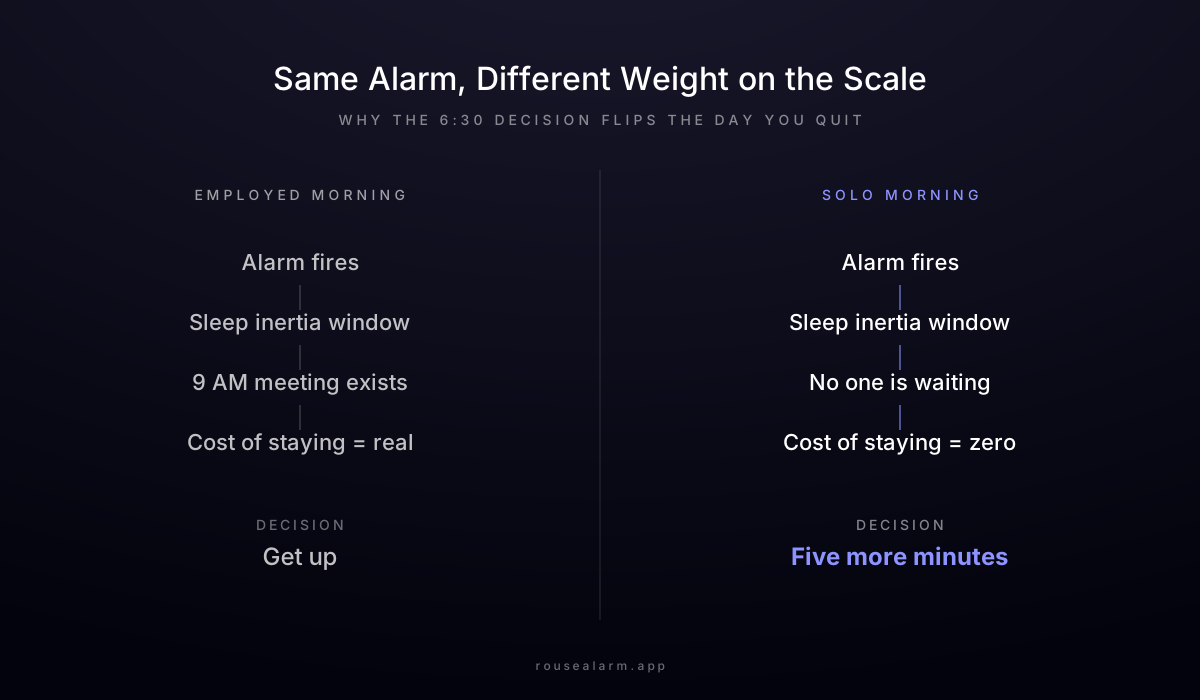
Your 6 AM wake-up was never a habit. It was an appointment.
Why "no boss" breaks the alarm (and willpower doesn't fix it)
I spent the second week of self-employment setting more alarms. Three, then five, then one every nine minutes like a backup generator.
They all fired. I dismissed them all.
At one point I texted myself from my own phone at 6:47. You need to get up. You quit your job for this. I read it. I set the phone down. I went back to sleep.
This is the part that embarrassed me for a while, and then it stopped embarrassing me when I found the research.
Robert Zajonc's 1965 paper on social facilitation (Science, 149(3681)) showed something uncomfortable about humans: the mere presence, or even the anticipated observation, of other people measurably changes how we perform. Peter Gollwitzer's work on implementation intentions (American Psychologist, 54(7), 1999) adds a second wrinkle. "I'll get up at six" is a weak plan. "I'll get up at six because Priya is calling at 6:15" is a strong one. The social consequence is the thing doing the work, not the resolve.
Your alarm clock was never a tool of discipline. It was a trigger attached to a consequence.
When you quit, you kept the trigger. You detached the consequence.
The sound is the same. The scaffolding is gone.
This is why pep-talking yourself at 6:47 AM does not work. You are trying to use the slowest, weakest, most sleep-inertia-compromised part of your brain to simulate something that used to be handled by thirty people you had never consciously thought about.
The fake structure trick most founders try, and why it stalls
There is a standard solopreneur move I hit somewhere around week three. I think a lot of people hit it. If you have read The Miracle Morning or any of the 5 AM blogs, you have probably tried some version of it.
The move is to build fake structure.
Calendar block at 6:15 labeled deep work. Gym clothes folded on the chair by the bed. A whiteboard with tomorrow's one priority written on it in sharpie. A pre-written to-do list sitting on the kitchen counter so the first thing you see is the plan.
It works. For three days.
By day five it has thinned out. By day ten the calendar block is the thing you ignore first. By day fourteen the whiteboard is a guilt object.
I could not figure out why for a long time. Then I read a paper by Bryan, Karlan and Nelson on commitment devices (Annual Review of Economics, 2010). They make a point that is obvious in retrospect and invisible at 6 AM. During sleep inertia, your brain picks the option with the lowest perceived cost in the moment. Fake structure only works if the cost of ignoring it feels real.
A calendar block you made for yourself. A to-do list you wrote for yourself. A rule you invented for yourself. When the groggy version of you is the one evaluating them, all of these collapse into the same answer: I made these, I can un-make them.
They are to-do lists without a witness.
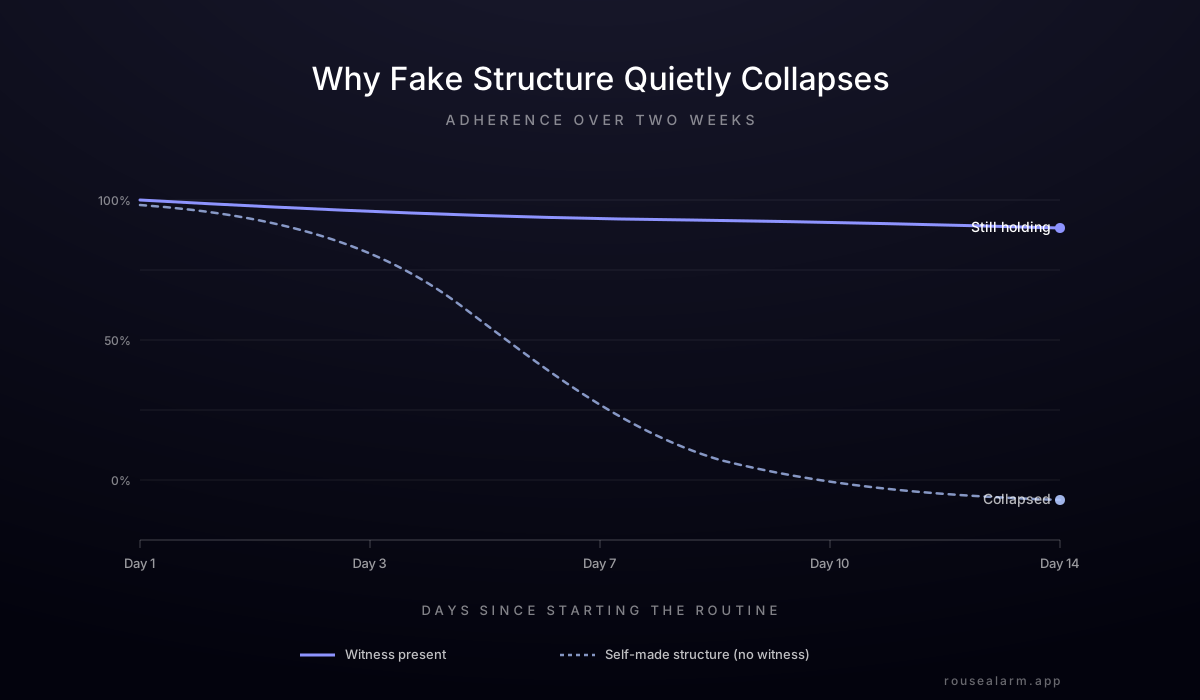
A 9 AM meeting is not a to-do list. It is a room that will exist whether you are in it or not. That is a completely different kind of object, and your brain at 6:30 knows the difference.
This is the thing that bothered me for months. Every founder I talked to had built some version of fake structure. None of them could explain why it quietly fell apart. The Reddit threads I kept finding said the same thing in the same words. I tried setting fake work hours. It worked for a week. The pattern repeats because the thing missing is the same thing every time.
The witness.
What I actually built (and why it works on the same morning the list doesn't)
I want to be honest about what made me build Rouse in the first place, because I did not start there. I started where everyone else starts. I tried the puzzle alarms, the math alarms, the shake-your-phone alarms, the alarm that makes you scan a barcode in another room. I have a small cemetery of these apps on my phone.
They all failed for the same reason. My groggy brain solved the puzzle on autopilot and went back to bed. The barcode one, I memorized the cupboard I had to walk to. I would do it with my eyes closed. It was almost impressive.
The feature they all shared was that they ended. I tapped something, I did something, the alarm stopped. That is a dismissable event. It is a lock my sleep-inertia brain is very good at picking.
What I wanted was the thing a meeting gives you. Something that stays live. Something that will not let you silently opt out. Something that, in the fifteen-minute window where you are most likely to bail, is a small pair of ears pointed at you.
That is why Rouse uses a conversation.
When the alarm fires, an AI starts talking to you. You talk back. The thing does not dismiss until the exchange is real. It asks what you were planning to do this morning. It notices when you are hedging. If last night you told it you were going to ship the first draft of a landing page, it will ask about the landing page. The alarm does not end because you solved something. It ends because you actually woke up and engaged.
It is the synthetic witness.
It is the 9 AM meeting you fired yourself from. It just decided to show up anyway.
I do not want to oversell this. It is not going to fix a sleep-deprivation problem. It is not going to fix burnout. It will not replace a co-founder, a coach, or a therapist. What it does is re-install the one specific thing that quietly disappeared the day you walked out of your old job and felt free. The accountability partner you can afford at 6 AM, that does not need to be on a time zone, and that knows exactly what you committed to last night.
One takeaway
Your morning did not fail when you quit. The scaffolding that was holding it up disappeared.
You got up at 6 AM for a job you hated. You cannot get up at 6 AM for the business you love. That is not a character flaw. It is a structural change. The alarm was a prop. The meeting was doing the work. When you quit, you accidentally fired the stage crew.
If you quit your job in the last six months and your alarm has quietly stopped working, set Rouse for tomorrow morning. Tell it what you are going to do with the hour between 6:30 and 7:30. Let it hold you to it. I would love to know if the conversation closes the gap the same way it did for me.
Sources
- Tassi, P., & Muzet, A. (2000). Sleep inertia. Sleep Medicine Reviews, 4(4), 341 to 353. PMID 12531174.
- Hilditch, C.J., & McHill, A.W. (2019). Sleep inertia: current insights. PMC6710480.
- Zajonc, R.B. (1965). Social facilitation. Science, 149(3681), 269 to 274.
- Gollwitzer, P.M. (1999). Implementation intentions: Strong effects of simple plans. American Psychologist, 54(7), 493 to 503.
- Bryan, G., Karlan, D., & Nelson, S. (2010). Commitment devices. Annual Review of Economics, 2, 671 to 698.