You're Not Lazy. You're a Late Chronotype. Here's What Your 5 AM Alarm Is Fighting.
The 5 AM Club assumes everyone's prefrontal cortex boots at the same time. For ~40% of us, it doesn't. Here's the lever the alarm keeps missing.
April 24, 2026
You're Not Lazy. You're a Late Chronotype. Here's What Your 5 AM Alarm Is Fighting.
Twice this year I tried to join the 5 AM Club. Both times the alarm did exactly what it was supposed to. It was me who didn't.
I kept reading that piece of advice where some 7-figure founder explains his routine and I kept thinking, why is mine breaking. I had the routine. I had the bedtime. I had the green-lit matcha ready to go.
Turns out the book I bought wasn't written for my brain. It was written for about 40% of the population. The other 40% is a different operator entirely, and it's not a willpower gap.
8 min read
In this post, you'll learn
- Why your 5 AM alarm keeps firing into an offline brain even when you went to bed "on time"
- How a late chronotype actually shifts the entire cognitive start of your day by two to three hours
- The one evidence-based lever that moves the clock, and why sound alarms structurally cannot use it
Why your 5 AM alarm is ringing into an offline brain
So here's what nobody explains when they hand you The 5 AM Club.
There's a thing called a chronotype. It's the genetic setting that decides when your circadian clock fires cortisol, when your core body temperature rises, when your prefrontal cortex comes online, and when you want to go to bed. About 40% of adults run "later" than the 9-to-5 assumes. Another 40% run "earlier." The rest are somewhere in the middle. The Roenneberg group has been measuring this on tens of thousands of people since 2003 and the distribution is pretty stubborn. Genetics, not discipline. The population is a bell curve, not a club.
Now layer in the second thing the 5 AM crowd never talks about.
Sleep inertia.
Tassi and Muzet's 2000 review is still the cleanest write-up: 15 to 30 minutes of measurably worse cognition right after waking. Reaction time, working memory, decision quality. All dragging. Hilditch and McHill's 2019 paper in Nature and Science of Sleep adds the part that matters for you: sleep inertia gets worse if you're pulled out of sleep at a circadian phase your body didn't expect to be awake. A forced early wake hits harder than a natural one. It lasts longer. The window where your executive function is on a dial-up connection is bigger.
Stack those two.
Late chronotype ≠ early chronotype + bad attitude.
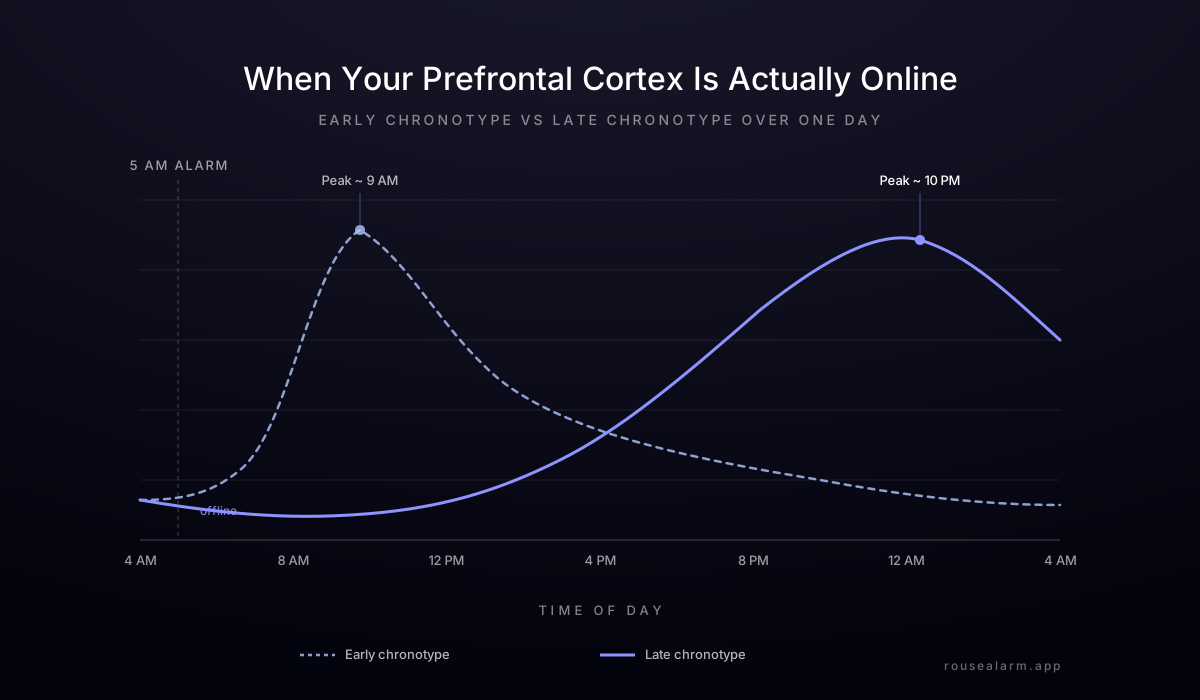
Late chronotype = a prefrontal cortex that's still 20 to 30 minutes away from being online at 5 AM. Not because you stayed up too late. Because your internal clock hasn't fired the "okay, lights on upstairs" signal yet.
So the alarm goes off, and right at the moment it asks "get up or don't," the part of your brain that would normally make that call is still booting. A decision gets made anyway. Just by a different operator, running on worse inputs, pretending to be you. Same two-self problem I wrote about here, in the willpower post, except now with the added gift that your clock hasn't even started the workday yet.
You're not losing the fight. You're being asked to show up for the fight 90 minutes before your brain does.
Why the 5 AM Club broke you harder than it broke your coworker
Here's the Reddit quote that finally made this click for me. Guy on r/productivity, 561 upvotes, and the thread reads like a group therapy session:
"For years I thought I was terrible at time management because I couldn't focus in the mornings. I'd drag myself through the first half of the day, down coffee after coffee and still feel like I was running on fumes. Then around 6pm I finally hit my stride focused, creative and efficient until late at night… after reading up on chronotypes and circadian rhythms I realized my body just isn't wired that way."
(u/dead_synopsis, r/productivity)
The top comment underneath is a sleep researcher in everything but the title:
"For 'morning people' that's around 8 to 10am. For 'night owls' like you, it's 6pm to midnight. It's mostly genetics and fighting your natural rhythm is a waste of time."
(u/escapevelocity1800, 71 upvotes on that thread)
I read that and felt something click that hadn't clicked in years of founder-bro morning content. Every "successful CEOs wake up at 5" story is technically true. It's just that the CEOs telling the story were almost certainly early chronotypes who discovered they were early chronotypes and then wrote a book about it. "All of the people who show up and proclaim that getting up early solved everything for me are just early birds who didn't realize they were early birds," as u/hermitix put it in the same thread. 41 upvotes. It reads like someone finally letting the air out of a balloon.
Then there's the part that actually hurts.
Even if you are a late chronotype and you decide you want to function at 5 AM anyway, the standard advice breaks you faster than it breaks your early-bird peer. Facer-Childs and colleagues in 2019 ran late chronotypes through a three-week protocol of consistent early wake times plus morning light, and yes, they shifted their clocks. Cognitive performance went up. Depression scores went down. But the catch is: it took three weeks of compliance, not three days. And the subjects who didn't stick to the full protocol got worse, not better. Because the move from late chronotype to functional-at-5 is a phase shift of two to three hours, and you can't willpower a two-hour phase shift. You can only entrain it.
Which is exactly what willpower-based 5 AM Club attempts don't do.
The book says go to bed earlier. Your late chronotype says "cool, I'll just lie here pissed off at the ceiling until 11:30 like every other late chronotype who tried this." You show up at 5, cognitively gutted, last about 9 days, conclude you're lazy, and go back to the old schedule.
Except now the old schedule is worse, because in those 9 days you also built up real sleep debt, which compounds the way Van Dongen's 2003 paper showed: by the end of two weeks of 6-hour nights, cognitive performance matches two full sleepless nights. Your brain running the self-assessment doesn't notice. It just rates you a foggy 6 out of 10 and quietly rewrites the story as "I'm not disciplined enough for this."
You didn't fail the 5 AM Club. The 5 AM Club failed to mention it was written for half the room.
The one lever that actually shifts a late chronotype
Fine. So 5 AM doesn't work for you. Do you just give up on early mornings?
No. That's where most "accept your chronotype" takes land, and I think that ending is wrong for founders. The accept-it-and-sleep-till-10 advice only works if your calendar lets you. Most of ours don't. Client calls, kids, partners on different schedules, investor syncs on someone else's continent. The functional question isn't "are you a late chronotype," it's "can you shift the chronotype a little, cleanly, without breaking yourself in the process."
And here's the part I actually care about, because it's the lever the 5 AM Club book skips entirely.
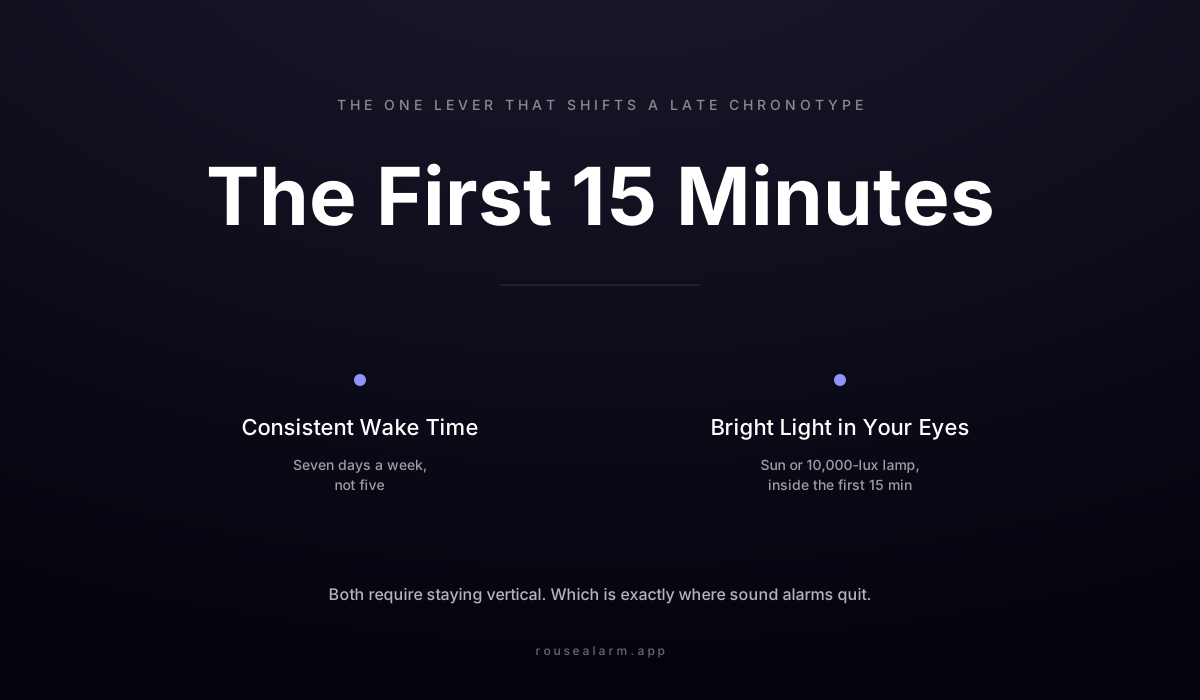
There are exactly two things that move a chronotype earlier, reliably, with research behind them:
-
Wake at the same time seven days a week. Not five. Seven. Wittmann, Dinich, Merrow and Roenneberg coined the term social jet lag back in 2006 to describe what happens when your weekend wake time drifts two hours later than your weekday wake time. Your body treats that as a transatlantic flight twice a week. A follow-up 2012 Current Biology paper showed 87% of the population has at least an hour of social jet lag, and the more you have, the worse your metabolic and mood markers get. Every Sunday lie-in is a phase delay you then try to fix with a 5 AM alarm on Monday. You cannot fix it on Monday. The clock was moved on Saturday.
-
Get bright light into your eyes within about 15 minutes of waking. Natural sunlight is best. A 10,000-lux light therapy lamp is second-best. This is the actual circadian reset signal your suprachiasmatic nucleus is wired to respond to. It's what tells your clock "the day has started, fire cortisol, bring PFC online, start the count for tonight's melatonin." Without it, you wake up early but your internal clock doesn't. You're just awake inside a body that still thinks it's 3 AM.
Both of those things require the same thing to happen: you have to stay vertical, out of bed, and moving toward the window or the door in the first 15 minutes after the alarm. That's it. That's the whole lever.
Which is the exact 15 minutes sound alarms abandon.
Set an alarm, dismiss it, roll over. Alarm does its job. You're still horizontal. You've told your circadian clock nothing. Set Alarmy with a barcode scan, hit the barcode, roll over. Same. Set a sunrise clock, watch it fade up, pull the duvet higher. Same.
The alarm isn't the problem. The silence after the alarm is. That's what my whole working-from-bed argument pointed at too, from a different angle: if nothing keeps you vertical in the window, nothing keeps you vertical.
That's why I keep building alarms around conversation. Rouse runs a voice conversation for 5 to 15 minutes after the alarm fires. Not to be cute. Because that's exactly the window where your late-chronotype prefrontal cortex is coming online and where you need to be physically moving toward light for the circadian shift to actually register. You can't mumble one-word responses to a conversation. You have to think. And by the time you've thought twice, you're sitting up, then walking, then at the window, and the lever you need to pull is right there for you to pull.
Two to four weeks of that, for a late chronotype, is the difference between "5 AM is something I keep failing at" and "5 AM is something my body agrees to now." You become the version of the founder who wrote the 5 AM Club book, except the version that also reads the circadian literature.
Takeaway
You're not lazy. Your clock is set later than the 5 AM Club assumes, and every morning you tried to fix with willpower was trying to override genetics with vibes. The real variable is consistent wake time plus light in the first 15 minutes. The only alarm mechanic that keeps you vertical long enough for both of those to happen is one you can't dismiss from under the duvet.
If you've tried the 5 AM Club twice and it keeps snapping in week two, set Rouse for tomorrow morning and keep the curtains cracked open tonight. Give it two weeks. I'd love to know if it lands.