Working From Bed Broke Your Alarm: The Stimulus Control Collapse No One Warned You About
Your bed used to mean sleep. Then it also meant Stripe, Slack, and 'just one more thing.' Here's why that broke your alarm, and how to fix it.
April 22, 2026
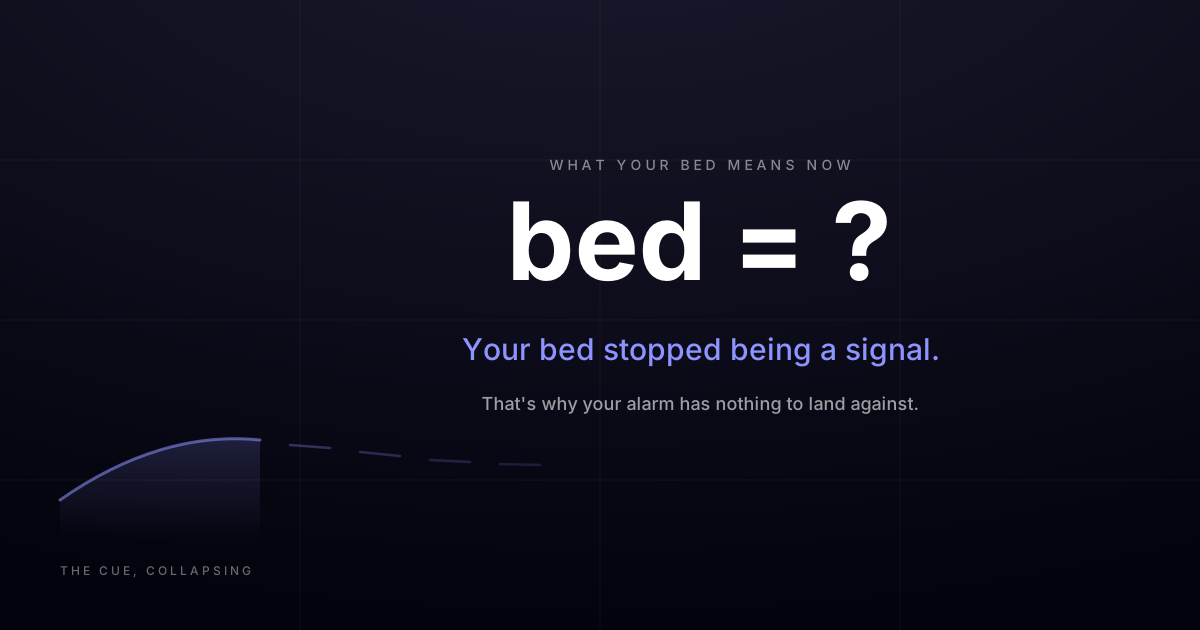
Working From Bed Broke Your Alarm: The Stimulus Control Collapse No One Warned You About
It's 6:47 AM. You dismissed the alarm ninety seconds ago and you're already refreshing Stripe under the duvet, in the same bed you closed the laptop in at 11:43 PM last night.
You tell yourself you'll get up in a minute. You don't.
Turns out your bed stopped being a sleep cue years ago. It also stopped being a wake cue. And your alarm has nothing left to land against.
For a long time I thought my mornings-from-bed problem was discipline. It wasn't. Nobody ever told me that the bed I'd spent twenty years training as a sleep signal had been quietly retrained by two years of laptop-in-bed, and that both sides of that training got erased at the same time.
So let me share what I found. Hopefully you can use it.
In this post, you'll learn
- Why every sleep blog tells solopreneurs "don't work from bed" and none of them explain what's actually happening
- What decades of psychology research calls the thing your bed used to do, and what breaks it
- Why the same collapse that keeps you scrolling at midnight is also why your alarm stops working at 6:47 AM
- What to do when your environment can't carry the signal anymore
6 min read.
1. Your bed used to mean something
For most of your life, your bed did one specific thing to your nervous system. You'd get in it, you'd fall asleep, you'd stay there seven or eight hours, and you'd leave. Every night, for years. Thousands of repetitions.
That's textbook classical conditioning. The bed (the cue) got paired with sleep (the response) so many times that the cue started firing the response on its own (Pavlov, 1927; Rescorla, 1988). Your heart rate dropped when you got in. Your cortisol dipped. Your brain started the pre-sleep cascade before your head touched the pillow.
In 1972, a clinical psychologist named Richard Bootzin noticed that the people sleeping the worst were the ones who'd taught their bed to mean a dozen other things: reading, eating, TV, phone calls, worry. He called the fix stimulus control, the idea that sleep onset depends on the bed being associated with one behavior only (Bootzin, 1972).
Half a century later, stimulus control is still the first and often most effective component of CBT-I, the gold-standard treatment for insomnia (Morin et al., 2006). The clinicians aren't guessing. Pair a cue with one response consistently and the cue does the response for you. Pair it with eight responses and it does none of them well.
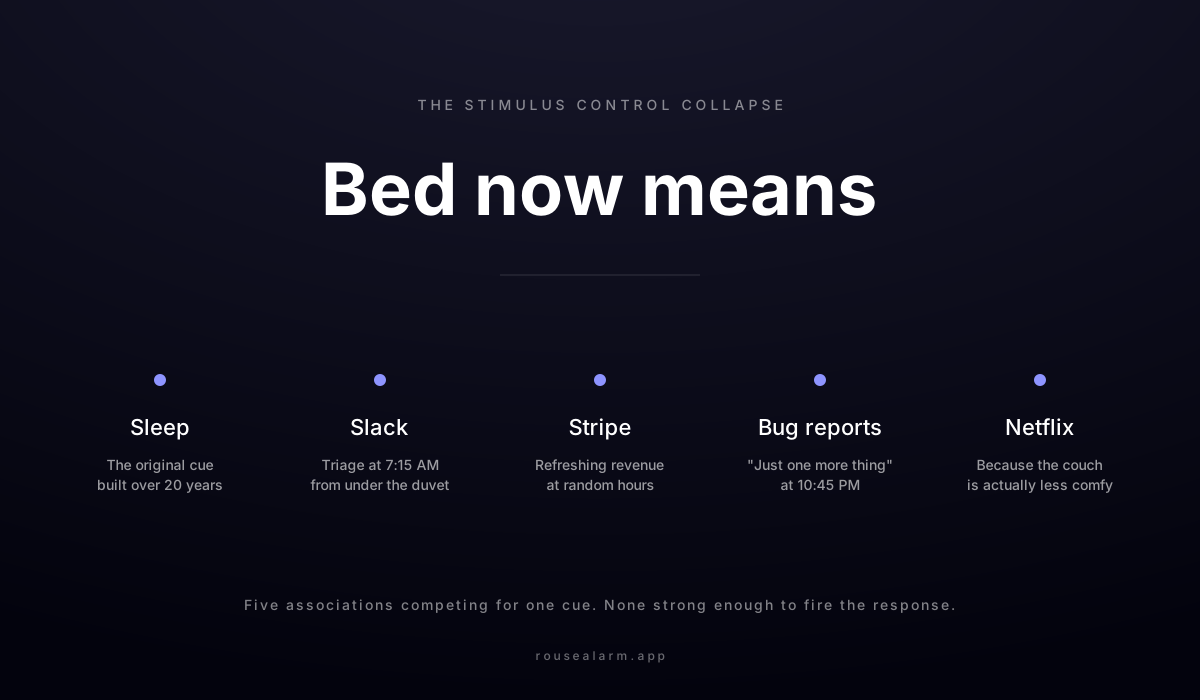
Bed + sleep = predictable response. Bed + sleep + email + Stripe + Slack + Netflix = noise.
2. Then you turned it into a desk, a couch, and a battlestation
For most of human history, most people slept somewhere different from where they worked. Even in a studio apartment, the bed was "the bed corner," not "where I open the laptop to triage a client bug at 10 PM." That separation wasn't a decoration choice. It was the thing keeping the cue clean.
Then you quit your job, and the spatial separation evaporated.
"The line between 'at work' and 'at home' basically disappeared, and I catch myself checking emails at midnight or realizing I've been in the same shirt for three days straight." (u/TopJobMaker, r/workfromhome)
That's the description of stimulus control collapsing in real time, phrased by someone who doesn't know the name of what's happening to them.
The bed, which used to be a one-association object, is now a polymorphous object. It's where you sleep. It's where you answer Slack at 7:15 AM. It's where you refresh Stripe on a Tuesday afternoon when a refund hits. It's where you fall into a client bug at 10 PM because "I just need to finish this one thing."
Another Solopreneur poster wrote it in devastating shorthand:
"Coding at 5:30am with one eye open. Falling asleep mid-commit. Watching my wife do the hard stuff while I 'just need 20 more minutes.'" (u/Emotional-Roof-7728, r/Solopreneur)
That's not a time-management problem. It's a cue-management problem. The bed is where the coding happens, so sleep has to fight for attention against work every time you get in it. And work wins, because cortisol, dopamine, and Stripe notifications are louder than a melatonin ramp.
3. The same collapse also broke your alarm
Here's the part that finally made the alarm problem click for me.
Stimulus control isn't just about falling asleep. The cue works in both directions. A bed that means sleep is also a bed that, when morning light hits, starts gently nudging you toward wake. Cortisol climbs. Your brain prepares to leave. The environment is telling you the sleep block is over.
But a bed that means sleep, work, email, entertainment, and "just five more minutes" is telling you none of those things at 6:47 AM. It's neutral. Ambiguous. And a half-asleep version of you, faced with an ambiguous environment, defaults to whichever script is easiest. Which is never "get up." It's always "stay, check something, close it, close eyes, it's fine."
Now add sleep inertia on top. For the first 15 to 30 minutes after waking, your executive function is measurably suppressed: working memory is sluggish, decisions are worse, and you are genuinely less capable of making a hard choice than at any other point in your day (Tassi & Muzet, 2000; Hilditch & McHill, 2019).
Executive-function-impaired, plus ambiguous environment, plus Stripe notification already open, equals: you dismissed the alarm, your body stayed horizontal, and the "morning" stopped being a distinct event. It's just the fuzzy front edge of a day that never really closed.
When I wrote about the first two hours after you wake being your sharpest, the assumption behind the fix was that you got vertical. Stimulus-control collapse happens one layer earlier. You don't just fail to use the peak window. You fail to leave the thing that was supposed to end.
Predictable environment = reliable wake cue. Collapsed environment = alarm has nothing to land against.
4. Why "just don't work from bed" isn't a real fix
Every sleep blog on the internet tells you to stop working from bed. It's technically correct and basically useless, for two reasons.
First, the CBT-I reconditioning protocol (the one that fixes this clinically) is months, not days. You get out of bed if you're not asleep within 20 minutes. You only use the bed for sleep. You keep doing it for six to eight weeks until the cue starts firing on its own again (UPenn CBTI protocol). This works. It is also a part-time job.
Second, a solopreneur doesn't have the option. Your whole apartment is your office. A bug report hits at 9 PM. A client Slack pings at 10:45 PM. You've got a launch on Thursday.
"A client email at 9am kills SaaS focus for the rest of the morning. A bug report Tuesday night means Wednesday morning is support, not the feature I planned. Context doesn't respect the boundaries you try to set up in your calendar." (u/Frequent-Football984, r/Entrepreneur)
The advice assumes a life the advice-giver doesn't understand. As an employee, the separation was externally enforced by a commute, a building, a manager's Zoom tile. As a solopreneur, nobody's enforcing anything at 10:45 PM after a bug report, when the bed is three feet away and the desk is cold.
Same problem I wrote about in you fired your alarm clock when you quit your job. You didn't just fire your boss. You fired a whole set of environmental scaffolds you didn't know were doing work, and the bed cue was one of them.
5. What to do when the environment can't be the signal
The insight that actually unlocked this for me: if the environment can't reliably carry the wake signal anymore, the signal has to come from outside the environment.
Not louder. Not more violent. External.
A louder alarm doesn't help, because your ambiguous-environment brain already has a default script for loud things (tap, roll over, check Stripe). A sunrise clock doesn't help much either, because light is an environmental cue, and your environment is already compromised. A bed shaker? You learn to ignore it in a week. This is the habituation loop I wrote about in why every alarm stops working after ~7 days.
The one category your half-asleep brain can't automate is language production. Sleep-inertia-impaired executive function can dismiss, tap, snooze, or close, because those are motor patterns you've done ten thousand times. It cannot hold a conversation, because a conversation requires you to generate new sentences in response to prompts you haven't heard before. There's no pre-cached autopilot for that.
That's why Rouse uses conversation as the dismissal mechanism. The alarm fires, you answer, and there's a voice on the other end asking what you're working on today and whether you're actually out of bed yet. You can't dismiss it by tapping. You can't dismiss it by shaking the phone. You have to talk to it, like a real human is on the line.
A phone call wakes you up because the call doesn't care that your bed is ambiguous. It imposes its own structure from outside. Rouse does the same thing, every morning, without requiring your dad to actually call.
What to take from this
- Your bed used to be a clean one-association cue: bed = sleep. That took twenty years of repetition to build.
- Working from bed pairs the bed with email, Slack, Stripe, and entertainment. That takes about a month to degrade the cue, and the degradation is two-sided: both sleep onset and wake discrimination break.
- At 6:47 AM, an ambiguous environment plus sleep inertia plus a dismissed alarm equals "the morning never really started." That's not laziness. It's cue collapse.
- "Don't work from bed" is true but not usable when your whole apartment is the office and the clinical reconditioning protocol assumes a life you don't have.
- When the environment can't be the signal, the signal has to come from outside it.
If this maps to you, set Rouse for tomorrow morning. Sleep wherever you sleep. Leave the laptop wherever it ends up. See if an external conversation lands differently than ten alarms screaming at an ambiguous bedroom.
I'd love to know if it works.
FAQ
Is this the same thing as "sleep hygiene"? Stimulus control is one component of what popular articles call sleep hygiene, and it's the one with the strongest clinical evidence. Most "sleep hygiene" lists blur it together with caffeine timing, screen time, and room temperature, which makes the whole thing feel like a generic checklist. The mechanism underneath stimulus control is specifically classical conditioning: a single cue, a single response, thousands of repetitions. The other sleep-hygiene items are real, but they don't fix a broken cue.
How long does it take to rebuild the bed = sleep association? The CBT-I stimulus control protocol typically runs six to eight weeks with strict adherence: get out of bed after 20 minutes awake, only use the bed for sleep, consistent wake time (Morin et al., 2006). Most solopreneurs can't do that. The practical question isn't "how do I rebuild it" but "how do I wake up reliably while it's broken," which is a different problem, and it's the one Rouse was built for.
Won't the conversation alarm also habituate? The content of the conversation is different every morning. Habituation works on predictable stimuli (the same sound, the same pattern) and stops working on stimuli that change, because your brain can't categorize them as background (Thompson & Spencer, 1966). This is the same reason an incoming phone call wakes you up when a fixed alarm tone doesn't. New input breaks the autopilot.
What if I actually like working in bed? Reasonable. This post isn't a prescription to stop. If the tradeoff works for you, it works for you. But the alarm failure is the downstream cost, and the fix isn't "have more discipline in the morning." The fix is to stop asking your broken environment to carry a signal it can't carry anymore.