The First 2 Hours After You Wake Up Are Your Sharpest. You Keep Spending Them on Email.
Cortisol peaks 30 to 45 min after you wake. Attention residue destroys the window by 9:30. Here's what solopreneurs keep getting wrong about mornings.
April 21, 2026
The First 2 Hours After You Wake Up Are Your Sharpest. You Keep Spending Them on Email.
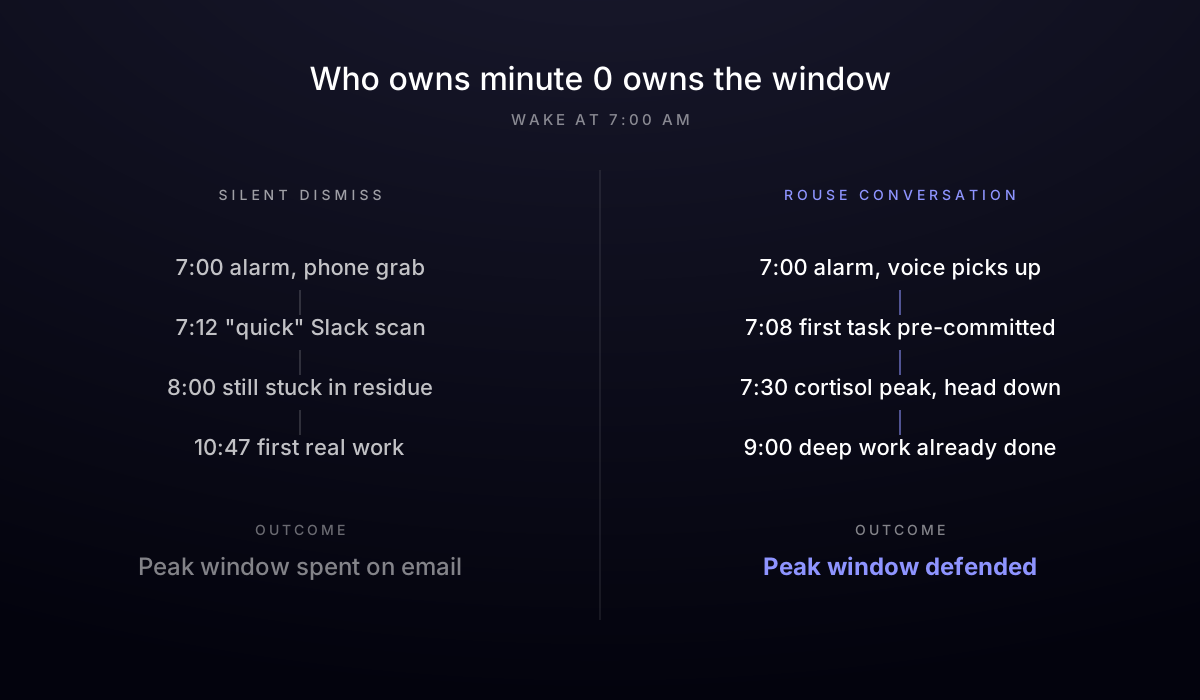
It's 7:12 AM. You're on your couch, coffee in one hand, phone in the other. Slack is open. You tell yourself it's just a scan.
By 9:30 you've answered four DMs, joined a thread about a launch that isn't yours, and decided to "clear the inbox real quick before the real work."
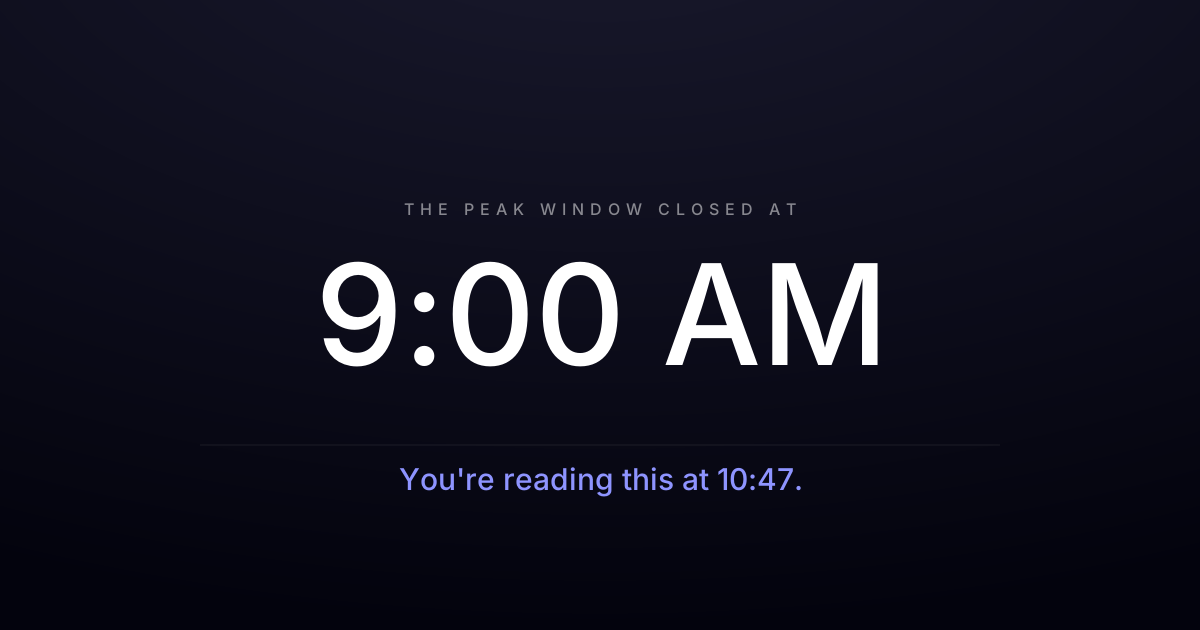
It's now 10:47. You still haven't opened the doc.
Turns out you didn't lose your morning to laziness. You lost it to a cognitive peak window that closed before most people finished their first coffee.
I spent a long time thinking the problem with my mornings was discipline. It wasn't. Nobody ever told me my brain had a window, and I was spending it on other people's emergencies every single day.
So let me share what I found. Hopefully you can use it.
In this post, you'll learn
- Why your brain has a real, measurable peak-cognition window in the first 60 to 90 minutes after waking (and what research actually says about it)
- Why solopreneurs lose this window every day while salaried employees mostly don't
- Why "just checking Slack" costs you the next hour, not the six minutes you spent checking
- The one structural change that pre-commits your first deep task before the inbox gets in
7 min read.
1. Your brain peaks within 45 minutes of waking. That's not a metaphor.
When you wake up, your body throws a lot of cortisol into your bloodstream. Fast. More cortisol than at any other point in the day.
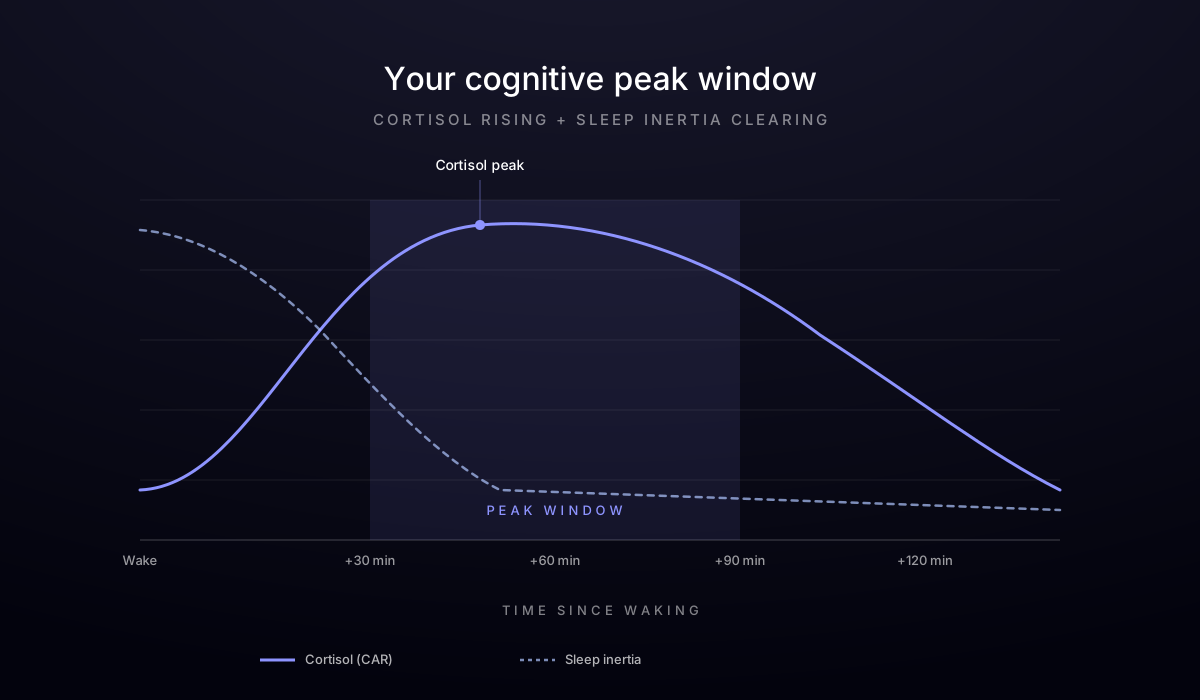
This is called the cortisol awakening response, or CAR, and the curve is pretty well-mapped after a couple of decades of research: cortisol jumps at waking, keeps rising for the next 30 to 45 minutes, peaks, then starts to come down.
The numbers aren't trivial. Peak cortisol lands somewhere between 38% and 75% above your waking baseline, depending on who you are and how you slept (Clow, Thorn, Evans & Hucklebridge, 2004; Fries, Dettenborn & Kirschbaum, 2009).
Cortisol isn't just a stress hormone. In the morning, rising cortisol is what helps your prefrontal cortex come back online. It's the hormonal version of the house lights turning on.
At the same time, the other thing happening is sleep inertia clearing out. Sleep inertia is the executive-function fog in the first 15 to 30 minutes after waking. Your working memory is sluggish, reaction time is slow, decisions are worse (Tassi & Muzet, 2000; Hilditch & McHill, 2019).
Stack the two:
- First ~30 min post-wake: sleep inertia still heavy, cortisol climbing.
- ~30 to 90 min post-wake: inertia mostly gone, CAR near peak. This is the window.
- ~90+ min post-wake: cortisol decays, the window closes.
So if you wake at 7:00 AM, you are measurably sharper between roughly 7:30 and 9:00 than at any other point in your day. That's not motivation. That's endocrinology.
And here's the part that actually changed how I think about mornings:
You can't add more peak window. You can only defend the one you have.
2. Why solopreneurs lose this fight every single day
Here's the trap specific to anyone who works for themselves. When you worked a regular job, you had a 9 AM standup, a 10 AM client call, and a boss who'd notice if your face wasn't on the Zoom tile. Those meetings weren't great for deep work, but they did one accidental thing: they protected the front of your morning from drift.
You didn't open Slack at 7:12 because there was no Slack you could open that early, and even if you did, the pressure of a 9 AM standup put a stop on it: you had until 8:45 to produce something. The window was defended by someone else's calendar.
Solopreneurs don't have that. You wake up, and you are the CEO, the engineer, the marketer, and the intern. Nobody has a 9 AM standup for you. Your calendar is empty until you put something in it.
And here's what happens in that empty space:
"I've been waking up feeling overwhelmed for months, and I realized most productivity tools were just giving me more to manage." (u/SweetInteresting6776, r/indiehackers)
The empty calendar doesn't feel like freedom at 7:12 AM. It feels like a vacuum. So your brain, still half in sleep inertia, grabs the nearest structure it can find. Usually that's your phone.
I wrote about the same dynamic from a different angle in you fired your alarm clock when you quit your job: the witness effect disappears the second you go solo, and the morning is where it hurts the most. This post is the mechanism version of that problem. It's not just that nobody is watching. It's that nobody's watching during the only 90 minutes of the day your brain is measurably at its best. That's the part that should sting.
3. Your inbox isn't costing you 6 minutes. It's costing you the next hour.
Here's the bit that surprised me most. In 2009, a researcher named Sophie Leroy ran a study on what happens when you switch tasks, and she called the effect attention residue: when you stop Task A and start Task B, a piece of your attention stays stuck on Task A, so your performance on Task B takes a hit, sometimes a big one, especially when Task A is unresolved or emotionally charged (Leroy, 2009).
Now read that definition again with Slack in mind.
A 6-minute Slack scan is never "resolved." There's always one more message. Half the threads are emotionally charged in some small way: a client who sounds annoyed, a teammate asking for a decision, a Stripe refund you feel bad about. You close the app thinking "cool, caught up." Your brain has already opened ten loops.
Then you try to sit down and write the landing page copy.
Your fingers are on the keys. Your cursor is blinking. A part of your attention is still running a subroutine about that teammate who sounded annoyed. You reread your own sentence three times, write a line, delete it, stare. You open the Slack thread again "just to check." Fifteen minutes. Forty minutes. An hour.
The cost of that Slack check wasn't the six minutes. It was the next sixty, the part of the peak window where you were supposed to be shipping.
Checking email at 7:15 = writing at 40% by 8:00.
That's the trade you keep making, and the employee version of you had a 9 AM meeting that forced the switch away from Slack, while the solopreneur version has nothing forcing it. You are free to check, feel "connected," and wonder at 11 AM why you can't focus. You can't focus because you already spent the window, four hours ago.
4. The fork happens at the alarm, not at your desk
This is the part that took me a while to accept. Every solopreneur I watched try to fix their mornings tried to fix them at the desk: bigger to-do list, Notion dashboards, "focus blocks" on the calendar, pomodoros, cold plunges at 6:45. None of it worked for long. I talked about the 5 AM version in I joined the 5 AM club three times: routines collapse because they're stacked on top of a broken primary sequence.
The primary sequence is:
- Alarm fires.
- Hand reaches for phone.
- First input arrives.
That's the fork in the road. Whichever input wins step 3 owns your peak window. If the first input is Slack, Slack wins. If the first input is a client email, the client wins. If the first input is your group chat, the dumbest thread in the group chat wins.
You're not losing your morning to a lack of Notion templates. You're losing it at 6:47 AM to a 3-second reflex.
Willpower won't wake you up, because the version of you at 6:47 AM isn't the version who planned the deep work yesterday. Hyperbolic discounting on one side, sleep inertia on the other, empty calendar pulling you toward whatever's loud. Three things pushing the same direction.
You can't win this at the desk. You already lost it an hour ago. The fix has to happen at the alarm.
5. So what actually fixes it
Short version: you need a forcing function in step 3.
Something that takes the reach-for-the-phone reflex and routes it through a different door, and while your cortisol is still climbing, asks you what deep-work task you're going to lock in instead of letting Slack ask you what everyone else needs.
This is what Rouse does.
An alarm fires. You answer. And instead of tapping dismiss, you have a 5 to 15 minute voice conversation with an LLM whose only job is to get you actually awake and pointed at the first thing that matters: "before I open any app today, what's the one task I want done before 10 AM?"
By the time the conversation ends, CAR is climbing, sleep inertia is thinning, and the first input of your day wasn't the inbox, it was the task you already pre-committed to.
The peak window doesn't get defended by a to-do list. It gets defended by whatever owns minute 0. That's the whole mechanism.
What to take from this
- Your brain has a real peak window in the first 60 to 90 minutes after waking. CAR + clearing sleep inertia. It's not motivation; it's endocrinology.
- Solopreneurs lose this window every day because no 9 AM meeting is protecting it.
- A 6-minute Slack check doesn't cost 6 minutes. It costs the next hour of attention residue.
- The fix happens at the alarm, not at your desk. Whatever wins minute 0 owns the window.
If this maps to you, set Rouse for tomorrow morning. Point the conversation at one thing you want done before 10 AM. See if the window holds.
I'd love to know if it lands.
FAQ
Does this apply if I'm not a morning person? The peak window is defined relative to your wake time, not to clock time. If you're a night owl who wakes at 10 AM, CAR still peaks 30 to 45 minutes after your wake, and your sleep inertia still clears on the same curve. Late chronotypes aren't broken. They just have a later window. The trap is the same: if you wake at 10 and open Slack at 10:05, you've still handed the window to whoever emailed you first.
How hard is it actually to not check Slack in the morning? With just willpower, very hard, because your prefrontal cortex is still coming online and Slack's entire UX is built to pull your attention. With a forcing function in minute 0, much easier. That's why implementation-intention research (Gollwitzer, 1999) keeps outperforming "try harder" interventions: you don't fight the decision in the moment, you pre-committed it before the decision window opened.
Isn't this just "don't look at your phone in the morning"? The common advice is "don't look at your phone," but your phone is already where your alarm lives. Telling someone to not look at the device that just fired a sound at them is unrealistic. The fix isn't moral ("have more discipline"), it's structural: route the first interaction with the phone through something that points at your real work.
What if a conversation just feels annoying at 6:47 AM? Probably less annoying than losing your next four hours to an inbox spiral. Also, habituation kills every other alarm mechanism in about a week, but a conversation is different every morning so your brain can't decide it's background noise. Same reason phone calls wake you up when three alarm clocks didn't.