I Joined the 5 AM Club Three Times. Each Time It Broke in the Same 15 Minutes.
Founders keep failing the 5 AM Club and blaming discipline. The real culprit is a 15-minute window that no standard alarm closes.
April 17, 2026
I Joined the 5 AM Club Three Times. Each Time It Broke in the Same 15 Minutes.
I've joined the 5 AM Club three times. Bought the book twice (lost the first one). Wrote the bedtime. Made the playlist. Set two alarms fifteen minutes apart like a responsible person.
Week two, every time, the same thing happens. The alarm goes off. I open one eye. And somewhere in the next fifteen minutes, a version of me I don't remember authorizing decides that today the world is fine without 5 AM.
Turns out that window has a name. And losing the argument inside it is the exact mechanism the 5 AM Club skips over.
7 min read
In this post, you'll learn
- Why the 5 AM Club almost always breaks in week 2 or 3, even for founders who did everything right the night before.
- What actually happens in the 5 to 15 minute window after the alarm, and why any decision made inside it is being made by a sleep-deprived version of you.
- The one alarm mechanic that keeps the window closed, and why Alarmy, Clocky, and sunrise clocks don't.
Why the 5 AM Club always breaks in week 2
The first week is easy. Novelty covers a lot of sins. You're running on adrenaline, proud of yourself, posting nothing but also kind of wanting to. The coffee tastes better. You sit at the desk at 5:12 and feel like a person who has finally figured it out.
Then week two shows up and the ceiling starts staring back at you at 11pm.
I'd write the bedtime down like it was a real thing. "In bed by 9:30." And then it's 10:15 and I'm still on Twitter, because the whole point of going to bed at 9:30 was to protect tomorrow, and tomorrow hasn't happened yet, so what's one more tab. At 11, I'd set the laptop down. At 11:20, I'd open it again to check something. In bed by 12:10, with the Calm app trying to rescue a day I'd already lost.
Turns out there's a name for this. Researchers call it bedtime procrastination, and the 2014 Kroese paper that named it was pretty specific: it's a distinct self-regulation failure, not laziness and not insomnia. You're not tired enough, or you are, and you stay up anyway. No external reason. Just the only hour of the day that still feels like yours.
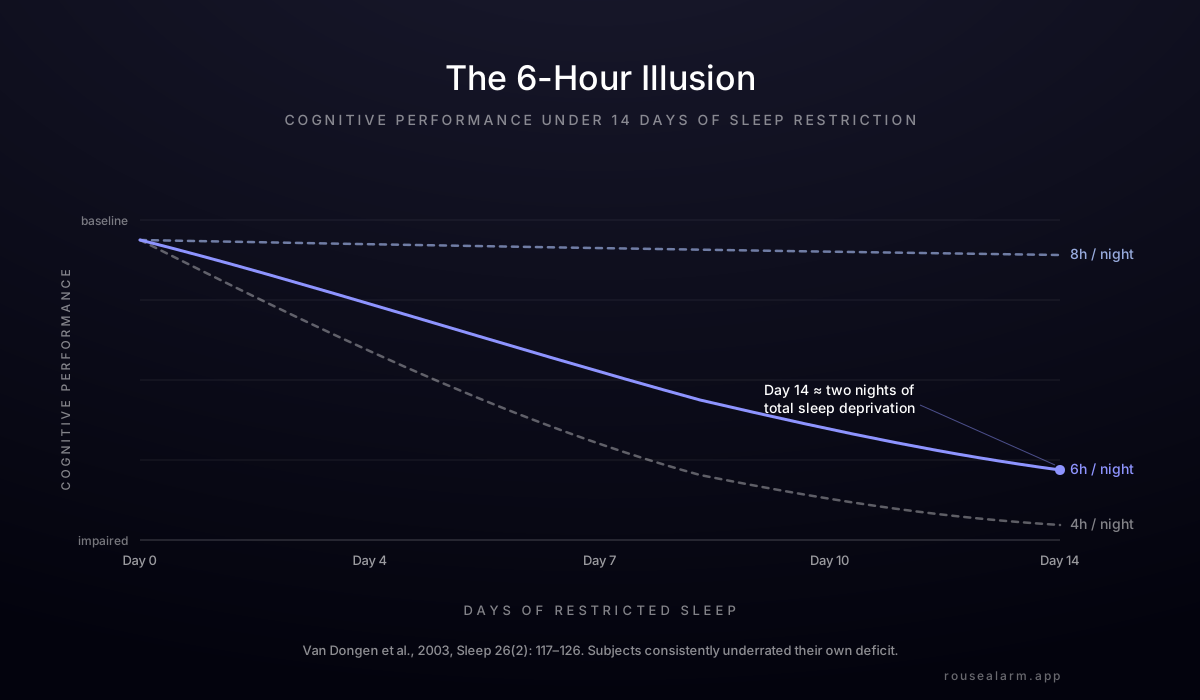
Now watch what that costs you by day 8. A 2003 study in Sleep by Van Dongen and colleagues had subjects sleep 6 hours a night for 14 nights. By the end, their cognitive performance was equivalent to being awake for two full nights in a row. Reaction time, attention, decision quality: all wrecked. The part that should scare every founder is this: the subjects didn't know. They rated themselves only slightly tired. The brain running the self-assessment was the same brain being assessed, and it was working with busted instruments.
So you arrive at day 8 of your 5 AM Club run having slept 5.5 to 6 hours a night, cognitively equivalent to having pulled two all-nighters, rating yourself a solid 6 out of 10. Then the alarm goes off.
Reddit's r/getdisciplined has this line in the top comments of the "5AM myth" thread: "I tried going to bed at 10pm and literally just stared at the ceiling pissed off because my body wasn't tired. Then 5AM hits and I feel like a truck ran over me."
You didn't fail the 5 AM Club in the morning. You failed it the night before, on day 8, without realizing you were already running on a 2-deprivation-night deficit.
What actually happens in the 5 to 15 minute window
Here's the thing about the moment the alarm goes off: the person who set the alarm isn't the one responding to it.
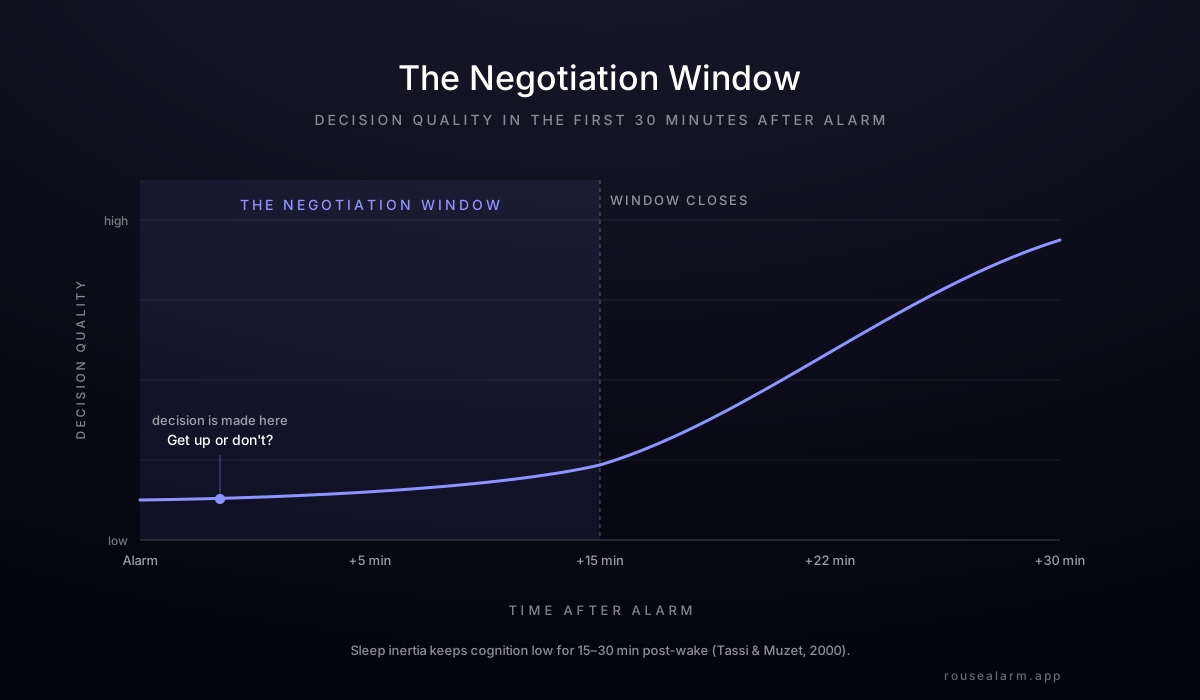
Sleep inertia is the word for this. Tassi and Muzet, 2000 reviewed the sleep science and the range is pretty consistent: 15 to 30 minutes of measurably degraded cognition right after waking, longer if you're in sleep debt, longer still if you're pulled out of deep sleep instead of a lighter phase. Reaction time is slower. Short-term memory is worse. Decision-making is worse. The phrase in the literature is "low cognitive performance during the post-wake transition." The phrase in the kitchen at 5:04 AM is "why am I awake."
Founders who are also night chronotypes get the same deal, but worse. Facer-Childs and colleagues in 2019 showed that late chronotypes forced into early wake times pay a cognitive and mental-health penalty that takes days of consistent schedule to reset. One alarm doesn't do it. One week doesn't fully do it. The "just be a morning person" advice is telling a system to be something it takes sustained re-training to become.
So the 5:00 AM alarm goes off. Sleep inertia is already running. Cognitive performance is at its worst point in the entire 24-hour cycle. And at exactly this moment, the alarm asks you to make a decision: get up or don't.
Let me walk you through what the decision actually looks like, because nobody writes about this part.
5:00. Alarm. Eyes open. I reach for the phone to silence it. 5:02. Phone in hand. I'll just check the weather. I'll just see if anyone emailed. 5:05. Slack is open. No emergencies. Good. 5:08. Now I'm lying on my side, phone face-down, and the thought that arrives is: "five more minutes is fine, you'll still hit 5:15 which is basically 5." 5:17. The voice that just convinced me has moved on. I'm not thinking about 5 AM anymore. I'm thinking about how warm the bed is. 5:47. The second alarm has fired and gotten dismissed three times. I don't remember any of them. 6:30. I wake up for real. Day already feels like catch-up.
The decision to stay in bed wasn't made by the founder who set the alarm the night before. It was made by a different operator running on worse inputs, pretending to be the same person.
Self-worth = willpower ≠ the real variable.
The variable is what the alarm layer does during those fifteen minutes.
Why conversation is the only alarm mechanic that doesn't open the window
I have an alarm graveyard. Sonic Bomb with the bed-shaker. Clocky. The Alarmy app with math puzzles, then barcode scans, then shake missions. A sunrise clock that did a very graceful fade from nothing to sunrise over 30 minutes and was easy to sleep through.
Every single one of them failed the same way. Not because they were quiet. They were all loud. They failed because they can all be defeated while cognitively offline.
Alarmy's own App Store listing is a tell. They have a "squat" mission, where you have to physically do squats to turn the alarm off, because users were defeating the math puzzles in their sleep. They built a physical mission on top because the cognitive mission wasn't holding. If you've ever seen your own Reddit confession on r/ADHD or r/getdisciplined, it's the same story: "I solved the math puzzle and I have no memory of it."
There's a reason this happens, and it's not a moral failing. Fitts and Posner's classic 1967 work on skill acquisition showed how fast any repeated physical sequence becomes autopilot. Within a week of doing the same shake, the same scan, the same math, your sleep-inertia brain can run the whole sequence without ever handing the keys to the conscious you. You become very, very good at dismissing the alarm in a way that costs you nothing to execute.
Every passive alarm opens the negotiation window. The math puzzle opens it. The shake opens it. The QR scan opens it. Clocky running across the floor opens it, because once you've chased it, you've still got to decide whether to climb back in. The window is the problem. The alarm mechanics that exist today don't close the window. They just add steps to what happens inside it.
That's why Rouse uses conversation. It's the one alarm mechanic that never gives you a window you can lose.
You can't autopilot a conversation the same way you can autopilot a tap. The brain can't pre-compute a response to a question it hasn't been asked yet. To dismiss the alarm, you have to actually say things, listen to the reply, respond back. And by the time you've held up your end of two exchanges, sleep inertia has broken, and the decision about whether to stay in bed is now being made by the version of you who set the alarm. Not by the stranger who showed up at 5:02.
Takeaway
The 5 AM Club isn't a discipline problem. You didn't fail because you're not built for 5 AM. You failed because the alarm layer handed the biggest decision of your day to the one version of you least qualified to make it.
Fix the window, or keep losing the argument in it.
If you've already joined the 5 AM Club and it already broke, set Rouse for tomorrow morning. Skip the bedtime pact. Close the window instead. I'd love to know if it lands.