Willpower Won't Wake You Up: The Two-Self Problem Your Morning Routine Can't Fix
Willpower can't wake you up because the 5 AM self who has to execute isn't the self who signed the contract. What actually works. (132 chars)
April 17, 2026
Willpower Won't Wake You Up: The Two-Self Problem Your Morning Routine Can't Fix
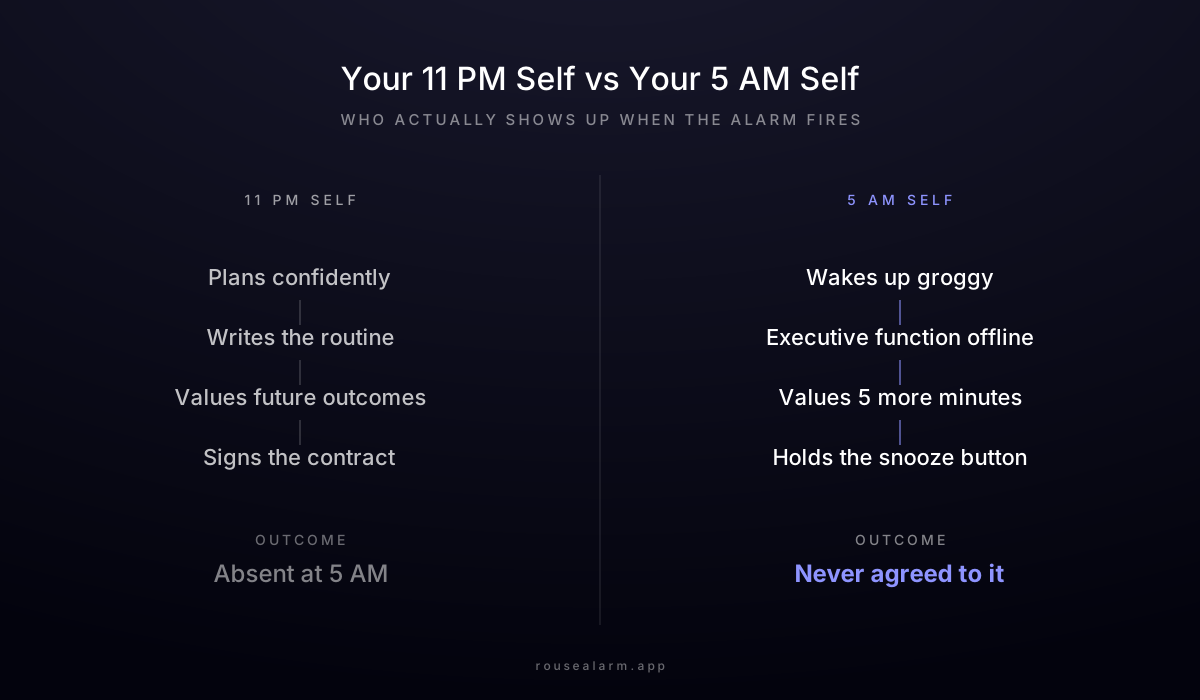
At 11:14 PM on a Sunday, I wrote out a 5 AM Monday in Notion. Workout, cold shower, two hours of deep work before the kids. Phone across the room. Two alarms, fifteen minutes apart. I went to bed feeling like a founder who had finally gotten serious.
At 5:02 AM Monday, a different person woke up. He had no memory of the contract. He also had a vote.
Turns out those two people aren't the same person. And every morning routine ever written assumes they are.
7 min read
In this post, you'll learn
- Why the first 30 minutes after your alarm are measurably not you, and why every "just do it" tactic is being handed to a cognitively offline version of yourself.
- The economic reason your 11 PM self keeps writing checks your 5 AM self won't cash, and why this has a real name.
- Why every morning routine is a negotiation you're going to lose, and what the tactics stack misses.
- The one thing that closes the negotiation window, and why sound-based alarms can't do it.
The 30 minutes after your alarm goes off, you are measurably not yourself
Here's the part the 5 AM routine industry skips.
Sleep inertia is the word for what happens in the first 15 to 30 minutes after you wake up. Hilditch and McHill's 2019 review in Nature and Science of Sleep is pretty specific about the damage: cognitive performance is flattened, reaction time is slow, and executive function is the last thing to come back online. That's the part of your brain that runs self-control, planning, decision-making, the whole chain of making yourself do a thing you don't feel like doing. Motor tasks recover first. Higher-order cognition lags. The part of you that was supposed to execute the morning plan is actually the part that's still booting.
How bad is it? The impairment is equivalent to, or greater than, what you'd see after 40 hours of continuous sleep deprivation. Tassi and Muzet's 2000 paper in Sleep Medicine Reviews points at the prefrontal cortex specifically. That's the region running "I committed to this last night." It isn't available yet.
The implication is ugly.
Every morning-routine tactic ever written (cold shower, 5-second rule, Alarmy math missions, phone-across-the-room, make your bed before anything else) is a plan that requires executive function to execute. And the 30-minute window where you're supposed to execute it is the exact window where executive function is offline.
The plan isn't wrong. The person expected to run it isn't present.
Your 11 PM self and your 5 AM self have different preferences. That's not a metaphor.
Okay so sleep inertia handles the neurology. But there's a second thing happening, and it's the one nobody talks about.
Your 11 PM self and your 5 AM self aren't just tired versions of each other. They're operating on different preferences. Economists have a name for this and it's 30 years old.
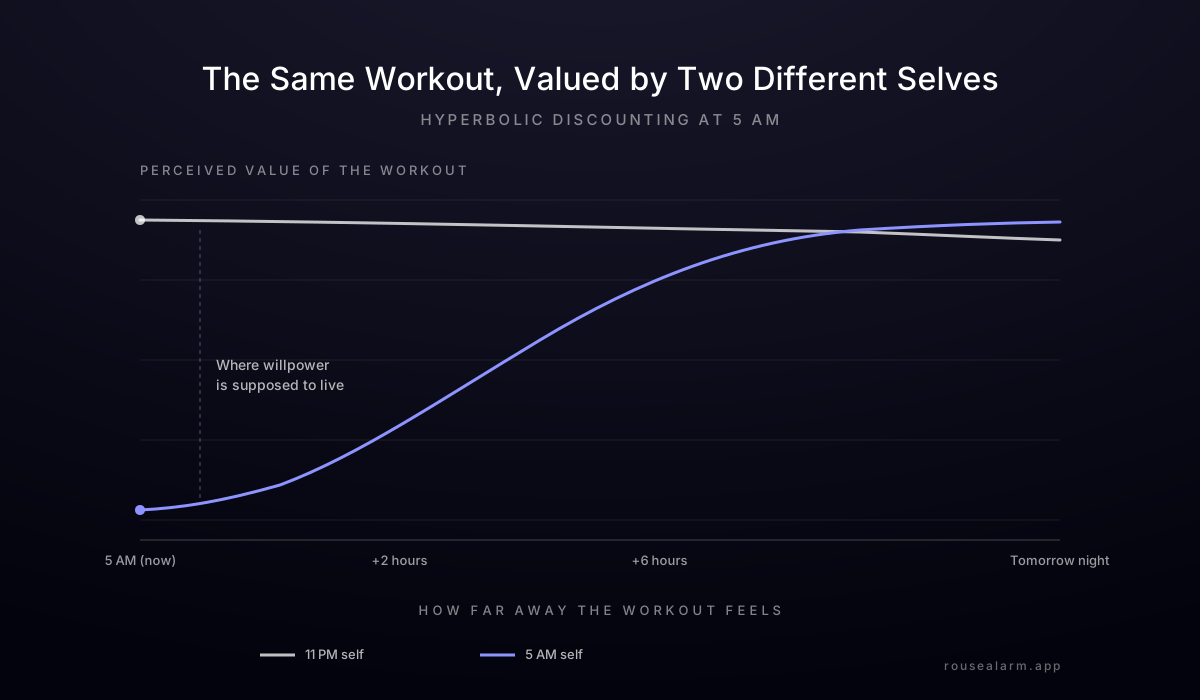
David Laibson's 1997 paper in the Quarterly Journal of Economics formalized something called hyperbolic discounting. The short version: people weigh immediate costs and benefits much more heavily than future ones, and the curve isn't flat. It's steep and time-inconsistent. Your 11 PM self, looking 8 hours ahead at a 5 AM workout, sees "tomorrow I'll be fitter, more productive, a better version of me." Your 5 AM self, looking 0 seconds ahead at the same workout, sees "cold floor, tired body, cognitive fog, zero."
Same plan. Completely different utility math.
Laibson's key insight was that hyperbolic consumers know this about themselves. They know the present self is going to defect on the future self's plan. That's why commitment devices exist: to constrain your own future choices, because you don't trust yourself to honor them.
This is exactly what we do when we put the phone across the room.
It's just that we use commitment devices that don't work.
There's a Reddit post on r/getdisciplined by u/luigisgarage (score 747) that nails the internal experience better than most research papers:
"My brain is a used car salesman when it comes to skipping workouts: 'Just 5 more minutes… you'll be way more productive after a nap.' Lies. All lies. I learned to act before the brain committee even starts talking."
The brain committee. That's the two-self problem in three words. Your 11 PM self drafted the plan. Your 5 AM self is the one in the room with the snooze button. And the 5 AM self is the used car salesman.
Willpower can't arbitrate between them.
Willpower is on one side of the table.
A morning routine is a contract your 11 PM self signed alone
Now look at every tactic you've tried through this lens.
Multiple alarms across the room. You still have to decide to walk to them. That decision is being made by the 5 AM self, with hyperbolic discounting maxed out, in the sleep inertia window. u/Aggravating_Many5091 on r/getdisciplined (score 90) described it cleanly: "even then it was a 50/50 chance that I would actually get up." Coin flip, run by the version of you you least want making coin flips.
Alarmy math missions. You have to solve math. The cortex running the math is the cortex that's offline. Plus Alarmy's own App Store listing shows they added squat missions and barcode scans because users were defeating the math puzzles in their sleep. They stacked physical missions on top of the cognitive ones because the cognitive ones weren't holding. The window stayed open.
The Mel Robbins 5-second rule. Count down from 5 and move. This also assumes an intact executive function to initiate the count. Try it on day 3 of a 6-hour-sleep run and see what happens. I have.
Cold showers. Requires getting vertical first. Requires the 5 AM self to decide to do the thing designed to fix the 5 AM self.
Every one of these is a commitment device of the wrong type. They're static. They wait for you to come to them. And they hand the execute decision to the agent least qualified to make it. Every single time.
Here's what makes this worse: Van Dongen's 2003 Sleep study showed that sleeping 6 hours a night for two weeks produces cognitive deficits equivalent to two full nights of sleep deprivation. Meaning the solopreneur running on 5.5 to 6 hours in pursuit of a 5 AM routine is compounding the problem. The 5 AM self on day 10 isn't just hyperbolically discounted. He's cognitively smaller. The 11 PM self's plan is going to be adjudicated by a smaller, more immediate, more groggy, more discount-rate-spiked version of you. And the part none of the morning-routine books tell you is this: 57% of Americans are habitual snoozers (University of Notre Dame / SLEEP journal, 2022). You're not broken. You're losing a negotiation that most adults are losing every morning.
Stop asking why the tactic failed.
Ask who was supposed to execute it. The 11 PM self signed the contract. The 5 AM self was never in the room.
What actually holds: an external voice your groggy self can't argue with
Laibson's framework gives us the fix. If the present self is going to defect on the future self, you need to constrain the present self's options. Not with willpower. With an external structure that doesn't accept renegotiation.
The question is what structure.
Static devices (alarms in other rooms, penalty apps, missions) all have the same hole. At some point the 5 AM self is making the call about how to handle them. Habituation, workaround, autopilot dismissal, going back to bed. I've got the alarm graveyard to prove it. Sonic Bomb with the bed-shaker I slept through. A $180 vibrating pillow I slept through. An Alarmy math puzzle I now know I can solve unconscious, because on day 9 I solved three in a row and had zero memory of it.
The common failure: every one of them is a tactic the groggy self can dismiss unilaterally. The window stays open. The negotiation happens. The 5 AM self wins.
What breaks this is taking the 5 AM self out of the negotiation entirely.
That's why Rouse is a conversation, not a sound. You can tell it at 11 PM what you're trying to do at 7 AM: the workout, the deep work block, the client call, the 5:15 gym session. At 7 AM when the 11 PM version of you is gone, Rouse is still there. It talks. It asks about the thing by name. It doesn't accept "five more minutes" as an answer, because there's nothing to dismiss on autopilot. You have to hold up your end of the exchange to end the call.
You can't autopilot a conversation the way you can autopilot a tap. The brain can't pre-compute a response to a question it hasn't heard yet. By the time you've answered two questions, sleep inertia has broken enough that the decision about whether to stay in bed is being made by the version of you who set the alarm. Not by the used car salesman who showed up at 5:02.
It's not willpower. It's an external agent carrying your 11 PM intent into the window where your 5 AM self can't vote it down.
The 11 PM self finally gets to keep the contract.
Takeaway
You don't need more discipline. You need to stop being the one on both sides of the negotiation.
Every morning routine book is designed for a unified self that doesn't exist between 5 AM and 5:30 AM. The 11 PM founder who wrote it and the 5 AM founder who has to execute it are two different agents with different preferences, different cognitive resources, and different discount rates. Willpower can't bridge that. Willpower is one of the things being discounted.
Fix the gap, or keep losing the argument inside it.
If you've been on the morning-routine carousel long enough to recognize the pattern (three 5 AM Club attempts, four productivity apps, a Clocky, an Alarmy, a sunrise clock), set Rouse for tomorrow morning. Tell the 11 PM version of yourself what matters. Then see what happens when the 5 AM version doesn't get a vote.
I'd love to know if it lands.