Wake at 4 AM for a Flight. Sleep Through 7 AM for Work. Your ADHD Has an Interest Switch.
Same brain. Same bedtime. Vacation morning, you're up before the alarm. Tuesday, you slept through three. Here's the ADHD mechanism that decides which one you get.
April 25, 2026
title: "Wake at 4 AM for a Flight. Sleep Through 7 AM for Work. Your ADHD Has an Interest Switch." slug: adhd-flight-vs-work-alarm description: "Same brain. Same bedtime. Vacation morning, you're up before the alarm. Tuesday, you slept through three. Here's the ADHD mechanism that decides which one you get." keywords: [ADHD interest based nervous system, ADHD wake up flight, ADHD hypoarousal morning, ADHD novelty alarm, Dodson interest based ADHD, ADHD boring alarm] category: ADHD persona: adhd-adult date: 2026-04-25
Wake at 4 AM for a Flight. Sleep Through 7 AM for Work. Your ADHD Has an Interest Switch.
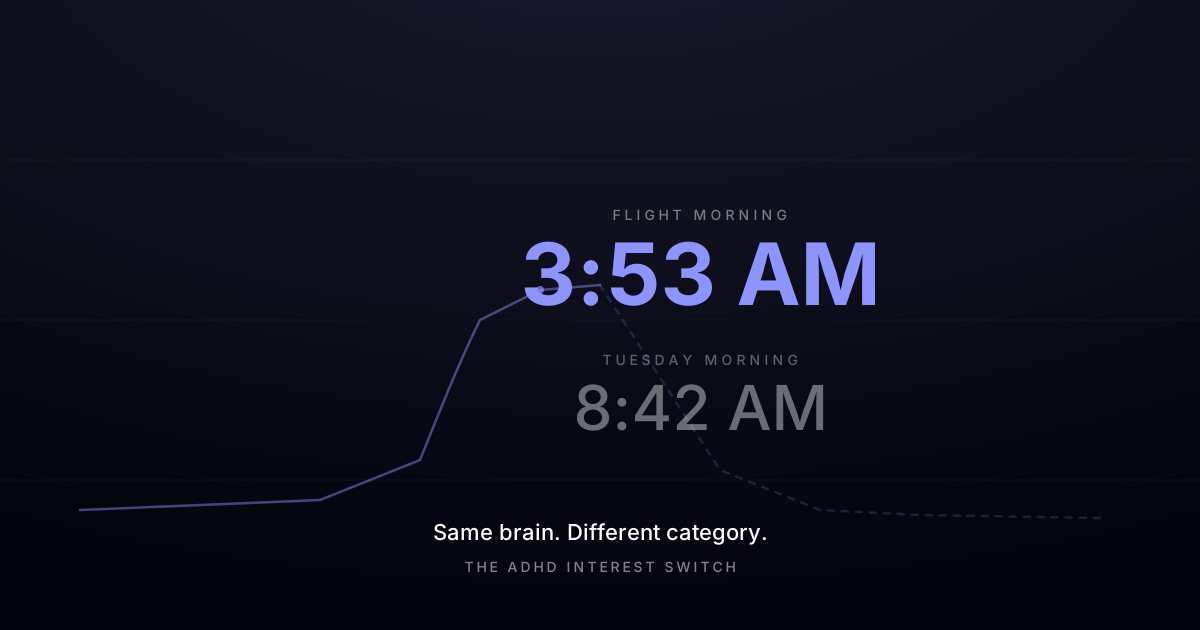
Last December I had a 6:35 AM flight to Lisbon. Alarm set for 4:10. I opened my eyes at 3:53, seventeen minutes early, no grogginess, already mentally rehearsing the Uber route.
The Tuesday before that flight, same body, same bed, same 8 hours of sleep, I slept through three alarms set at 7:00, 7:08, and 7:15. Got up at 8:42. Joined the standup with a wet collar and an excuse.
Same brain. Same week. Two completely different wake-ups.
For a long time I thought this was discipline rot. Like the flight version of me was the "real" me, and the Tuesday version was some weaker ghost I had to fight off.
Turns out it isn't a willpower difference. It's a category difference. My brain rated the flight as interesting and the standup as boring before I was even fully conscious. And ADHD brains do not bring themselves online for boring.
I've been building Rouse for the past year and reading r/ADHD daily. The pattern is everywhere. u/mitwab posted this thread, 402 upvotes, describing what he was already feeling:
Every single morning I wake up feeling extremely sleepy and "out of it," no matter how much I sleep. […] But the weird thing is: if something is really interesting or urgent, I can suddenly feel wide awake. So it doesn't feel like pure sleep deprivation, more like my brain's arousal level just drops when I'm bored or overwhelmed.
That's not a quirk. That's a named mechanism. It has a clinical framing, a neurobiological substrate, and a very specific consequence for how alarms work, or don't, for ADHD adults.
In this post, you'll learn
- Why your ADHD brain wakes up reliably for vacations, flights, and first days, but not for the meeting you have every Tuesday
- What "interest-based nervous system" actually means, where the framing comes from, and why the underlying neuroscience holds up
- Why a flat, predictable alarm tone is the worst possible stimulus for an arousal-deficit brain
- Why your alarm habituates in about a week and your flight alarm never does
- Where conversation alarms (like the one I'm building) fit, and where they don't
7 min read.
The interest switch is a category your brain uses, not a metaphor
The framing comes from Dr. William Dodson, writing for ADDitude. His piece on "the secrets of the ADHD brain" is the canonical reference. The claim, distilled: ADHD brains do not run on the importance-based nervous system the rest of the world assumes. They run on an interest-based one. The four levers that bring an ADHD brain online are interest, novelty, challenge, and urgency. Duty is not on the list.
The framing is downstream of well-replicated neuroscience.
The cognitive-energetic model from Sergeant in Biological Psychiatry, 2005 frames ADHD as, at its core, an arousal regulation deficit. Not an attention deficit. A state-regulation deficit. The brain has trouble landing on the right level of arousal for the task in front of it.
Volkow et al.'s 2009 JAMA paper showed the dopamine reward pathway runs differently in ADHD adults. Tonic dopamine, the background level the brain uses to mobilize attention and effort, sits lower than baseline. Phasic dopamine (the spikes that fire when something interesting, novel, or urgent shows up) still works fine. Sometimes better than fine.
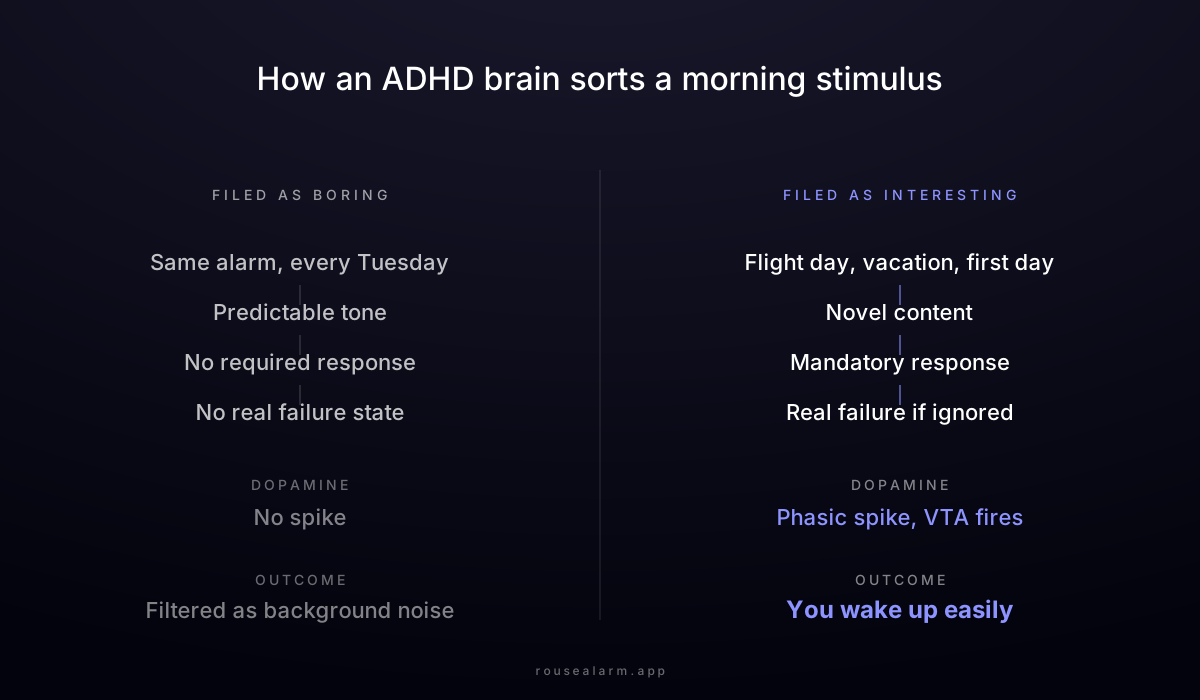
So the ADHD brain isn't broken. It's on a different fuel mix. Background fuel is low. Spike fuel works on demand. Anything boring or predictable doesn't get the spike. Without the spike, the arousal level needed to mobilize executive function never arrives.
Bunzeck and Düzel's 2006 Neuron paper is the piece I keep coming back to. They showed that the substantia nigra and ventral tegmental area, the dopamine-producing regions deep in the midbrain, fire specifically in response to novelty, even when there's no reward involved. Just "this is new" is enough. That's the spike fuel. That's the mechanism the flight alarm uses. That's the mechanism your Tuesday alarm doesn't.
Why your brain rated your alarm "boring" before you were conscious
Here's the part that stops feeling like a moral failure once you see it.
Your brain decides which sensory inputs to amplify and which to filter out before "you" (the conscious narrator) has any say. The orienting response, described originally by Sokolov in 1963, says the brain assigns each repeating stimulus a "model." If the new input matches the model, it's filtered down. If it deviates, you orient. You wake up, you turn your head, you register.
The classic Thompson & Spencer 1966 review is the foundational habituation paper. Repeated stimuli with no consequence get suppressed. Faster suppression for predictable patterns. It's the entire argument I made in the habituation post.
Now stack the ADHD piece on top.
A neurotypical brain still hears the alarm and dredges up enough background arousal to drag itself into executive-function range. The hypoaroused ADHD brain has less background arousal to dredge. The tonic dopamine deficit means the lift from "asleep" to "online enough to make a decision" requires a bigger spike than a familiar tone can produce.
Your alarm doesn't fail because it's too quiet. It fails because your brain filtered it down to background noise the same week you bought it. Once it's background noise, no amount of volume rescues it. Sonic Bombs habituate. Bed shakers habituate. Three stacked alarms habituate, all at once, because they're stacked predictably.
The flight alarm doesn't habituate because the morning is novel. You aren't just hearing a sound. You're orienting to an entire context your brain has flagged as "today is different." The novelty signal hits the VTA. Phasic dopamine fires. Arousal rises. You're up at 3:53, no grogginess, already moving.
Why "just be more disciplined" can't fix this
Discipline is a strategy that lives upstream of action. It works on a brain that's already in executive-function range and is choosing what to do.
ADHD mornings are downstream of arousal. The brain isn't online yet. There's no executive function to be disciplined with. Sleep inertia suppresses prefrontal activity for 15 to 30 minutes after wake on its own. Stack ADHD's tonic dopamine deficit on top, as Hilditch and McHill describe in their 2019 review, and the window where you "just need to make better choices" is a window where the part of your brain that makes choices is still booting.
You're trying to use a tool that doesn't exist yet. The interest switch isn't a willpower setting. It's the thing that determines whether the tool boots at all.
This is why the standard ADHD alarm advice (bigger speaker, second alarm in the kitchen, foot mat with capacitive sensors, alarm clock that flies away) runs the same race every time. They all assume the problem is "you aren't being woken up hard enough." I wrote the long version of why every alarm hack stops working here. The mechanism isn't volume. It's the category your brain put the stimulus in before any of those things had a chance to work.
What an "interesting" alarm actually is
Three properties, from the Dodson framing and the Bunzeck/Düzel novelty work:
- Novel content. Same trigger time is fine. Same phone is fine. The content has to be something your brain can't pattern-match against last Tuesday.
- Requires a response. A sound asks nothing of you. Your sleeping brain files it under "ignorable." A question, even a banal one, raises a different category. You can't cleanly file an unanswered question.
- Can fail. The flight alarm has a real failure state. You miss the flight. The standup has a soft failure state. Your manager raises an eyebrow on Slack. Brains, especially ADHD ones, weight failure asymmetrically.
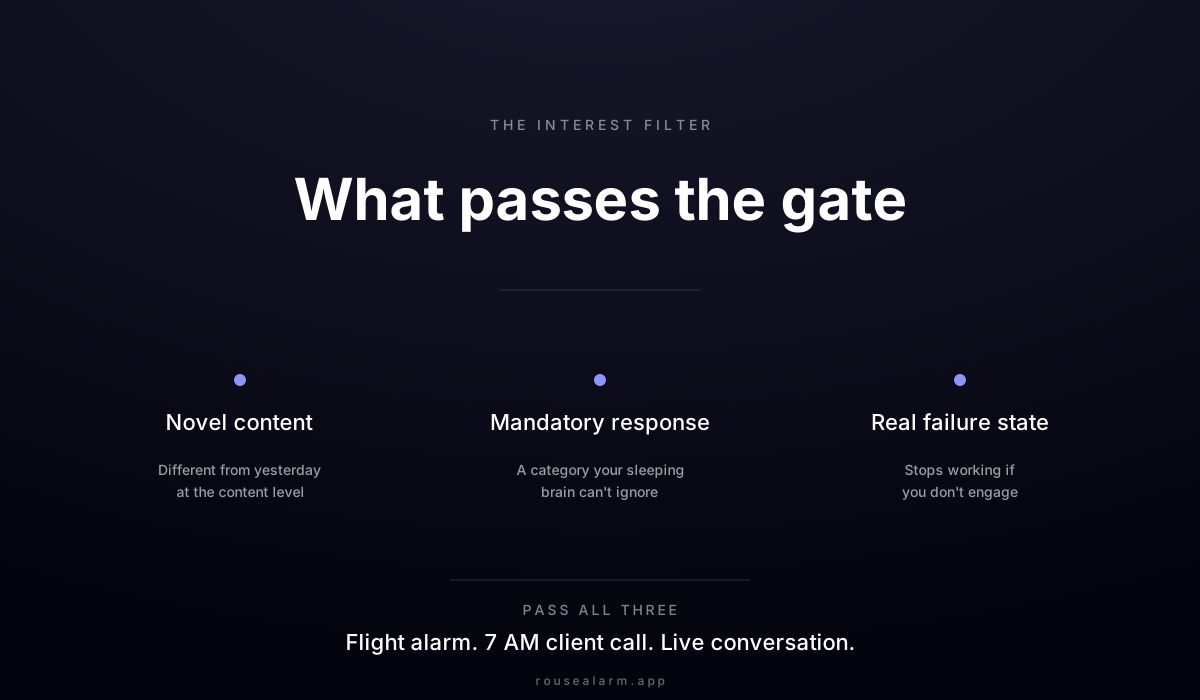
A standard alarm passes none of these. A buzzing pillow passes none. A foot mat that requires you to stand on it passes (2) and arguably (3), but fails (1) within a week. Habituation eats it.
A live conversation passes all three by construction. The content is unknown each morning. The response is mandatory. And if you stop talking, the alarm doesn't stop, which is a thing your brain notices.
That's the design constraint Rouse is built on. It's an iOS alarm that fires, starts a voice conversation with an LLM, and won't quit until you're awake enough to hold a coherent back-and-forth. It references your evening notes. It asks specific questions. It pushes when you slur. It isn't a feature. It's the entire mechanic. You can't muscle-memory through a sentence the way you can muscle-memory through a snooze button.
I'll be honest about what it isn't. It isn't a substitute for stimulants. If meds bring your tonic dopamine back, they're doing more than any alarm can. What conversation does is bridge the gap between alarm-fires and meds-kick-in (the dead zone I keep writing about) by being the one stimulus your hypoaroused brain can't categorize as boring.
What to actually do this week
If this maps to you, run a one-week observation before changing anything.
For the next seven days, keep a note in your phone. Every morning where you woke up easily, write one word: what made the morning interesting? "Flight." "First day." "New gym." "Kid's birthday." Every morning you slept through the alarm, write the alternative: what was the morning's content? "Same standup." "Tuesday." "Email."
I bet the ratio is brutal. The "easy" mornings will all have an interest tag. The hard ones will all have a category tag.
That isn't a discipline graph. It's a mechanism graph. It tells you what category of intervention can actually work, and which ones (louder alarm, more alarms, harder snooze puzzle) can't, because they're operating one layer below where the gate is.
If you want to test a stimulus that passes the interest filter without booking a flight every Monday, set Rouse for tomorrow morning. Tell it one specific thing you want to do when you get up. See if the conversation feels like a flight day or like Tuesday. I'd love to know which.
FAQ
Is "interest-based nervous system" a real clinical term, or is it a pop-psychology concept? The phrase is Dr. William Dodson's. It isn't in the DSM. The neuroscience under it (tonic vs phasic dopamine, the arousal regulation deficit, novelty-driven VTA/SN firing) is well-replicated peer-reviewed research. Treat the phrase as a clinical framing, not a diagnosis. The mechanism it describes is real.
Why does the flight alarm work even though I've taken hundreds of flights? Because each flight day is novel in content. Different destination, different time, different stakes. The morning fails the orienting brain's "match the model" test. It isn't the sound that's novel. It's the day.
Why doesn't setting different alarm tones every day fix this? Because the category is the same. You're still being asked to wake up to "an alarm sound on the bedside table at this time." Your brain models categories, not just acoustic features. A new sound in a known category fails the novelty test in a few mornings. This is the same reason why every alarm stops working after about seven days.
I'm medicated and my mornings are still hard. Why? Because most stimulants only kick in 30 to 60 minutes after you take them. The window between alarm-fires and meds-active is the exact window where your brain's tonic dopamine is floored. That window is what the pre-dose alarm post is about, and it's the window the interest filter is gating.
Does this only apply to diagnosed ADHD? No. Hypoarousal is more pronounced in ADHD brains, but every brain runs on an interest filter for first-thing-in-the-morning arousal. If you wake up for vacations but never for routine, this still explains why. It just hits harder if you do have a diagnosis.
Kuba builds Rouse, an iOS alarm that wakes you up by holding a real conversation with you until you're actually awake. If you've slept through every "louder, smarter, harder" alarm and still can't beat Tuesday, set it for tomorrow morning and tell me how it goes.