The Pre-Dose Alarm: Why Half the r/ADHD Subreddit Takes Meds in Bed
Medicated ADHD adults set an alarm early, take their meds in bed, and go back to sleep. The ritual works. The second alarm doesn't. Here's why.
April 17, 2026
The Pre-Dose Alarm: Why Half the r/ADHD Subreddit Takes Meds in Bed
The ritual nobody writes about honestly, and why the second alarm is where it breaks.
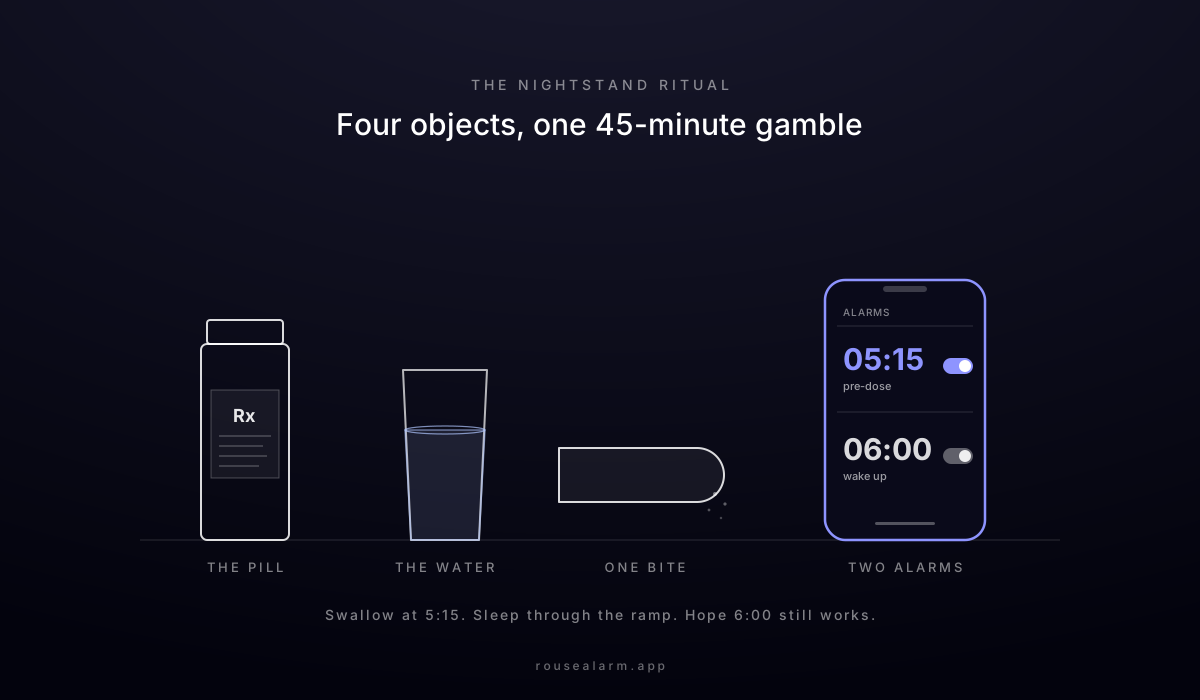
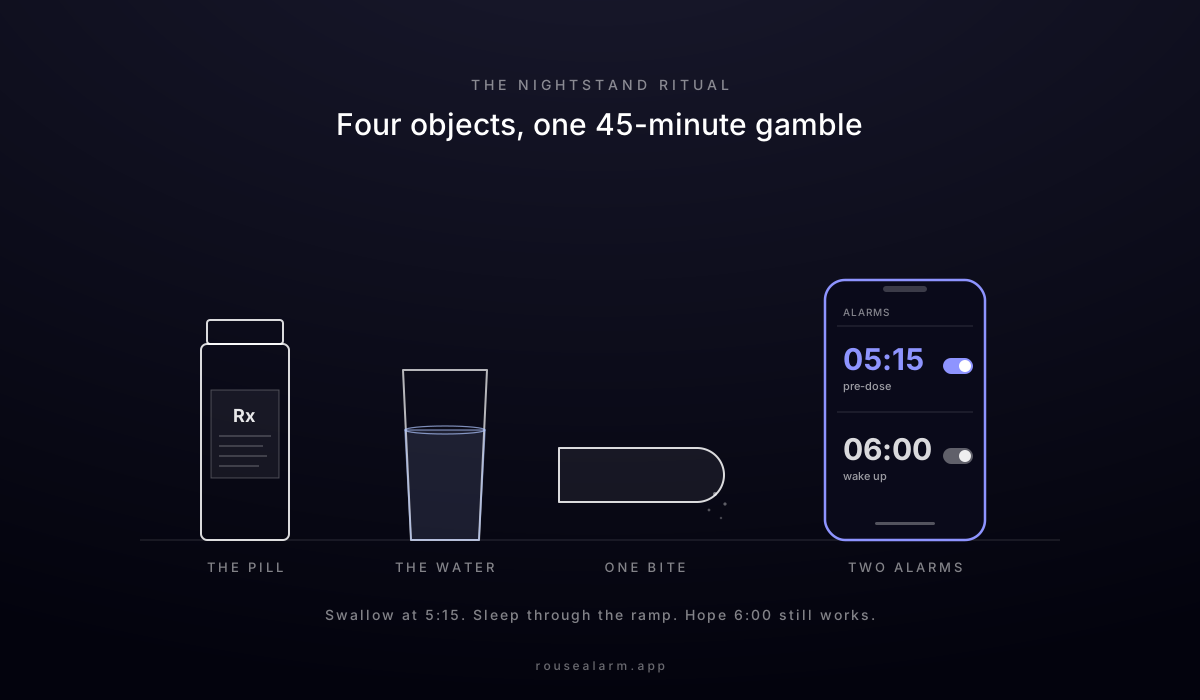
There's a protein bar on my friend's nightstand with teeth marks from last Tuesday. Next to it: a pill bottle, a glass of water, and a phone with two alarms set. The first fires at 5:15. He swallows the Vyvanse, takes a bite, drinks enough water to get it down, and goes back to sleep. The second alarm is set for 6:00, and it is the one that is supposed to actually get him up.
It does not work.
Turns out tens of thousands of people are running this exact ritual, and the part that breaks is almost never the pill. It is the second alarm.
Quick note before you read: nothing here is medical advice. I am documenting a behavior people on r/ADHD describe openly, and talking about what happens in the 45-minute window it creates. If you want to change how or when you take your medication, that is a conversation for your prescriber.
In this post, you'll learn:
- Why tens of thousands of ADHD adults set an alarm 45 to 90 minutes early to take their stimulants in bed
- What is happening in the gap between "pill swallowed" and "executive function online"
- Why the second alarm, the one meant to actually wake you, is the one that habituates fastest
- What kind of stimulus can bridge the dead zone when willpower is chemically unavailable
7 min read
The nightstand pharmacy
If you do not have ADHD, the ritual looks strange. If you do, and you are medicated, there is a nonzero chance you are already running it.
The setup is consistent across thousands of r/ADHD comments: pill bottle, a stash of something small and protein-y (bar, yogurt cup, pepperoni sticks), water, and a first alarm 30 to 90 minutes early. The alarm fires, you half-sit-up, chew enough of the bar to keep the stimulant from nuking your stomach, swallow the pill, and go back to sleep.
The theory is clean. By the time your second alarm fires, the medication has had an hour to climb into your bloodstream, and the version of you that alarm is waking is a version that can actually stand up.
u/ColinA1122 laid it out on r/ADHD in "Cheat code to Vyvanse", which hit 617 upvotes:
"When I first started back on Vyvanse I would take it as I was walking out the door to kick in when I got to work in the morning. That was really messing with my sleep and I was always restless at night. So I started to take it when I woke up instead to try and reduce the effects in the evening. Helped a little bit yes and honestly I got a little better sleep. BUT it didn't solve the getting out of bed crisis."
That last line is the whole reason this post exists. He moved the dose earlier. It helped. It did not solve the thing the ritual is supposed to solve.
u/marvickmadness on stimulant timing and bed rot:
"I do get stuck in bed rot in the AM. It takes me 60-90 min to push myself out of bed… I recently read about bed rotting and I was surprised to see a lot of people take it while still in bed or go back to sleep. Then get up when the medication starts working."
"Surprised to see a lot of people." That is the signal. Not one redditor inventing a coping move, but a pattern big enough that regular users are just now discovering other regular users have been running the same script for years. It is not a secret hack. It is half your subreddit, quietly engineering around a problem nobody has written up honestly.
Why pre-dosing exists
Two clocks run in every medicated ADHD morning, and they do not line up.
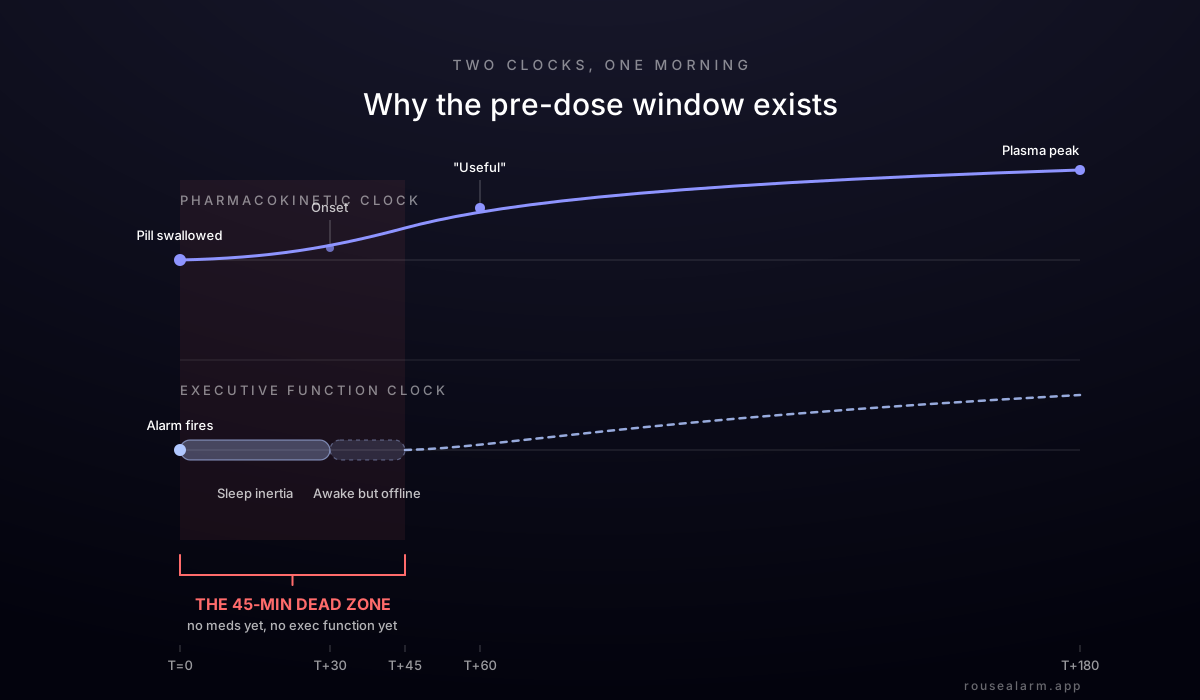
The first is pharmacokinetic, the clock inside the pill. Adderall IR starts crossing into the bloodstream in about 30 minutes, with plasma peak around 3 hours per FDA prescribing info. Vyvanse is a prodrug, which means what you swallow is inert until your red blood cells cleave it into active amphetamine, which takes another hour on top. Vyvanse FDA labeling puts Tmax around 3.5 hours, with subjective "kicking in" at roughly 1 to 2 hours post-dose.
The second clock is executive function, the one outside the pill.
Tassi and Muzet reviewed the sleep inertia literature in 2000, and the window is consistent: 15 to 30 minutes of measurably degraded cognition after waking, longer if you are sleep-deprived, longer still if you are yanked out of deep sleep. For ADHD adults with the delayed circadian phase that affects roughly 75% of us (Lunsford-Avery & Kollins, 2018), that window hits during what your body still reads as the deepest part of the night.
Two clocks, side by side.
Pharmacokinetic: pill in, 30 minutes to "starting to feel something," 60 to 90 minutes to "actually useful."
Executive function: alarm fires, 15 to 30 minutes of sleep inertia, then the low-drive morning window anchored to the dopamine transporter differences Volkow et al. (JAMA, 2009) documented in the ADHD reward circuit.
Take the pill on standing up, and the two clocks overlap in the worst possible way: your first 45 minutes happen with no meds and no executive function. That is the "I stared at the ceiling for an hour and missed my meeting" morning. Take the pill in bed at 5:15 and go back to sleep, and you have bent one of the clocks, so that the pharmacokinetic ramp is now running underneath your last 45 minutes of sleep and the meds are doing something by the time the second alarm fires.
u/Pure_Philosopher_845 described the adjacent version:
"I would avoid eating in the morning to allow Adderall to 'kick in' and work more effectively. This led to fatigue shortly after. It is and was not sustainable."
Same impulse. Manipulate the pharmacokinetic clock because the executive function clock is not moving. People are not pre-dosing because they are impatient. They are doing it because the two clocks in their morning are misaligned, and this is the one variable they can shift without a prescriber appointment.
The 45-minute dead zone is where alarms fail worst
Here is the part the pre-dose subculture has not pieced together in public.
The ritual is smart. The first alarm does its job (pill in, clock started). The pill does its job (ramp in progress). But the second alarm, the 6:00 one meant to get you vertical, is firing into a perfect storm where three things collide at once.
One. The stimulant has not fully engaged executive function yet. At T+45 a Vyvanse dose is maybe 60% of the way to useful.
Two. You are in the back half of a sleep cycle that now ends abruptly, with sleep inertia reloading at full strength, so your prefrontal cortex is, for the next 20 minutes, mostly offline.
Three. The second alarm is the one you have been using every morning for months, which means your brain has already classified it as noise.
I went deep on habituation in why every alarm eventually stops working. Short version: Thompson and Spencer described the mechanism in 1966. Your nervous system tunes out predictable, non-threatening stimuli so you can sleep through safe repeating sounds. Hospitals call it alarm fatigue, and a 2012 review found roughly 70% of clinical nurses become desensitized to monitor alarms designed to prevent patients from dying. Your 6:00 AM is not a hospital monitor, but the mechanism does not care.
Predictable = background noise.
And the dismissal itself is a motor skill. Fitts and Posner showed in 1967 that any physical sequence, practiced enough, moves from effortful to automatic. Swipe right, tap, confirm. Your half-asleep brain learns the choreography in about a week and runs it without you. That is how people solve math puzzles in their sleep.
u/Kooky-Challenge8875, on being 35 minutes late to work:
"I have tried taking my medication two hours earlier than going back to bed, that's no longer working."
Read that twice. She moved the pharmacokinetic clock by two hours and it stopped working. Because the bottleneck was not the meds. It was what was happening on the other side of the 45-minute dead zone.
This is the same reason the cortisol side of the ADHD morning fails people: the alarm is solving for sound, and the problem is not sound. The problem is that during the 45 minutes between the pill and standing up, nothing in your room is actually interacting with your brain.
I own a Sonic Bomb. On day 1 it jolted me out of bed. By day 10 I was dismissing it without remembering. Habituation does not care about your prescription. It cares about whether the stimulus is novel, and by day 10 the Sonic Bomb was as novel as my ceiling fan.
The pre-dose ritual is smart. It is also load-bearing on the weakest link in the chain: an alarm that is already losing its grip.
What actually works in the dead zone
I figured this out by accident.
One morning my phone rang right before my alarm was set to fire, and I picked up and within seconds I was awake. Not the "awake but fog" kind. Actually awake. Talking in full sentences. Five seconds before the call I had drool on my pillow.
The difference was not volume. The ringtone was not louder. The difference was that a conversation requires me to respond, in real time, with words, and my brain cannot pre-compute what the other person is about to say, so it cannot pre-compute my reply. To say anything back, the language-processing parts of my cortex have to come online and stay online.
A sound I can ignore. A question I cannot.
Novel = unignorable.
That is the one thing that can bridge the 45-minute window on the outside of the pill. Not volume. Not aggression. Something that requires active language processing, that does not repeat, and that you cannot execute as a motor skill.
That is why I built Rouse around conversation instead of sound. The alarm fires and you do not swipe or tap or shake the phone. You talk. The conversation is different every morning, so your brain has nothing to habituate to, and there is no fixed motor sequence for your half-asleep brain to memorize, because the response changes every exchange.
For the pre-dose ritual specifically, Rouse replaces the second alarm. The 6:00 one. The pill is still the pill, your prescriber is still your prescriber, and whatever you are doing with the first alarm is between you and them. The second alarm is the piece that has not updated, and it is the piece that decides whether the 45 minutes you spent pre-dosing actually gets cashed in.
If the ritual is working for you, keep running it. The question is not the meds. It is what is in the room with you during those 45 minutes.
FAQ
Is pre-dosing safe?
I am not a prescriber and nothing here is medical advice. I am documenting a pattern people on r/ADHD describe openly. Stimulants have real interactions with food, sleep, heart rate, and other meds. If you want to change how or when you take yours, that is a conversation for the person who wrote the prescription.
How long do Adderall and Vyvanse actually take to kick in?
Per FDA labeling, Adderall IR starts crossing into the bloodstream around 30 minutes post-dose with plasma peak near 3 hours. Vyvanse is a prodrug, which needs activation first; onset is roughly 1 to 2 hours, peak around 3.5. Individual response varies.
Why does my alarm work for a week and then stop?
Habituation. Your nervous system tunes out predictable, non-threatening stimuli so you can sleep through safe repeating noises. Alarms are repeating safe noises. Full breakdown in the alarm dismissal post.
What if I am not on meds but wake up in the same dead zone?
Same mechanism, minus the pharmacokinetic overlay. Delayed circadian phase and sleep inertia do not need a prescription to mess with you. The morning cortisol piece covers the chemistry of an ADHD wake-up with no stimulants in the loop.
Does Rouse replace the pill?
No. Rouse is an alarm. It replaces the second alarm in the pre-dose ritual, the one meant to actually wake you after the meds ramp. Medication is a medical decision. Rouse is a wake-up tool.
Closing
You already solved the hard part. You worked out that your mornings are a pharmacokinetic problem and not a character flaw, and you engineered a ritual around it before anybody wrote the post. The second alarm is the last piece that has not been updated.
If you have been running the pre-dose ritual and the second alarm keeps failing, set Rouse for tomorrow morning and see if the dead zone actually shortens. I would love to know if it lands.
Kuba builds Rouse, the alarm app that wakes you with conversation. He is not on stimulants, but he has read enough r/ADHD threads at 2 AM to know that volume is never the variable.