I Tried Every Alarm Hack for ADHD. Here's Why They All Stop Working.
Your ADHD brain learns to dismiss any alarm on autopilot. Here's the neuroscience of why, and the one stimulus it can't pattern-match.
April 18, 2026
I Tried Every Alarm Hack for ADHD. Here's Why They All Stop Working.
I own a Sonic Bomb, two sunrise clocks, and a vibrating pillow that cost more than my first phone, and at various points over the past three years I've thrown each one across the room in rotation.
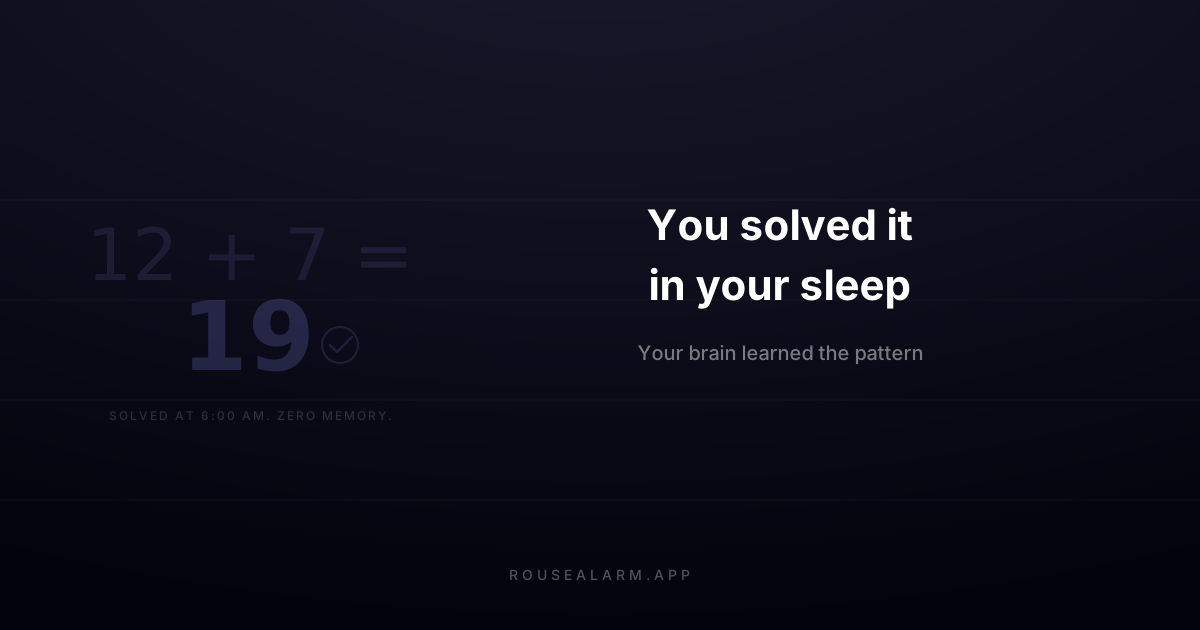
But here's the part that broke me: one morning I walked across my apartment, solved three math problems on my phone screen, turned off the alarm, walked back to bed, and woke up two hours later with zero memory of any of it.
Turns out there's a name for what my brain was doing.
It's called procedural memory. And it's the reason every alarm you've ever tried eventually stops working.
In this post, you'll learn:
- Why your brain categorizes alarm sounds as background noise (and how fast it happens)
- The specific mechanism that lets you dismiss alarms without waking up
- Why puzzle alarms, math alarms, and barcode alarms all hit the same wall
- What actually forces your brain online in the morning (hint: it's not volume)
7 min read
Your brain is designed to ignore your alarm
You know that ceiling fan in your bedroom, the one that's been humming the exact same frequency for months now and you genuinely forgot it makes any sound at all until someone visiting mentions it? You heard it the first night. Maybe the second. By the third night your brain filed it under "not a threat, stop paying attention."
Your alarm sound, that same tone firing at the same time every single morning in the same room, gets the exact same treatment from your brain.
It's a process called habituation, and it's one of the most fundamental things your nervous system does to keep you functional: when a stimulus repeats and nothing bad happens, your brain progressively dials down its response until it stops registering the thing entirely. Psychologists have studied this since the 1960s (Thompson and Spencer published the definitive paper on it in 1966, and it's held up for six decades).
In hospitals, this is so well documented they have a name for it: alarm fatigue. A 2012 review in Biomedical Instrumentation & Technology found that roughly 70% of clinical nurses become desensitized to the monitor alarms that are literally designed to prevent patients from dying. Life-or-death alarms. The brain still tunes them out.
Now think about your phone alarm. Same sound, same time, same room, every single morning.
Predictable = background noise.
I had an air-raid siren alarm for two weeks. By day four I wasn't hearing it. By day ten I was turning it off without remembering doing it. My brain had categorized "extremely loud noise at 7 AM" the same way it categorized traffic outside my window: ignorable.
So you switch to a new alarm sound, and for the first few mornings it's great because your brain hasn't categorized it yet and the novelty of an unfamiliar stimulus forces you awake, which feels like you've finally solved the problem. Then the cycle resets. This is exactly how habituation works. Your brain isn't broken. It's doing exactly what it evolved to do, which is to conserve energy by filtering out anything that repeats and carries no new information.
The problem is that every sound-based alarm is, at its core, a repeating stimulus. Loud or quiet, gentle or aggressive, melody or buzzer. Your brain will learn it.
You can dismiss an alarm without being conscious (yes, really)
This is the part that messed with me the most, because I could accept that my brain tunes out sounds after a while, but I could not wrap my head around the fact that I was walking across a room, solving math problems, and going back to bed with absolutely no memory of any of it.
Sleep inertia.
When you wake up, your brain doesn't come online like flipping a light switch. There's a transition period where you're technically awake but operating at severely reduced capacity. Tassi and Muzet published the canonical review on this in Sleep Medicine Reviews (2000). They found that sleep inertia can last anywhere from a minute to four hours, though it rarely exceeds 30 minutes if you're not severely sleep-deprived.
During that window, you can perform simple, practiced actions on autopilot.
Here's the key: your brain treats the entire sequence of dismissing an alarm as a motor skill, the same kind of learned movement pattern you use to tie your shoes or unlock your front door. The first time you used a puzzle alarm, it was genuinely hard. Your groggy brain had to figure out the interface, read the numbers, do the math. It required real cognitive effort.
By the tenth time? Your fingers knew the pattern. Fitts and Posner described this back in 1967: any motor sequence, practiced enough times, moves from effortful and conscious to automatic and unconscious. That's how you drive to work without remembering the route. That's how you type without looking at the keys.
And that's how you solve three math problems on a phone screen at 6 AM while functionally asleep.
The sequence is always the same: alarm fires, swipe right, tap numbers, swipe to confirm, and your half-asleep brain has been practicing that exact sequence every single morning until it got so efficient at the whole thing that it no longer needed you to be conscious for any of it.
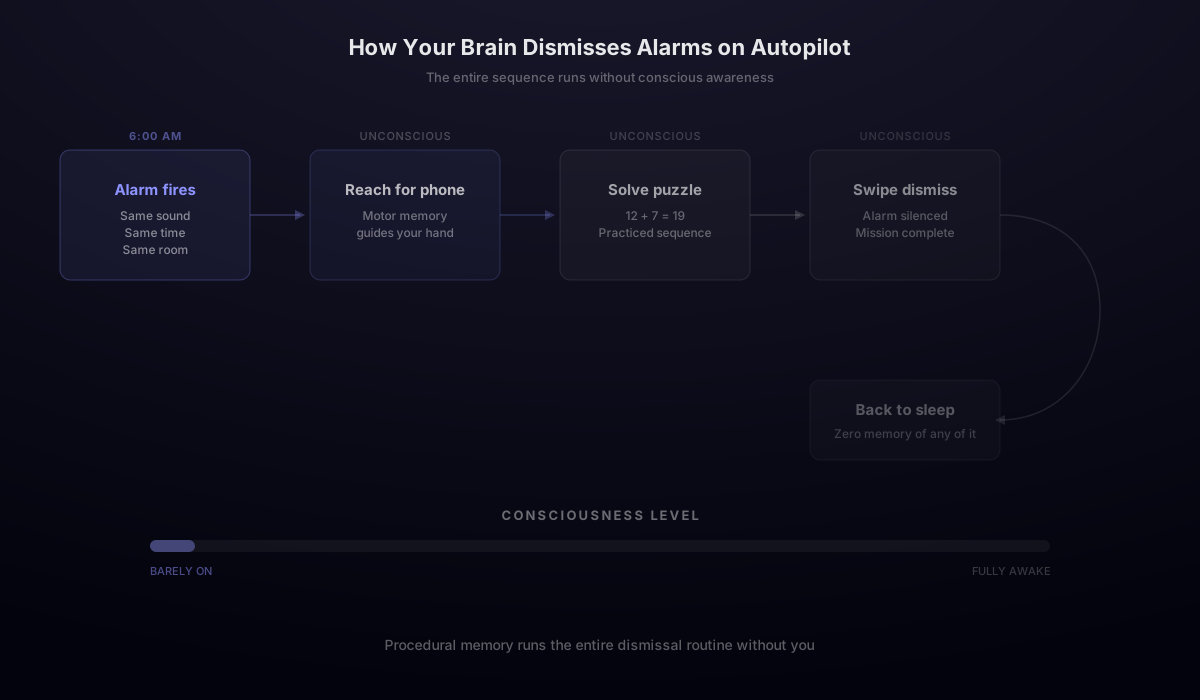
This is why "harder" alarms eventually fail. A barcode scan is a fixed sequence of movements your body can memorize. A shake-the-phone task is a fixed sequence. Walk to the bathroom and photograph the sink is a fixed sequence that feels creative the first time and becomes muscle memory by the fifth. Your brain will learn any repeatable pattern and execute it without you.
ADHD makes all of this worse
If you have ADHD, everything I just described hits harder.
About three-quarters of adults with ADHD have what researchers call a delayed circadian rhythm phase, and multiple studies from Kooij and colleagues over the past decade put the number consistently between 73% and 78% depending on the cohort and diagnostic criteria used. What this means in practice is that your melatonin, the hormone that signals "time to sleep," starts rising about an hour and a half later than it does for neurotypical adults, which means your entire sleep cycle is shifted forward.
So when your alarm fires at 7 AM, your circadian clock is saying it's more like 5:30 AM. You're not waking up at a normal time for your biology. You're waking up in the biological equivalent of the middle of the night.
That means deeper sleep at alarm time. Which means worse sleep inertia. Which means your brain is even more likely to run on autopilot and dismiss whatever alarm you set without engaging your conscious mind.
And here's the part that makes me angry on behalf of everyone with ADHD reading this: most alarm advice you'll find on productivity blogs and even from well-meaning friends assumes you just need to "try harder," as if moving your phone across the room or buying a louder alarm or going to bed earlier would fix a problem that is fundamentally neurological and has nothing to do with effort or discipline.
It's not a discipline problem, and it never was. It's neurology.
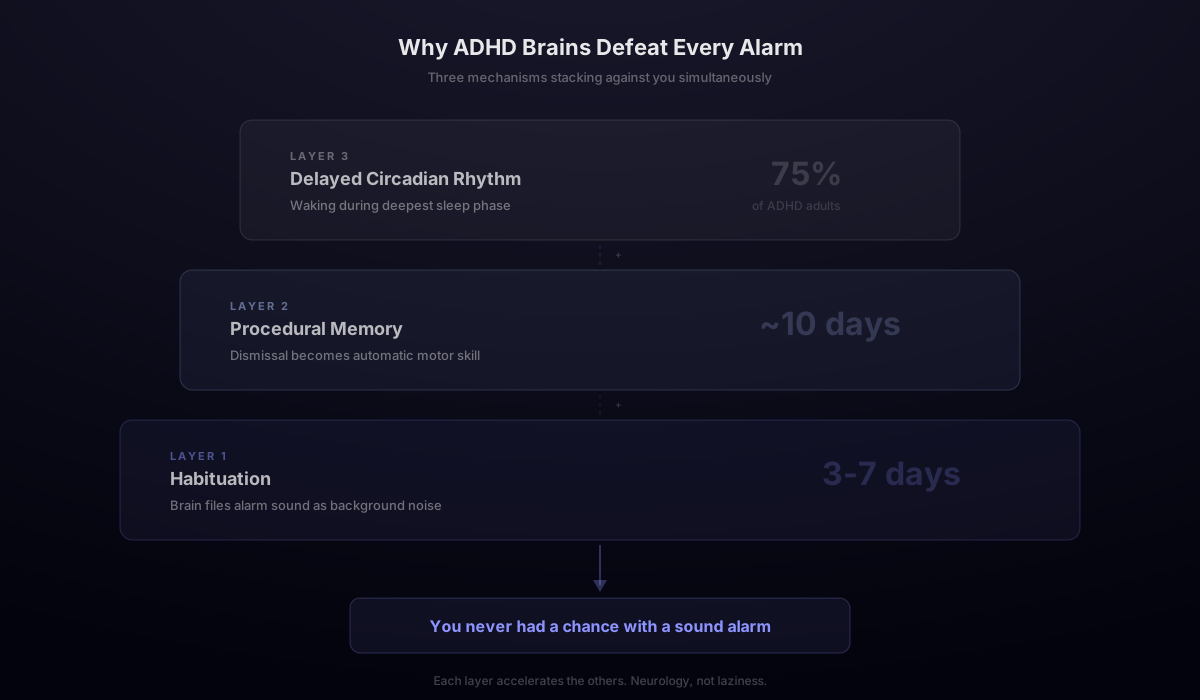
Your brain's clock is shifted. Your sleep inertia window is hitting during a deeper phase. And your incredibly efficient pattern-matching system has already learned how to defeat every alarm you own.
What actually forces your brain online
I figured this out by accident.
One morning, right before my alarm went off, my dad called me, and I picked up the phone and within seconds I was fully alert, talking in complete sentences, sounding like someone who had definitely been awake for at least an hour. Five seconds before the call I'd had drool on my pillow.
The difference wasn't volume. His ringtone wasn't louder than my alarm. The difference was that a phone call requires me to respond. My brain couldn't autopilot through a conversation the way it could autopilot through a swipe or a math puzzle.
When I looked at what actually works for heavy sleepers, not what the productivity blogs recommend but what real people in ADHD communities on Reddit and in support groups consistently describe as the things that actually get them out of bed, the pattern was obvious. Kids screaming. A dog who needs to be fed. A partner physically shaking them. An Alexa narrating their morning schedule out loud in the room.
Every single one of those things that actually work involves another entity engaging the person in real time, something unpredictable and novel that requires a genuine response from a brain that can't fake it on autopilot.
Novel = unignorable.
That's the opposite of a sound alarm, which delivers the exact same stimulus every single morning and gives your brain the exact same motor sequence to practice until it can execute the whole dismissal routine without you being conscious for any of it. A conversation is different every time. Your brain can't habituate to it because there's nothing to habituate to, and there's no fixed motor sequence to learn because the response changes with every exchange.
That's why I built Rouse around conversation instead of sound. When your alarm fires, you don't swipe or tap or shake your phone or scan a barcode. You talk. The conversation is different every morning, which means your brain has no repeating pattern to file as noise and no fixed motor sequence to learn. And you can't answer a question on autopilot the way you can solve 12 + 7 in your sleep.
By the way, if this maps to your experience, you can set Rouse for tomorrow morning. I'd love to know if it lands.
Kuba builds Rouse, the alarm app that wakes you with conversation. He's been late to enough things to know that volume isn't the variable.