"Impending Doom at 6am": Why ADHD Mornings Feel Like an Emergency
Your alarm isn't the problem. Your cortisol is. The ADHD morning dread explained, with what actually helps.
April 17, 2026 · Updated April 17, 2026
"Impending Doom at 6am": Why ADHD Mornings Feel Like an Emergency
I opened my eyes at 6:14 AM last Tuesday and my chest was already tight. Not anxious about anything. No bad dream. Just... dread. Raw, physical, electric. Like something terrible had happened and my body got the memo before my brain did.
If you have ADHD and that sounds familiar, I have good news and weird news.
The weird news: your body has a chemical alarm clock, and in ADHD brains, it's frequently broken.
The good news: once you understand what's actually happening in those first 15 minutes, you can stop blaming yourself for losing the morning. And you can start working with the right variable instead of just making things louder.
In this post, you'll learn:
- Why your body panics before your brain even turns on (the cortisol awakening response)
- Why this hits ADHD brains harder than everyone else's (and the research that proves it)
- What actually helps when your wake-up chemistry is misfiring
7 min read
The chemical alarm clock inside your head
Before your phone alarm ever goes off, your body is supposed to run its own wake-up sequence. It's called the cortisol awakening response, or CAR.
Here's how it works in a typical brain: about 30 to 45 minutes after you open your eyes, cortisol spikes by roughly 50%. That spike is your body's way of mobilizing glucose for energy, firing up your cardiovascular system, and booting your prefrontal cortex into something resembling consciousness.
Think of it like the startup sequence on a computer, where cortisol handles the BIOS and all the underlying systems that need to come online before you can actually do anything. Your alarm? That just provides the power button.
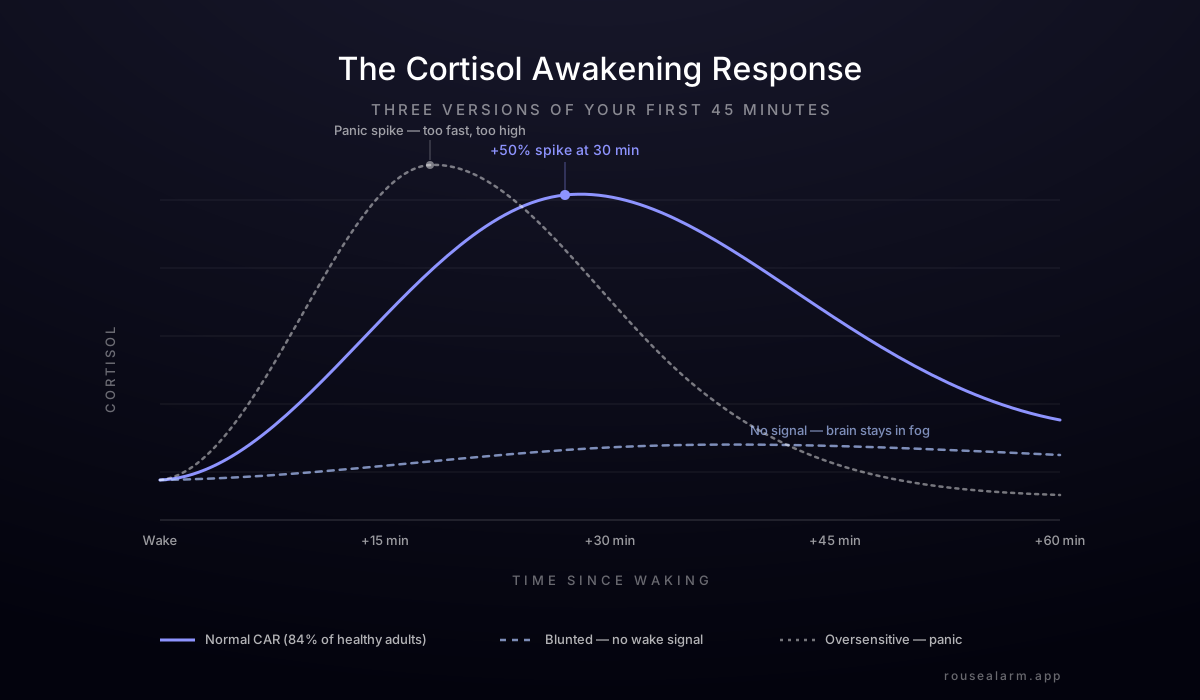
For about 77% of healthy people, this system runs fine. Cortisol goes up, brain comes online, you feel groggy for a few minutes and then you're functional. The whole thing is automatic. You don't even think about it.
But here's the part nobody talks about: if your nervous system is sensitive, that same cortisol spike can register as something completely different.
Not energy. Not alertness.
Panic.
One person on r/ADHD described it as "impending doom, palpitation and dread waking up in the morning, like you overslept and didn't hear the alarm kind of feeling." That comment had 247 upvotes. Because apparently, a lot of people recognized themselves in it.
I did too. I've had mornings where the dread hit before I'd formed a single thought. Eyes open, heart hammering, body saying something is very wrong while my brain was still loading. My family used to call it nerves. Turns out there's a more specific explanation.
Why ADHD brains get this worse than everyone else
A 2016 study by Ramos-Quiroga and colleagues measured the cortisol awakening response in adults with ADHD versus healthy controls. The findings were striking.
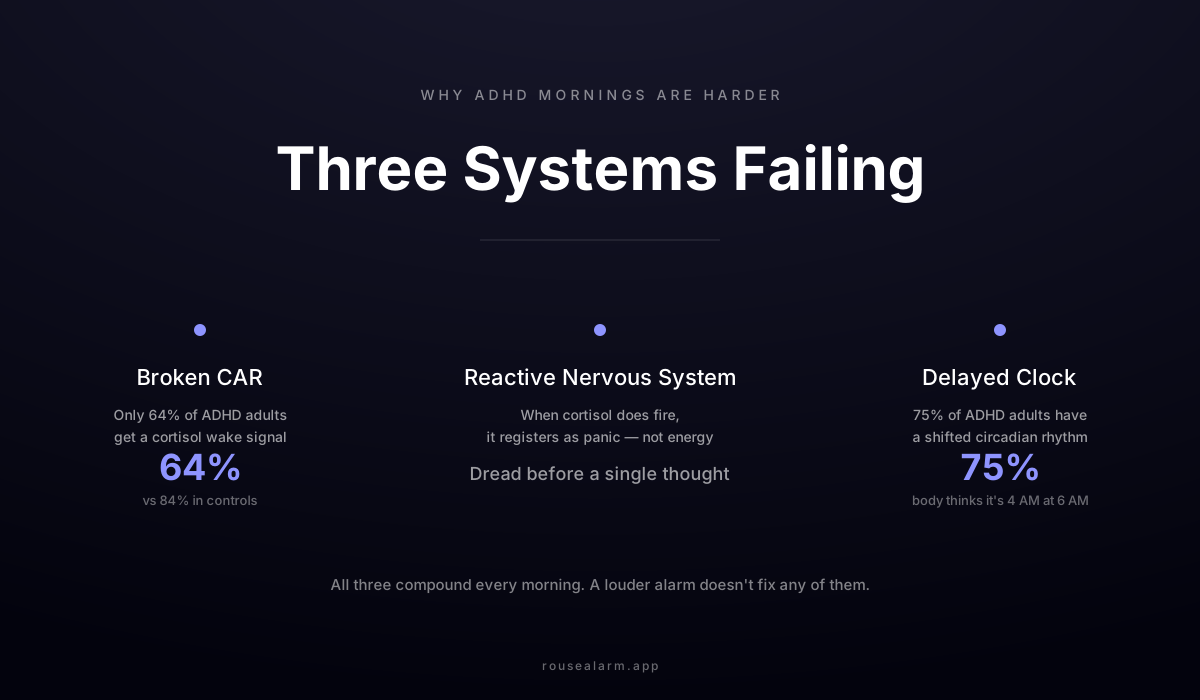
In the control group, 84% had a normal cortisol awakening response. Their chemical alarm clocks worked.
In the ADHD group? Only 64%.
That means more than a third of ADHD adults in the study didn't get the wake-up signal at all, which is a wild number when you consider that this is the system your body relies on to transition from unconscious to functional every single morning. No cortisol spike. No chemical boot-up. Just... nothing. The body's built-in alarm stayed silent.
And it gets more specific. For the combined subtype (the one with both inattention and hyperactivity), only 61% had a functioning CAR. The system designed to pull you into consciousness just doesn't fire for a lot of us.
So now you've got two failure modes happening in ADHD mornings, and they look completely different from the outside:
Failure mode one: Blunted CAR. No cortisol spike. You wake up and feel like you got hit by a truck made of fog. The "brick of grogginess" that one Redditor described, where it doesn't matter if you slept 5 hours or 9. Your body never sent the wake-up signal.
Failure mode two: Oversensitive response. The cortisol spike fires, but your already-reactive nervous system interprets it as a threat. You wake up in fight-or-flight before you've had a single conscious thought. The dread. The doom. The racing heart with no cause.
One person wrote: "I woke up feeling scared for decades before Elvanse helped ease that significantly." Decades. Not days, not months.
And here's the thing that makes this extra frustrating: on top of the cortisol problem, about three-quarters of ADHD adults have a delayed circadian rhythm. Your internal clock is shifted later than the schedule the world runs on. So you're fighting the cortisol misfire AND a body that genuinely believes it's 4 AM when your alarm says 6.
Now think about what a regular alarm does in this situation.
It makes noise.
That's it. A sound. Aimed at a problem that isn't about sound. Your body either didn't get the cortisol signal (so the sound bounces off a brain that's still in sleep mode) or your body is already in panic mode (and the alarm just adds another stressor to a system that's already overloaded).
I own a Sonic Bomb. It vibrates the bed hard enough to rattle the nightstand. Worked for about five days. Then my brain filed it under "background noise" and I slept through it. I wasn't being lazy. My cortisol wasn't firing, and no amount of vibration was going to replace a chemical process that wasn't happening.
What actually helps when your cortisol is misfiring
So if the problem isn't volume or aggressiveness or math puzzles or QR codes, what IS the variable?
I figured this out by accident.
One morning, right in the middle of that fog, my phone rang. Not an alarm. An actual phone call. I picked up and within 30 seconds I was awake. Not groggy-awake. Actually awake. Alert. Talking in full sentences.
Weird.
Because I'd been hitting snooze on a 90-decibel alarm for 45 minutes before that call came in, completely useless, doing absolutely nothing for my consciousness. But one conversation cut through the fog like it was nothing.
I spent the next few weeks paying attention to this. And the pattern held. Mornings where someone talked to me early, I was up. Mornings where it was just alarms, I was lost in the dead zone for 20, 30, sometimes 45 minutes.
The mechanism, as far as I can piece it together: conversation does what cortisol is supposed to do. It loads your prefrontal cortex with novel input. It forces processing. You can't passively absorb a conversation the way you can passively absorb a sound. Someone asks you a question and your brain has to assemble a response, pull words together, figure out what they're saying, decide what to say back, which means the executive function circuits have to come online whether cortisol gave them the green light or not.
For the dread version of the problem (failure mode two), it works differently. Instead of lying there marinating in objectless panic while cortisol floods your system, the conversation gives that arousal somewhere to go. It redirects the energy from "something is wrong" to "someone is talking to me and I need to respond." The panic doesn't vanish, but it gets channeled into something functional.
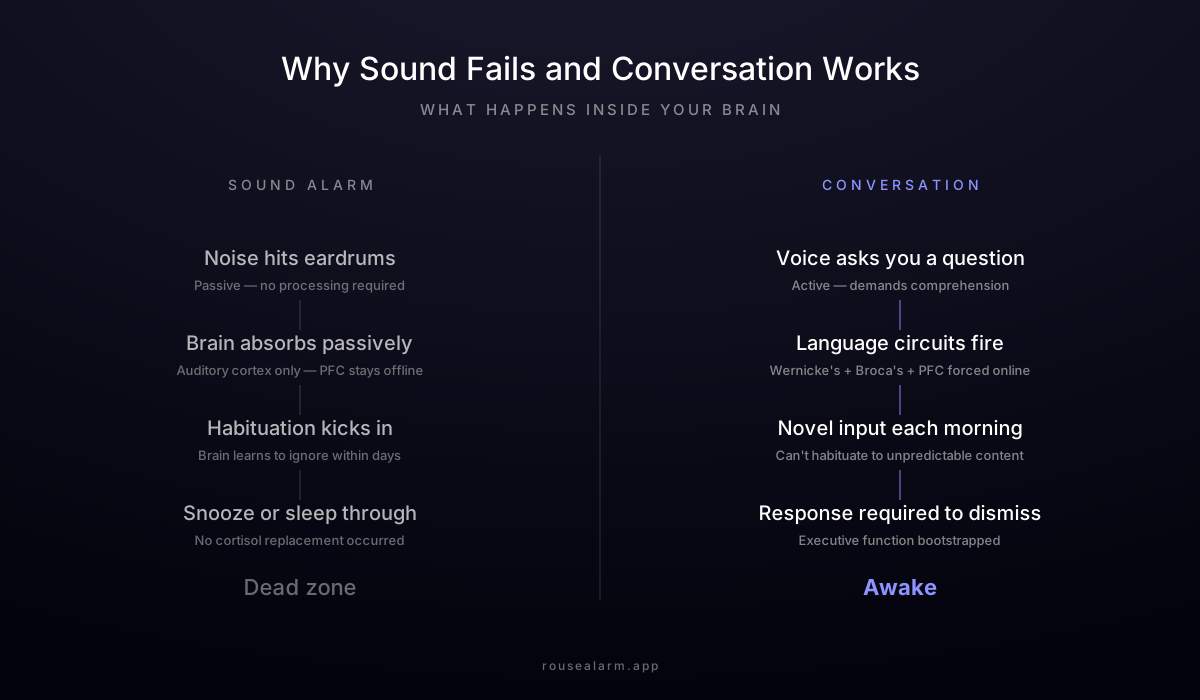
That's why I built Rouse around conversation instead of sound. A voice that talks to you, asks you things, keeps your brain loaded with novel input during the exact window when cortisol is supposed to be doing that job and isn't. You can't dismiss it by tapping a button or solving a half-asleep math problem. You have to actually engage.
I don't know if this is the mechanism for everyone. But I know the research now points to cortisol as a real, measurable piece of the ADHD morning problem. And I know that every sound-based alarm I've ever tried was solving for the wrong variable.
If your mornings start with that wave of dread before you've even had a thought, or if you wake up feeling like your brain is wrapped in concrete and no alarm cuts through, now you know one reason why. It's not laziness. It's not bad sleep hygiene. It's a cortisol response that either didn't show up or showed up wrong.
If that sounds like your mornings, try Rouse for a week. I'd love to know if it changes anything.
Sources:
Ramos-Quiroga JA, et al. "Cortisol awakening response in adults with attention deficit hyperactivity disorder: Subtype differences and association with emotional lability." Psychoneuroendocrinology, 2016. (PMID: 27084305)
Lunsford-Avery JR & Kollins SH. "Delayed circadian rhythm phase: a cause of late-onset ADHD among adolescents?" Journal of Child Psychology and Psychiatry, 2018. (PMC6487490)
Kooij SJ & Bijlenga D. Research on DLMO delays in ADHD adults. Multiple publications, Psychiatry Research, 2013 to 2019.