Awake But Frozen: Why ADHD Morning Paralysis Hits AFTER the Alarm (And Why 'Just Get Up' Is Biologically Impossible)
The real ADHD morning isn't sleeping through the alarm. It's being fully awake and unable to send the motor command. Here's the neurology.
April 22, 2026
Awake But Frozen: Why ADHD Morning Paralysis Hits AFTER the Alarm (And Why "Just Get Up" Is Biologically Impossible)
There's a thread on r/adhdwomen called "How do I win over the bedridden goblin that possesses my body the moment my alarm rings in the morning?" It has 303 comments. One of them is almost 600 words long, and I have read it four times.
The top reply, the one that made me feel less insane, goes like this:
"for the life of me I cannot transition from asleep to awake and vertical without a knock out dragged out fight between my stupid body, brain, and responsibilities."
You know the moment. You are not asleep. You heard the alarm. You turned it off. Your eyes are open, the ceiling is right there, and somewhere in the back of your head a loud voice is listing every consequence of not getting up right now. You agree with the voice. You intend to move. You have been intending to move for nineteen minutes.
You are fully conscious, fully willing, and completely unable to send your legs the command to swing off the mattress.
That moment has a name nobody talks about, because it is not the moment anyone built a product for.
In this post, you'll learn:
- Why the post-awareness bed freeze is a different failure mode from sleep inertia, unconscious dismissal, and task initiation, and why it matters that you can tell them apart
- The actual neurology of "awake but frozen" (prefrontal lag plus dopamine floor plus motor-sequencing bottleneck)
- Why every alarm on the market, including the ones that hurt, cannot touch this moment
- What does work in the wild, and what the pattern has in common
- Where Rouse fits, and where it genuinely does not
9 min read
Four failure modes, not one
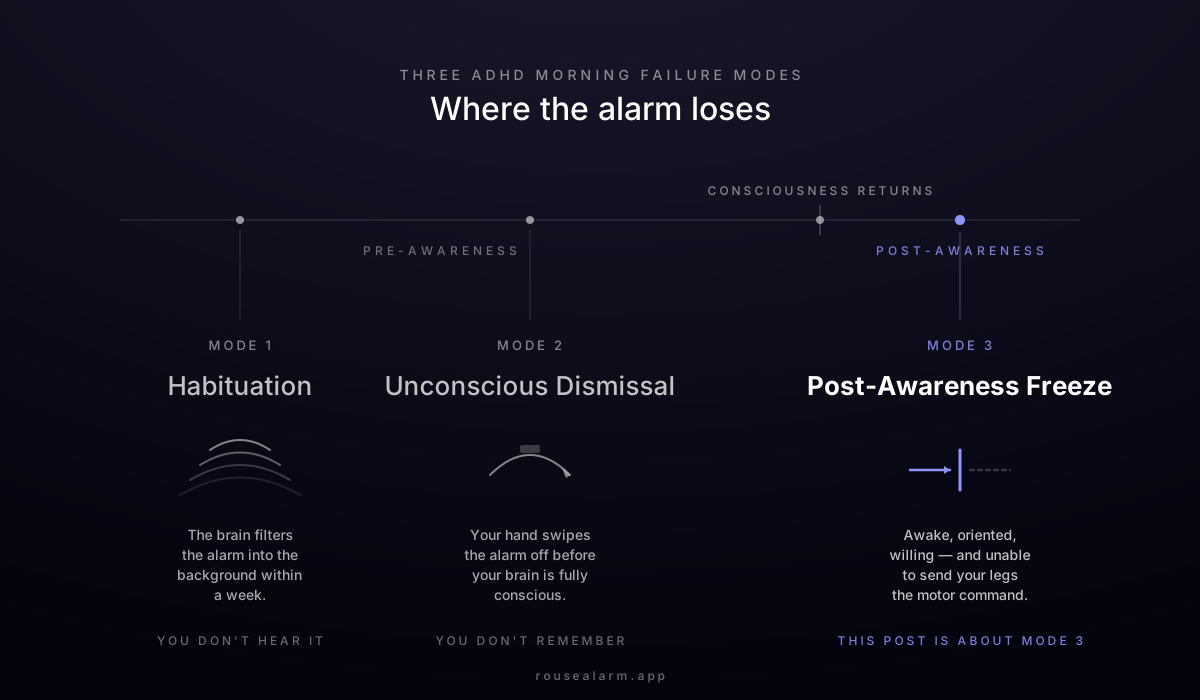
Everyone in this niche keeps lumping four different problems together and then wondering why none of the fixes work. Let me pull them apart, because the post you are reading is specifically about the fourth one, and the other three have already broken you in ways this post cannot address.
Failure mode 1: Unconscious dismissal. Your hand finds the phone and swipes before you are conscious. You have no memory of it. This is a procedural-memory problem and I wrote a whole post about it over here: I tried every alarm hack for ADHD, here's why they all stop working. If this is where you lose, get that fixed first.
Failure mode 2: Habituation. Your brain filters the alarm sound into the background within a week. Louder alarm, same outcome. I wrote about the habituation ceiling here: why every alarm stops working after a week.
Failure mode 3: Sleep inertia. The first 15 to 30 minutes after waking you are cognitively impaired. Reaction time slow. Working memory offline. Tassi and Muzet's 2000 review in Sleep Medicine Reviews called it a "performance deficit," and Hilditch and McHill's 2019 paper pinned it specifically to the prefrontal cortex coming back online late. Neurotypical humans get this too. It just clears faster for them.
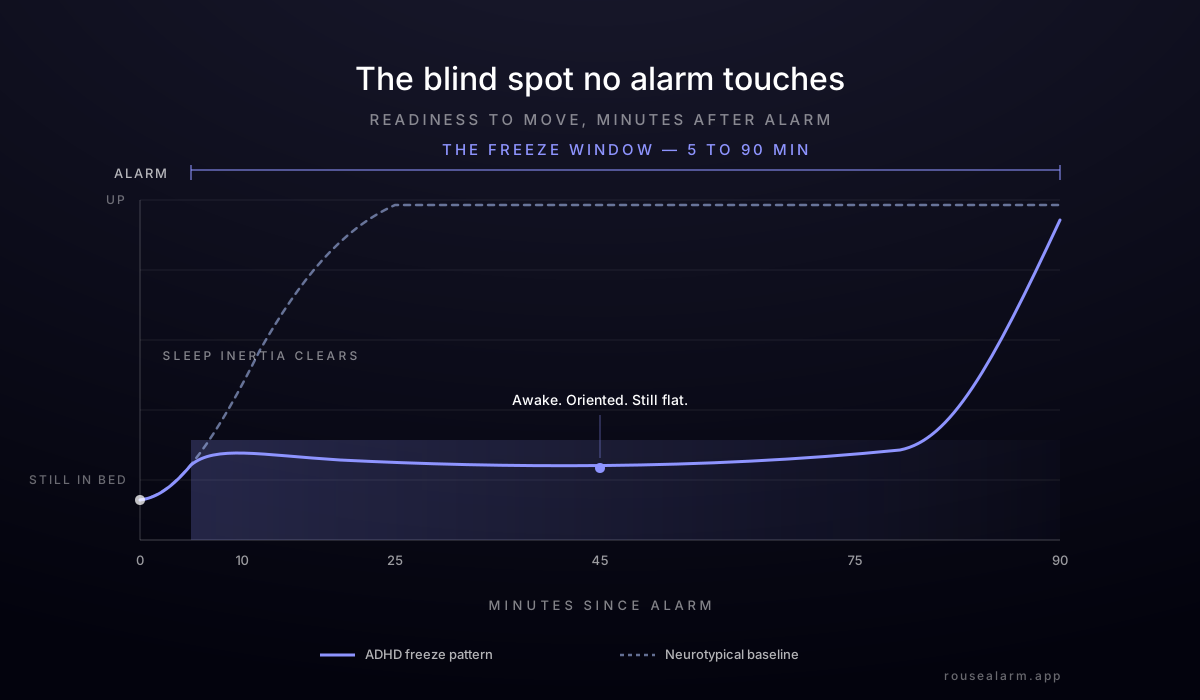
Failure mode 4: Post-awareness executive freeze. This is the one that owns the bedridden goblin thread. You are past the inertia. You are aware, oriented, and you know the time. You have decided to get up, have formed the intention, and you still cannot execute the physical action. Your prefrontal cortex is up but under-fueled. Your motor cortex is not receiving a "go" signal. You are stuck in the gap between deciding to move and moving, and that gap is measured not in seconds but in tens of minutes.
Modes 1 through 3 are about waking you up. Mode 4 starts after you are awake. Nothing built for modes 1 through 3 does anything for mode 4. That is the whole problem.
What's actually happening in your head at 6:47 AM
Here's the rough picture, based on what's published.
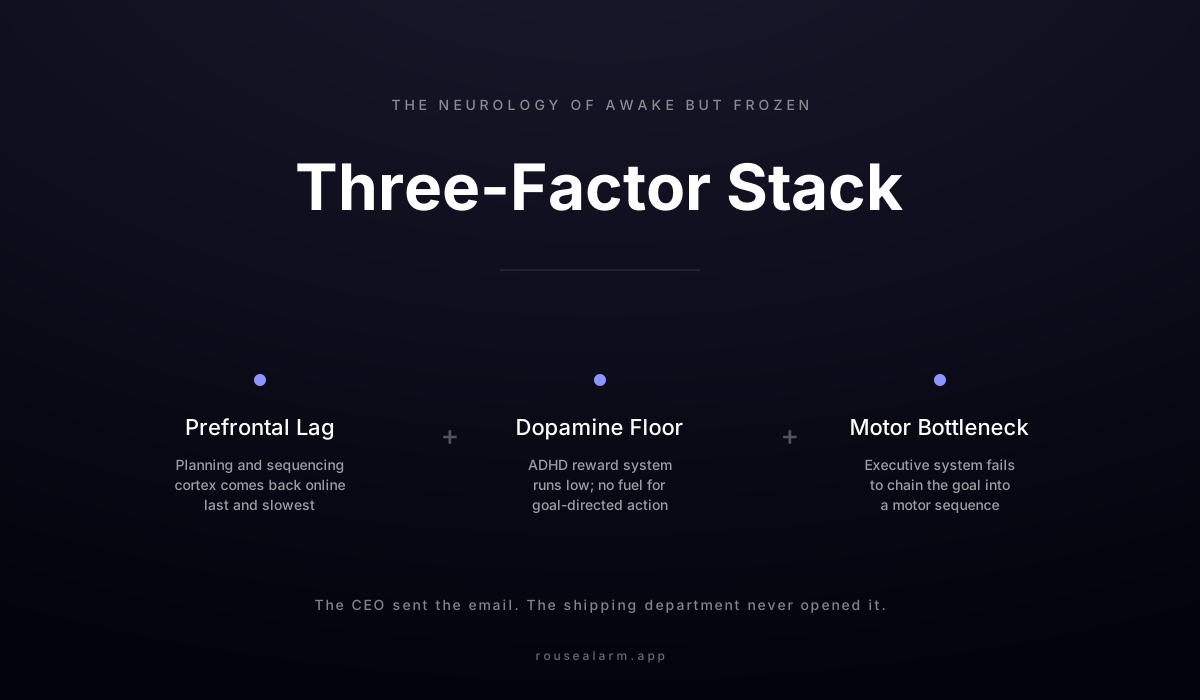
When you wake, your brain does not boot up all at once. EEG and fMRI work on sleep inertia (Tassi & Muzet 2000, Hilditch & McHill 2019) shows that the prefrontal cortex, the part that handles planning, goal-directed sequencing, and overriding lower-level impulses, lags. Subcortical areas are online. The lights-and-sirens parts of your brain are online. The thing that sends "stand up, walk to the bathroom, put on the kettle" is still on dial-up.
That is inertia. Normal biology.
For the ADHD brain, a second thing stacks on top.
Volkow and colleagues' 2009 paper in JAMA documented reduced dopamine receptor and transporter availability in the reward pathway of adults with ADHD. Translate that into what the reward system is doing at 6:47 AM. Dopamine is not just a "reward" chemical. It is also the fuel for initiating goal-directed action. William Dodson has been saying for years that the ADHD brain runs on an interest-based nervous system, not an importance-based one. Urgency, novelty, challenge, interest. Those are the four things that release enough dopamine for an ADHD brain to initiate. "It's Tuesday, the calendar says work" is not on that list.
So at 6:47 AM you have:
- A prefrontal cortex that is up but still throttled
- A reward system with low baseline dopamine looking for a reason to fire
- A task in front of you (get out of bed) that contains zero novelty, zero urgency, zero interest
Then the third layer, which is the most under-discussed of the three.
Russell Barkley's 1997 model of ADHD, published in Psychological Bulletin, reframes ADHD as an executive function disorder, specifically one of behavioral inhibition and the downstream capacities that depend on it. One of those downstream capacities is the sequencing and initiation of motor programs. Not moving. The brain's ability to take an abstract goal ("get up") and chain it into the specific motor commands ("push the duvet off, rotate hips, plant left foot on floor") that actually deliver the outcome.
That chain is where the freeze lives.
You have the goal. You have the intent. You do not have the motor program queued up and firing. The CEO sent the email. The shipping department never opened it.
And here is the part that ruins people. None of the above feels like the neurology I just described. It feels like being lazy. Being weak. Being the same broken person you were in third grade when you could not get dressed for school. The internal experience is shame. The underlying event is a dopamine-starved executive system failing to issue a motor command.
You are not refusing to get up. Your brain is not sending the packet.
Why every alarm on the market is structurally unable to fix this
Take a tour of the alarm aisle. I own most of it.
Clocky (the wheeled alarm that runs away). Forces you to get out of bed once, on day one. By day three you are fishing it out from under the dresser with a coat hanger without waking up. Addresses unconscious dismissal, sort of. Does nothing for the freeze, because the freeze happens before you decide to chase it.
Sonic Bomb (130 decibels plus a bed shaker). Loudest alarm I own. It is just noise. Your brain habituates inside a week. And if you are past the habituation window and genuinely awake? It is still just noise. Noise does not queue a motor program. It just makes you tense.
Shock Clock (the wristband that zaps you). You can fully intellectually register the zap, flinch, swear, and remain exactly where you are. Pain does not equal motor initiation. ADHD brains can tolerate a shocking amount of low-grade discomfort without moving, because the discomfort still is not interesting.
Sunrise lamps. Lovely. Smooth. Completely unrelated to the executive function bottleneck. A sunrise lamp is an inertia tool, not a freeze tool. You wake up gentler, and then you lie there frozen in gentler lighting.
Alarmy with math puzzles, barcode scans, photo missions. These force a narrow burst of cognition to dismiss the alarm. Then the alarm is gone and your phone is in your hand and you are exactly back in the freeze, now with Instagram inside thumb's reach. I wrote about that failure separately in the ADHD morning phone scroll trap. The scroll is often what the freeze collapses into.
What do all of these have in common?
Every single one of them is built on the assumption that the problem is waking you up or forcing you out of bed by making bed unpleasant. None of them are trying to activate your prefrontal cortex. None of them are sequencing your motor program. None of them care whether you are interested.
They are sensory inputs. The freeze is a sequencing and initiation problem. Wrong category of tool.
Sound + predictability = background noise.
Sound + pain = background noise with a wince.
Sound + puzzle = background noise with a detour.
None of those multiply out to motor command.
What actually works in the wild (and the pattern underneath it)
Go scroll the "what actually gets you out of bed in the morning (not 'discipline')" thread on r/ADHD. 969 upvotes, 1,072 comments. The stuff that works, consistently, in a way that does not fail after a week, clusters into a surprisingly narrow pattern.
- A partner shoving them, talking to them, threatening to leave.
- A toddler climbing on their face.
- A friend or parent who calls at the agreed time ("are you up?").
- A dog that needs to be let out right now.
- A 7 AM meeting they have to dial into with camera on.
- A one-off flight at 5 AM for a trip they are excited about (from that same thread, one commenter: "the only thing that does work: a one time urgent deadline. Like if I have a flight to catch or a weird early morning meeting, I can make those.").
Everything on that list has two properties.
One, an external human presence that the ADHD brain registers as something that requires a response.
Two, novelty, interest, or urgency that is different today than it was yesterday. The kid is doing a new thing. The dog is insistent. The meeting has a specific topic. The flight is to a specific place.
The pattern is not force. The pattern is not pain. The pattern is body doubling plus interest.
Body doubling is a well-documented ADHD productivity technique, popularized through the ADHD coaching community and covered regularly in ADDitude Magazine. It is the single most reliably-reported productivity hack for ADHD adults and it is almost entirely absent from the alarm category.
The version that works for mornings is the version where a human is, in some sense, with you in that first frozen window, giving your brain an external reason to run the motor program. They ask you a question. You answer. The prefrontal cortex is pulled online by the demand of the conversation. The dopamine system is pulled online by the novelty of what they are saying. Your body starts receiving motor commands again.
You do not think your way out of the freeze. You get talked out of it.
Where Rouse actually fits
If I tell you I built an alarm that has conversations with you, your instant read is probably "cute gimmick, also I am not talking to my phone at 6 AM." That is fair.
Here is the mechanism angle I care about.
A conversation is the one stimulus you physically cannot consume passively. You cannot scroll through it. You cannot habituate to it in a week, because the content is different every morning. You cannot zombie your way past it, because the LLM is waiting for a response and the alarm does not stop until it gets one. And the thing you have to do to produce that response is exactly the thing the freeze is blocking, which is run a coordinated sequence (listen, process, speak) that pulls your prefrontal cortex and motor system online together.
It is the body-doubling pattern, on-demand, scheduled.
I did not start with that framing. I started with "I am tired of lying in bed." I built Rouse because every other alarm I owned was addressing the wrong failure mode. The bedridden goblin thread exists because millions of ADHD adults have the fourth failure mode and the market has built for the first three.
If this maps to you, you can try Rouse for a week and see if the freeze still holds when the dismissal gesture is a conversation instead of a swipe.
Honest caveats
A few things this post is not claiming, because it would be stupid to.
This will not fix delayed sleep phase. If your melatonin onset is at 3 AM and you are trying to wake at 6, no alarm on earth is the answer. Meds, light, sleep schedule, and in some cases professional help. I wrote about the circadian side of the ADHD morning here: why your alarm worked and you still missed work by 40 minutes (time blindness is the failure mode after the freeze resolves, once you are finally up).
This does not replace stimulant medication. For a lot of ADHD adults the meds are the thing that finally lets the freeze shorten from 90 minutes to 10. If you pre-dose in bed, that is its own interesting workaround and I wrote about it here: the pre-dose alarm. Rouse stacks with meds. It does not replace them.
It will not fix the phone-scroll collapse on its own. If the freeze resolves and you immediately fall into a 42-minute Instagram spiral, the fix you need is the one in the ADHD morning phone scroll trap. Two different moments, two different fixes.
This will also not make you a morning person. It will maybe make you the person who gets up when they said they would.
FAQ
Is this the same thing as sleep inertia?
No. Sleep inertia is the first 15 to 30 minutes after waking where your cognition is impaired across the board (Tassi & Muzet 2000, Hilditch & McHill 2019). The post-awareness freeze often starts during sleep inertia and continues for long after inertia has cleared. You can be fully oriented, know exactly what day it is, have checked your phone, and still be frozen. That is the tell.
Is this executive dysfunction? Or is executive dysfunction something else?
The freeze is one specific symptom of executive dysfunction, not the whole thing. Executive function covers inhibition, working memory, planning, task initiation, emotional regulation, and motor sequencing (Barkley's 1997 model in Psychological Bulletin is the standard reference). The freeze is task initiation plus motor sequencing, at the worst possible moment of the day for both.
Why do I sometimes wake up fine? Like on vacation or for a flight?
Interest-based nervous system (Dodson's framing, published extensively through ADDitude). Novelty, urgency, challenge, and interest release enough dopamine to kick your initiation system into gear. A flight to Lisbon hits all four. A Tuesday at your desk hits none. Your neurology is not broken. It is tuned to a different fuel than "importance."
If the freeze is dopamine, can I fix it with caffeine?
Caffeine helps with alertness. It does not reliably produce the goal-directed activation that a novel, interest-rich stimulus does. Most ADHD adults I know have been drinking coffee in bed for years and can confirm caffeine alone does not break the freeze. It sometimes turns a 40-minute freeze into a 35-minute freeze. That is not the intervention.
I've already tried everything. Why should I try one more thing?
Because every other thing you have tried addressed one of the first three failure modes. If the fourth is where you actually lose, none of them were built for your problem. Rouse is the first alarm whose whole mechanism is a body-doubling conversation, and body doubling is the single most consistently reported thing that works for this in the wild. It might not work for you. It also might be the first tool that has ever targeted the right failure mode.
If you have been staring at the ceiling for fifteen, thirty, sixty minutes every morning knowing you need to move and unable to move, that is not laziness and it is not weak willpower. It is a dopamine-starved executive system failing to issue a motor command, and you have been trying to fix it with louder noise.
Set Rouse for tomorrow morning. Talk back. See if the command actually leaves the dock. I'd love to know if it lands.