Your Alarm Worked. You Still Missed Work by 40 Minutes. Here's the Trap.
The 15 minutes after your ADHD alarm aren't 15 minutes. Time blindness plus sleep inertia is why 5 feels like 45. What actually closes the gap.
April 19, 2026
Your Alarm Worked. You Still Missed Work by 40 Minutes. Here's the Trap.
The alarm went off at 6:15. I remember hearing it. I remember thinking, tons of time, I'll just check one thing.
Next time I looked up, it was 7:03.
Not because I fell back asleep. I was awake the whole time. Standing. Scrolling. Mid-shower. Shoe in hand. Staring at a drawer I'd already opened twice.
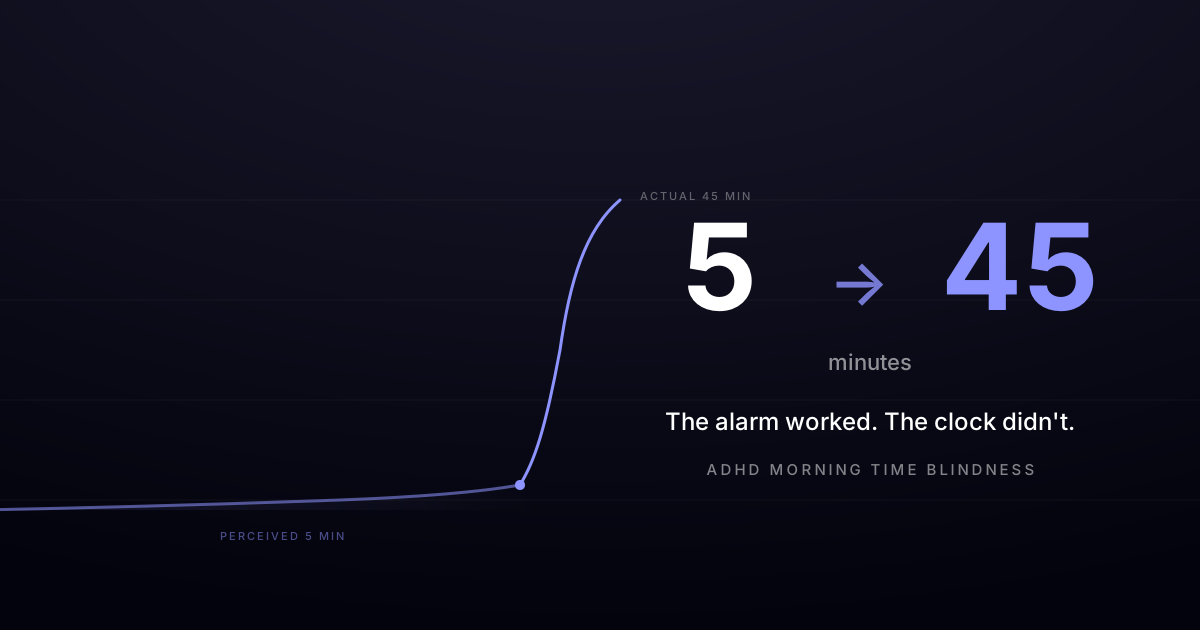
The 48 minutes didn't feel like 48 minutes. They felt like maybe 5.
If that scene lands a little too close, you're not late because you're disorganized. You're late because ADHD brains can't produce time in the window right after an alarm goes off. And every standard fix (more alarms, analog clocks, setting every clock in the house 10 minutes fast) is adding time information to the one part of the day when your brain can't process it.
In this post, you'll learn:
- Why the 15 minutes after your alarm aren't 15 minutes for an ADHD brain
- Why every "time blindness hack" quietly fails in this specific window
- What actually closes the dilation gap, and why it has to keep talking
6 min read
The 15 minutes after your alarm aren't 15 minutes for an ADHD brain
There's a phrase that keeps showing up in every ADHD morning thread I read: 5 minutes felt like 45. Different users, different years, different subreddits. Same sentence.
One post from last month, 2,179 upvotes:
"I'll be getting ready in the morning and think I'm moving fast and being efficient, and then suddenly I'm 40 minutes behind schedule and I have no idea how. I swear I was only in the shower for 5 minutes, but apparently it was 25."
Another one, 3,589 upvotes: "As soon as I step foot into the shower time just doesn't exist anymore and I somehow spend 40 minutes, which feel like 5."
That isn't a phrase someone borrowed from a magazine. That's a native description of a cognitive deficit.
Turns out there's a name for it. Time blindness. More specifically, perceptual timing impairment.
The research goes back decades. A 2013 review by Noreika, Falter, and Rubia in Neuropsychologia pulled together neurocognitive and neuroimaging studies on timing in ADHD and found ADHD brains consistently underestimate duration, misjudge intervals, and lose track of elapsed time compared to controls. Russell Barkley has been writing about this since 1997, arguing that impaired internal timing is one of the core executive function deficits of ADHD, not a lifestyle issue on top of it.
Your brain doesn't run a stopwatch. It runs a guess, built from context clues: how much has happened, how much input you've processed, how recent the last marker event was. For ADHD brains, every one of those signals is unreliable.
So far, that's a general problem. It is. And it's at its worst in the morning.
Here's why.
A second mechanism kicks in the second your alarm goes off. It's called sleep inertia. Research by Tassi and Muzet (2000) and more recently Hilditch and McHill (2019) found that the first 15 to 30 minutes after waking are when your prefrontal cortex is running at reduced capacity. Reaction time drops. Working memory drops. Self-monitoring drops. You're operating with the executive function of someone who's been awake for 24 hours straight, except you feel alert.
Stack that on top of ADHD's baseline time-perception deficit.
A neurotypical brain in the morning has a wonky clock for 15 minutes. An ADHD brain in the morning has a wonky clock on top of a clock that was already wonky. That's the window where 5 minutes and 45 minutes genuinely feel the same. Not metaphorically. Literally. Your brain's duration estimator, already unreliable, is now running on a brain stem.
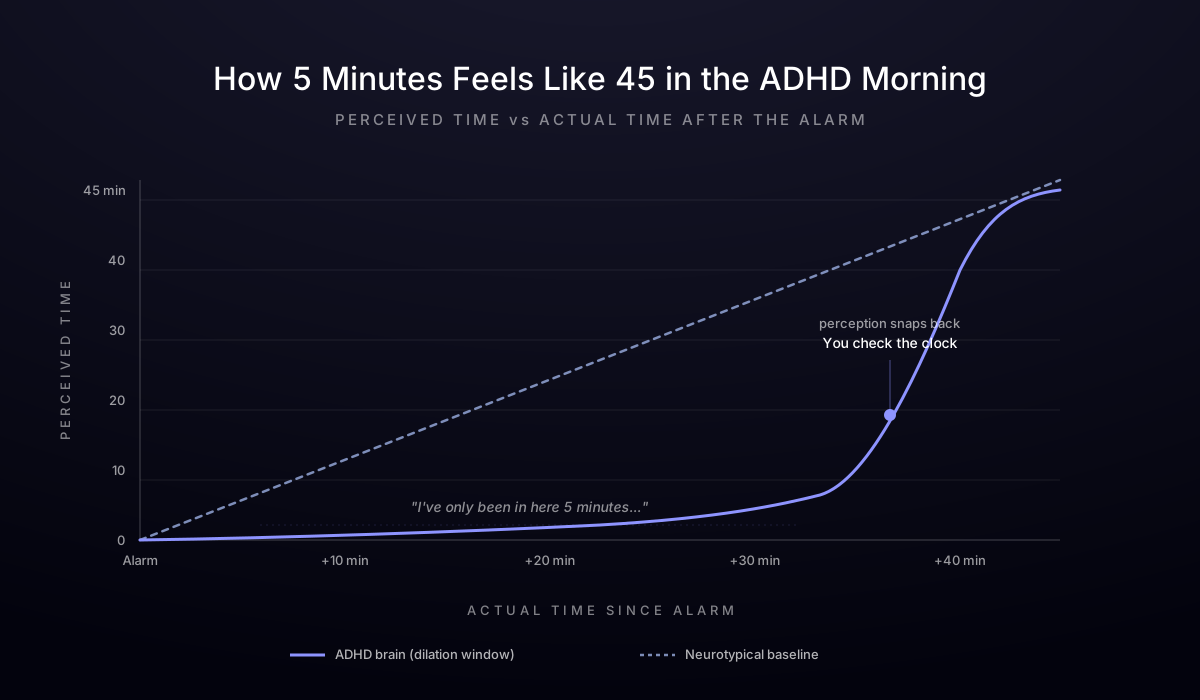
(This is the same window where the cortisol awakening response fires wrong in most ADHD adults, which is a whole other article. Time blindness and cortisol misfiring are stacking on each other in the same 20 minutes. That's the dead zone.)
This is also the exact window where you pick up your phone to check one thing.
You know how this ends.
One comment from r/ADHD captures the chain reaction better than any paper I've read:
"I was putting on my shoes, noticed a loose thread, pulled it, saw a stain, went to grab cleaner, noticed dishes in the sink, started washing them, forgot about the shoes, checked the time, panicked."
That isn't lazy. That isn't getting distracted. That's an ADHD brain in sleep inertia trying to run an 11-step morning routine with a clock it can't read.
Why every "time blindness hack" fails in this specific window
Here's what makes this uniquely cruel.
The standard advice for ADHD time blindness is to add more time information. Set alarms every 15 minutes. Buy an analog clock. Set every clock 10 minutes fast. Wear a watch that buzzes on the hour. Add calendar pings at 8 AM, 9 AM, 10 AM.
I've tried every one of these. They work OK during the workday. In the morning they're useless.
Go back to the two mechanisms. The problem isn't that you don't have time information. Your phone is six inches from your face showing you 6:52 while you still think it's 6:35. The problem is your brain can't use time information in this window. More pings just become more stimuli to filter out, same as the original alarm.
One person on r/ADHD said it plainly:
"'I'll leave in 5 minutes.' 45 minutes later I'm still not ready. Not because I'm procrastinating. Not because I don't care. Because 5 minutes and 45 minutes genuinely feel the same to my brain."
Notice what she's describing. She's not missing the clock. She's watching it. The clock just isn't doing anything.
Alarms every 15 minutes? Your brain habituates to those inside a week. Analog clocks? You see them, you register them, the information doesn't stick. A haptic watch buzzing on the hour? Fine at 10 AM. Useless at 6:47 AM when your cortex is still booting.
Adding more time signals to a brain that can't process time is like turning up the volume on a radio with a broken speaker. The signal's fine. The receiver is what's down.
And it isn't a willpower problem either, which is the other thing people try to patch this with. The brain that decided last night to be out the door by 7:05 is not the same brain that's standing in front of an open drawer at 6:58. You can't discipline a clock into existing.
What actually closes the dilation gap
I figured this out by accident one morning when my phone rang at 6:40.
I'd been getting ready for 25 minutes. If you'd asked me, I'd have sworn maybe 8 had passed. I picked up the call. The other person said, "Hey, sorry for the early call, it's 6:40 and I just saw your email."
That one sentence snapped something into place. Not because the information was new. I had a clock six inches from my face. Because someone external had spoken the time at me, and my brain had to listen, parse, and respond.
From that call onward I was tracking time in real-time. The dilation window collapsed.
The mechanism, once I sat with it, is pretty simple:
An ADHD brain in the morning can't generate a clock internally. But it can receive one externally, as long as the external source keeps talking.
A beep is a point event. It fires once and then there's silence. Silence is where the dilation reopens.
A clock-tick carries time but no content, so working memory never engages with it.
A conversation is different. Every exchange carries time anchors inside the content. It's 6:42. We've been talking four minutes. You said ten minutes ago you'd check the schedule. Before this call you had 35 minutes, now you have 30. Each sentence forces working memory to load a fresh clock marker and tie it to something you're actually processing. The clock isn't a background variable anymore. It's riding on the content.
That is exactly the stimulus ADHD brains need in the dilation window, and exactly the stimulus a sound alarm can't provide.
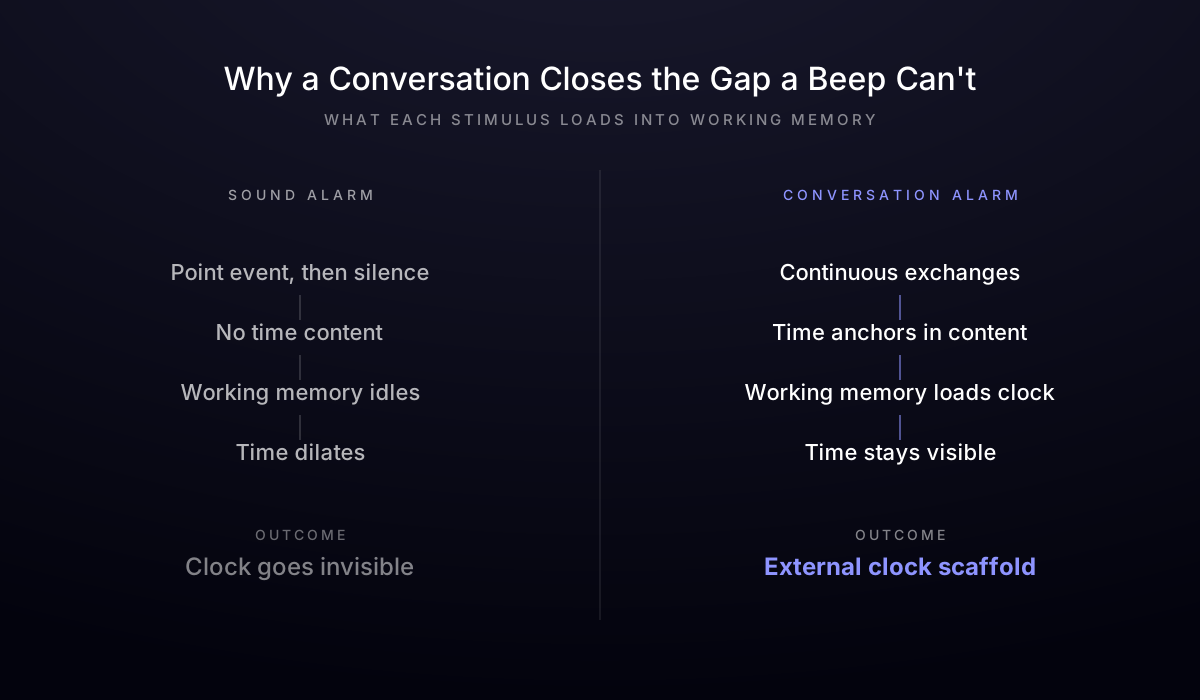
That's why Rouse works the way it does. The alarm fires, and instead of another beep you get a voice that talks to you until you're actually in the morning. It references clock-time. It calls back things you said 90 seconds earlier. It makes your brain load time markers every few exchanges, in the exact window it normally can't. You can't dismiss it by tapping a button. You can't swipe it off in your sleep. You have to stay in the conversation, which is the same thing as saying you have to stay in time.
I'm not going to claim this fixes time blindness as a general symptom. Time blindness is real across the whole day. But the post-alarm window is the one slice of the day where conversation is disproportionately powerful, because it's the one slice where an internal clock is offline and an external one, delivered as speech, is the only kind of time information a half-booted cortex can actually hold.
If your mornings follow this pattern, the one where the alarm works fine, you get up, and somehow 40 minutes vaporize between the bed and the door, you're not failing a discipline test. You're running a routine without a working clock in the window your routine needs one most.
By the way, if this maps to you, set Rouse for tomorrow morning. I'd love to know if it closes the gap.
Sources:
Noreika V, Falter CM, Rubia K. "Timing deficits in attention-deficit/hyperactivity disorder (ADHD): Evidence from neurocognitive and neuroimaging studies." Neuropsychologia, 2013. (PMID: 23313625)
Barkley RA. "Behavioral inhibition, sustained attention, and executive functions: Constructing a unifying theory of ADHD." Psychological Bulletin, 1997. (The time-representation framework.)
Tassi P, Muzet A. "Sleep inertia." Sleep Medicine Reviews, 2000. (PMID: 12531174)
Hilditch CJ, McHill AW. "Sleep inertia: current insights." Nature and Science of Sleep, 2019. (PMC6710480)
Reddit threads: r/ADHD "time blindness is ruining my life, what feels like 5 minutes is apparently 25" (u/CourteousPasta, 2,179 upvotes); r/ADHD "time blindness is the ADHD symptom nobody talks about enough" (u/CircularFrequency, 2,683 upvotes); r/ADHD "I just cracked the code to showering" (u/manicpixietgirl, 3,589 upvotes).