You Dismissed the Alarm in 0.8 Seconds. You Put the Phone Down 42 Minutes Later.
The ADHD morning scroll isn't a willpower failure. It's the predictable output of using a phone as your alarm. Here's the four-mechanism stack and the structural fix.
April 20, 2026
You Dismissed the Alarm in 0.8 Seconds. You Put the Phone Down 42 Minutes Later.
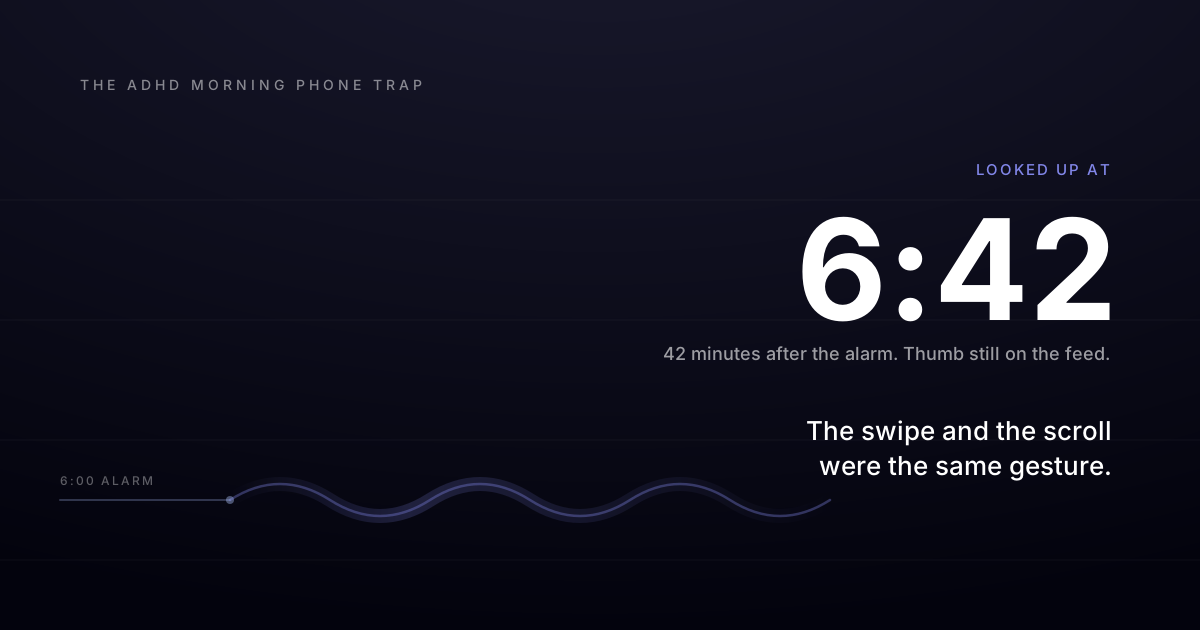
The alarm went off at 6:00. I swiped to dismiss it without opening my eyes. My thumb, still on the screen, drifted about two centimeters left to where Instagram lives on my home screen.
I looked up at 6:42.
I was late. I hadn't moved. I was now watching a stranger explain how she meal preps her egg whites on Sunday.
The swipe and the scroll were the same gesture. My brain had never treated them as two separate decisions.
If you have ADHD and you've ever stared at the ceiling thinking why do I keep doing this, the honest answer is that you're not self-sabotaging. You're just the second user of a device whose first job of the day is to hand you its most addictive surface at the exact moment your prefrontal cortex has the least authority it will have in the next 16 hours. The phone trap isn't a willpower failure. It's the output of the interaction model.
In this post, you'll learn:
- Why the dismissal swipe and the doomscroll are one continuous motion, not two choices
- What's happening in your brain during the 30 minutes you vanish into the feed
- Why "put the phone across the room" keeps failing after two or three nights
- What the interaction has to look like for the scroll to lose its on-ramp
7 min read
The swipe and the scroll are the same motion
There's a r/ADHD thread that hit 2,257 upvotes last year with one of the most honest questions I've ever read on that sub:
"Like… I'll be fully aware that I'm running late. I'll literally see the time, know I should be leaving, but instead my brain goes yeah but what if we check Instagram one more time? It makes zero sense. I'll be stressing about being late WHILE still scrolling, and then get mad at myself later."
The top comment, 1,715 upvotes: "This is a prime example of executive dysfunction."
True, but underspecified. The real question is why every morning funnels into that same behavior, even when the person knows it's coming, is already anxious about it, and has spent money on five different apps to stop it.
Go look at your morning. Your alarm fires from the same device that contains every app specifically engineered to keep your attention. To make the alarm stop, you either pick up the phone or reach for it on the nightstand. By the time it's quiet, your thumb has already traveled through the gesture: unlock, swipe, dismiss, release.
Now your hand is holding a glass rectangle, unlocked. Your home screen is glowing. A red notification badge is sitting on Instagram.
You haven't decided to scroll yet. You haven't even decided to be awake yet.
The decision is already made by the design.
What your brain is doing during the 42 minutes
I want to walk through the four mechanisms stacking on top of each other in that window, because once you see them lined up, the scroll stops feeling like a personal failing and starts looking like a predictable output.
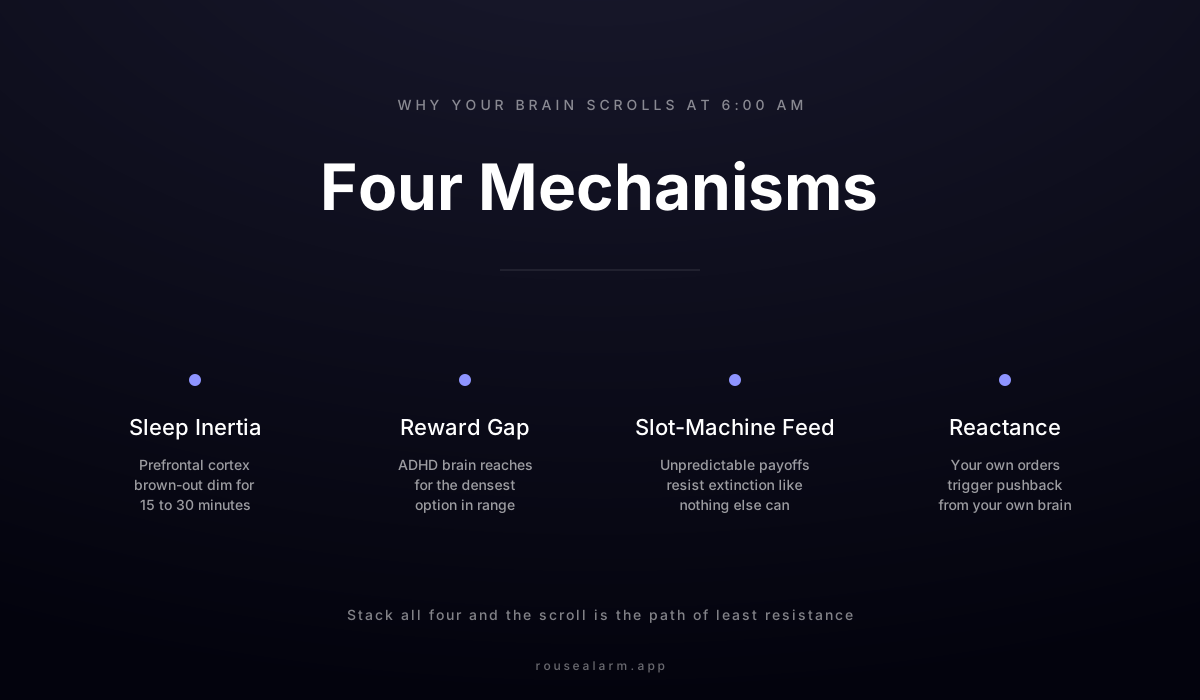
1. Sleep inertia is running the first decision of your day
Tassi and Muzet's 2000 review in Sleep Medicine Reviews laid out the core finding: for 15 to 30 minutes after waking, cognitive performance drops sharply. Reaction time slows. Working memory is impaired. Executive function operates at roughly the level of someone legally impaired by alcohol. Hilditch and McHill's 2019 review in Nature and Science of Sleep pinned this specifically to the prefrontal cortex, which is the part of the brain that handles "should I be doing this right now."
During this window, you are literally less capable of choosing the harder action. The brain architecture responsible for "stand up instead of open Instagram" is brown-out dim.
2. The ADHD reward system reaches for the densest option
Volkow and colleagues' 2009 work in JAMA on dopamine pathways in adult ADHD found reduced dopamine receptor and transporter availability in the reward circuit. This is the same circuit that drives attention to novel, stimulating input. You've probably read the summary version of this a dozen times: ADHD brains under-respond to low-stimulation tasks and over-respond to high-stimulation ones.
Instagram is, by design, the highest-stimulation option available inside two centimeters of your thumb. A made bed is the lowest. There's no contest. When your reward system is handed that menu, it will pick the feed every single time, and it will feel genuinely involuntary, because the "choice" is happening at a layer below deliberate cognition.
This is also the same gap I wrote about in the morning dopamine gap that keeps ADHD brains in bed. The feed isn't just easier. It's the only option in the room that meets the reward threshold.
3. Social feeds are the purest variable-ratio schedule ever built
B.F. Skinner's original work on schedules of reinforcement established that variable-ratio reinforcement, where rewards are delivered on an unpredictable schedule, produces the most persistent, hardest-to-extinguish behavior in any organism. Slot machines were the canonical example in the 70s. Social feeds are slot machines with better graphics.
Every swipe has an unknown payoff. Sometimes it's a funny meme. Sometimes it's a post from a friend you haven't seen in a year. Sometimes it's nothing. The unpredictability is the feature, not a bug. It's the mechanism.
Now picture a brain running on sleep-inertia-diminished executive function, with an amplified reward sensitivity, handed a slot machine. Ten minutes of scrolling isn't surprising. Forty-two minutes isn't surprising. The only thing that breaks the loop is an external interrupt the brain didn't schedule. You hear your partner in the kitchen. Your bladder wins. Your calendar alert goes off.
4. Self-inflicted demand avoidance
The Reddit thread had a comment I keep thinking about, score 203:
"I don't know if it's an actual thing but I call it self inflicted demand avoidance. I can't tell myself what to do."
It's a real thing. Brehm's 1966 theory of psychological reactance found that any perceived constraint on autonomy triggers a motivational pushback to reassert it, even when the constraint is coming from your own prior intentions. For ADHD adults, that reactance is amplified, and it's especially amplified at moments of low executive function.
Meaning: the more you tell yourself get up, get up, get up, the more the part of your brain that governs autonomy treats "get up" as an external imposition and resists it by doing anything else.
The feed is the perfect form of anything else. It's morally neutral. It doesn't feel like rebellion. It just feels like you accidentally checked something.
Stack those four mechanisms and the scroll becomes the path of least resistance in a literal, physics-of-the-brain sense.
Why "put the phone across the room" stops working by day three
Everybody on r/ADHD has tried the standard fixes. The thread I quoted above has hundreds of people in the comments listing what they've already cycled through:
- Charge the phone in the kitchen. Works for two nights. On night three, you carry it to the bedroom "just so the alarm is louder."
- Phone-across-the-room. You walk over, dismiss, walk back with the phone in your hand, lie down, scroll.
- App blockers like One Sec, Opal, ScreenZen. Work for three to five days. Then you discover the emergency override button, or the Uninstall App button, and in a sleep-inertia haze at 6 AM you use it.
- Screen time limits. You set them, then allow yourself the 15-minute "just this once" grant every morning, which becomes 45 minutes.
- An analog alarm clock next to the bed. Still doesn't stop you from reaching for your phone to dismiss the second alarm on your phone, which you kept "as backup."
I've tried all of these. They don't fail because ADHD adults are lazy. They fail because every one of them is trying to fix a second-order problem (the phone is available) while leaving the first-order problem in place: the interaction model rewards and enables scrolling as the frictionless next step.
This is the same cycle I broke down in why every alarm hack eventually stops working. Your brain is not bad at habits. It's catastrophically good at finding the path of least resistance inside whatever constraint you build, and the constraint has to be structural, not motivational.
The one structural fix: the dismissal gesture has to keep the phone unavailable
Here's the fix in one sentence: for the 60 to 90 seconds after the alarm fires, the phone has to be in use in a way that physically prevents the scroll.
The version of that fix that happens to be the one I'm building is Rouse. When an alarm fires, instead of a dismissal swipe, the phone holds a voice conversation with you. You talk. It talks back. The alarm doesn't stop until you've actually answered back enough to demonstrate you're awake. Sitting up. Feet on the floor. Oriented to the day.
The reason that works, mechanically:
- Your thumb is not on the screen. The phone is at your ear or sitting on the nightstand with speakerphone on.
- Your attention is on an external voice demanding a response, which bypasses self-inflicted demand avoidance (the demand isn't coming from you, it's coming from something outside).
- The reward-system decision is made for you. There's no menu. There's no slot machine. There's a person asking you what time you said you'd leave the house.
- By the time the conversation ends, you are vertical. You are oriented. You have missed the 30-minute sleep inertia window where the scroll had its best on-ramp.
I built this because my own mornings looked exactly like the Reddit thread above. I was not proud of it. I was also not going to solve it with another app that asked my 6 AM self to have more discipline than my 11 PM self had when she set the alarm.
The mechanism is the product. Conversation is the one interaction your brain can't autopilot through and can't redirect to a feed.
FAQ
Why does this matter more for ADHD brains than neurotypical brains? Neurotypical sleep inertia clears in 15 minutes with somewhat normal executive function on the other side. ADHD sleep inertia runs longer, stacks on an amplified reward-seeking baseline, and collides with weaker task-initiation. The scroll-as-first-decision has worse consequences because the other systems that would normally redirect attention aren't online yet.
Isn't this just regular phone addiction? Regular phone addiction happens throughout the day. The morning scroll is specifically structural. It's the predictable output of using your phone as your alarm, combined with sleep inertia, combined with your phone being the densest reward object in the room. It responds to different fixes than general screen-time reduction.
Can I fix this without an app? Yes. Move your phone out of the bedroom permanently, use a dedicated analog alarm clock with no snooze, and don't pick up the phone until you're dressed and out of the bedroom. About 10% of ADHD adults can sustain this. The other 90% are back to phone-as-alarm within a month. If you're in that 90%, the interaction model is the variable, not your discipline.
Is conversation guaranteed to work? No. It works for me and it works for a lot of the people who've tried Rouse so far, but any alarm mechanism can eventually lose teeth if the brain learns to shortcut it. The bet with a conversation alarm is that novelty stays higher longer, because the conversation isn't identical every morning, unlike a sound, which habituates in about 7 days. I wrote more about that habituation ceiling in why every alarm stops working after a week.
If you've been losing 30 to 45 minutes a morning to the feed and you've already tried the phone-across-the-room fix more than once, the thing worth testing isn't more willpower. It's a dismissal gesture that doesn't route to a feed.
Set Rouse for tomorrow morning and see if the scroll even has an opening. I'd love to know if it lands.