The Body Double Your Alarm Can't Be: Why ADHD Brains Need Presence to Wake Up, Not Sound
Your ADHD brain wakes up for kids, partners, and 7 AM meetings. It ignores every alarm you've ever bought. Here's the mechanism, named.
April 23, 2026
The Body Double Your Alarm Can't Be: Why ADHD Brains Need Presence to Wake Up, Not Sound
A few weekends ago my girlfriend's mom stayed over. She knocked on the bedroom door at 7:14 AM to ask if we wanted coffee.
I was up. Feet on the floor, hair pushed back, answering with a sentence that had both a subject and a verb, before my eyes had finished opening.
The same brain that, thirty-six hours earlier, had slept through three stacked alarms, a Sonic Bomb on the dresser, and a genuinely confused cat walking across my face.
I didn't wake up because of a sound. I woke up because someone was at the door.
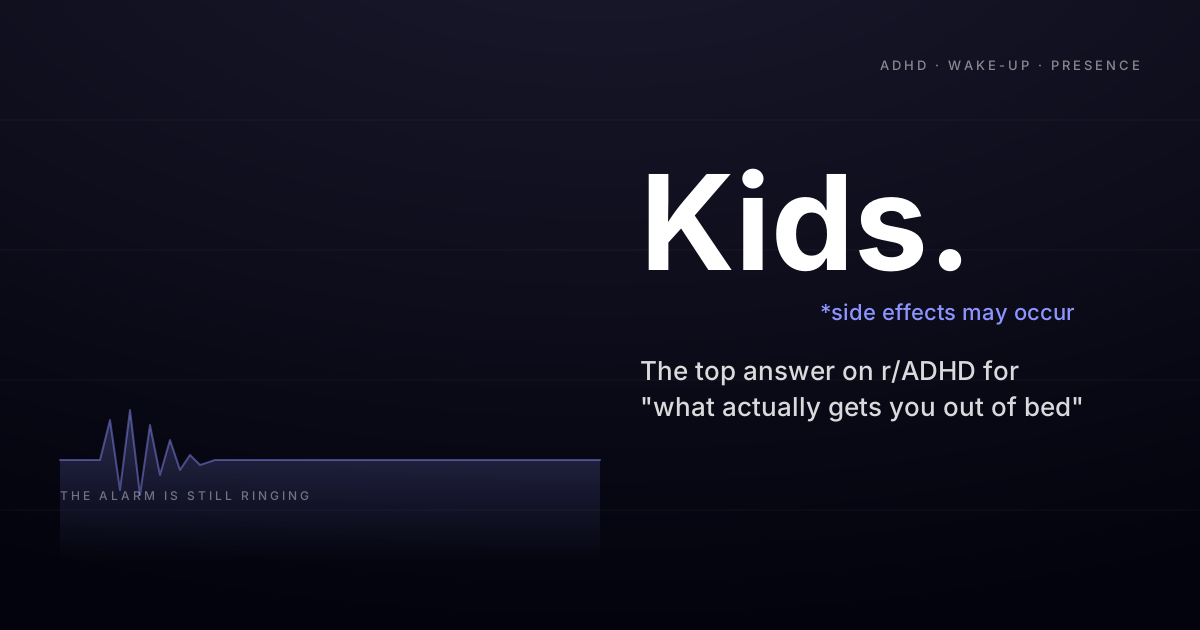
I've been building Rouse for a year now and I've been reading r/ADHD the entire time. The top comment on the thread "What actually gets you out of bed in the morning (not 'discipline')" has 907 upvotes and is two words.
Kids.*
* Side effects may occur.
That's the whole ADHD wake-up problem in one joke.
Because here's the pattern: your alarm doesn't work. Your partner's voice does. A knock on the door does. A 7 AM client call does. An 8-year-old climbing into bed does. The things that work all have one feature in common, and it's not volume, and it's not novelty, and it's definitely not discipline.
It's presence.
In this post, you'll learn
- Why ADHD adults wake up reliably for other people and almost never for themselves (it's a specific mechanism, not a moral failure)
- What body doubling is, why it's a clinically-recognized ADHD coping strategy, and why it stops at the bedroom door
- Why the first fifteen minutes after the alarm are the worst possible window for your brain to act alone
- Why sound-based alarms structurally cannot substitute for a body double, and what can
- Where Rouse fits in this, honestly, without me pretending it's magic
7 min read.
The word for what you're doing wrong is "body doubling"
Body doubling is one of the few ADHD coping strategies that's crossed over from Reddit wisdom into the clinical literature. ADDA has a whole page on it. Cleveland Clinic wrote one too. The idea is simple: your brain does the thing when someone else is in the room, and it stalls out when you're alone. You don't need them to help. You don't need them to watch. They just need to be there.
ADHD Twitter figured this out a decade ago and turned it into a cottage industry. Focusmate, Flown, Pledgd, Caveday. All of them sell you a Zoom call with a stranger so you can finally finish your taxes. The category is growing. The clinical framing is catching up.
And here's what's missing from every conversation I've ever read about it:
Body doubling works for tasks. It's never been productized for the moment ADHD adults fail at the most.
Waking up.
u/ExistentialNomad42 on r/ADHD, 585 upvotes:
I'm honest about my executive dysfunction and frequently ask friends to body double so I can actually finish tasks.
Friends. Tasks. No one has a friend who will body double their 6 AM alarm. Which is a problem, because that's exactly the moment you need one.
Why the morning is the worst possible time for your brain to be alone
Here's the neurology, as cleanly as I can say it, with citations you can actually check.
Your executive function, the network that decides "get out of bed, put on pants, go to the thing", is weakest right after you wake up. There's a name for that state. It's called sleep inertia, and a big review by Tassi and Muzet in 2000 found it lasts on average 15 to 30 minutes, sometimes significantly longer. Hilditch and McHill's 2019 neurocognitive review is the modern canon on the same thing. fMRI work by Vallat and colleagues in 2018 showed that the default-mode network doesn't hand control back to the task-focused network cleanly during those minutes. Your brain is literally in a different operating mode than it is an hour later.
Now stack ADHD on top of that.
Barkley's executive function model (Psychological Bulletin, 1997) frames ADHD as a deficit in self-regulation, not a deficit in ability. Volkow et al. in JAMA, 2009 showed the dopamine pathway differences that make internal motivation harder to mobilize. Put those two facts together and you get a brain whose self-start system is already working on a budget. And the moment you're asking it to start is the moment the budget is lowest.
Which is the exact mechanism I wrote about in the bed paralysis post and the phone-scroll trap post. The alarm works. Your eyes are open. And your executive function is still loading.
This is the window where body doubling matters most. It's also the window where you don't have anyone around.
A bell is a stimulus. A person is a witness.
Here's the part that made me stop trying to fix my alarm stack.
The reason "Kids" is the top answer on that thread isn't that kids are louder than a Sonic Bomb. They aren't. My old Sonic Bomb was 113 decibels and would shake a coffee mug off the nightstand. I slept through it for a week.
The reason Kids works is that a child in the doorway is a social situation. There is a witness. There is a person who needs a response. Your brain, even half-asleep, recognizes a category of event ("person asking me something") that it cannot file under "ignorable background noise."
This is social facilitation, and it's been studied for sixty years. Zajonc's 1965 paper in Science kicked off the literature. Bond and Titus's 1983 meta-analysis in Psychological Bulletin cleaned up the effect sizes. The summary: the presence of another person changes your cognitive state in ways a non-social stimulus doesn't, even when they're not doing anything.
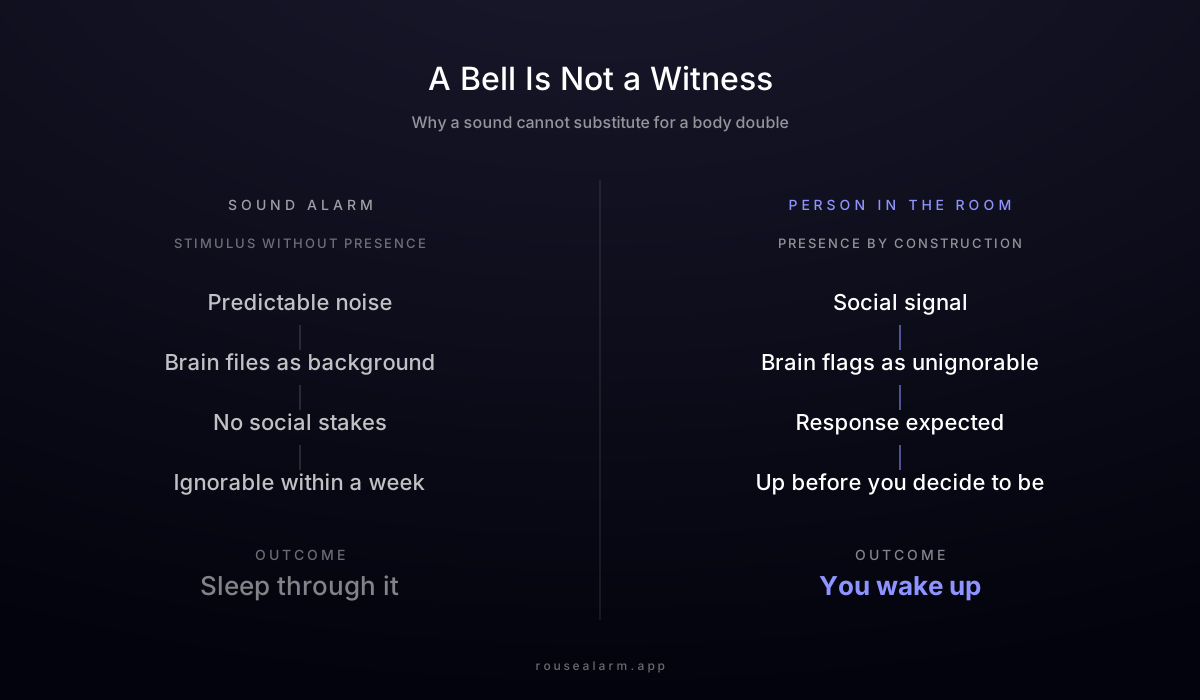
A sound alarm is a non-social stimulus. Which means:
Sound alarm = stimulus without presence. Kids / partner / 7 AM call = presence by construction.
u/Less_Student_4945, r/ADHD, 372 upvotes, 186 comments:
I've tried all the standard ADHD life hacks, the pomodoros, the body doubling, all of it. But my brain eventually learns the trick and knows there is no real penalty for ignoring the timer or the to do list.
Sound alarms habituate. Presence doesn't, because presence isn't a sound, it's a relationship. And every relationship has stakes.
This is the same mechanism I wrote about in "You Fired Your Alarm Clock When You Quit Your Job", just turned inward. The solopreneur lost the 9 AM witness. The ADHD adult never had one in the first place.
What an AI body double is (and, more importantly, what it is not)
I'll level with you on the product side, because I'd rather you trust me than hard-sell you.
Rouse is an iOS alarm that fires, starts a live voice conversation with an AI, and keeps talking until you're engaged enough to confirm you're actually up. It knows your name. It knows what you told it last night about this morning. It asks you questions you have to answer, not with a button, with a sentence.
It is not a substitute for human connection. It is not a friend. It is not a therapist. If you have a partner who will wake you up every morning, that is better than Rouse.
What it is, structurally, is a witness that is already present at 6:15 AM. Which is a category of thing that did not previously exist in your bedroom.
A sound alarm you can sleep through, because a sound becomes background noise to an adapted brain in about a week. You can't sleep through a conversation directed at you, because a dialogue fails the second you stop responding, and the failure is the reason the alarm hasn't stopped yet. The presence isn't a feature bolted on top. The presence is the mechanic.
You can muscle-memory a button press. You can turn off an alarm in your sleep without ever waking up. You cannot muscle-memory a conversation.
It's not willpower. It's presence. And presence is the one thing your alarm has never been able to give you.
What to do with this
If this maps to you, try running the mental test for a week before you touch any app.
For the next seven days, notice every morning where you wake up on the first ping. Ask: was there a person involved? A text that needed a response. A call scheduled. A partner. A kid. A knock. I bet the ratio is close to 100%.
Then notice every morning you snoozed into oblivion. Ask the same question.
The pattern will tell you what category of tool you actually need. It isn't a louder bell. It isn't a harder puzzle. It's a witness who's already there when the alarm fires.
If you want to try that as an app, set Rouse for tomorrow morning. Tell it one specific thing you want to do when you get up. See if you can hang up on it. I'd love to know if it lands.
By the way, if it doesn't work in the first week, that's useful information too. The habituation curve is real even for novel stimuli, and presence is novel, not magic. If it works for a month and then stops, tell me. I'm building this for people who have a list of alarms they've fired.
FAQ
Is body doubling actually a clinical ADHD technique, or is it just a Reddit thing? Both. It started as Reddit/coaching-community wisdom and has been written up by ADDA, Cleveland Clinic, Hallowell Todaro, and Medical News Today. It's not in the DSM, because very little ADHD coping strategy is. But the cognitive mechanism underneath it (social facilitation + executive function offloading) has been studied since the 1960s.
Why doesn't setting multiple alarms work the same way? Because your brain adapts to any predictable stimulus within days. That's the habituation problem I wrote about here. Multiple alarms are still the same category of thing: stimulus without presence. More of them doesn't change the category.
Is Rouse really different, or is this another "shake your phone 30 times" gimmick? Shake-your-phone alarms are procedural. Your body learns to do them in your sleep. A voice conversation is not procedural, because the content of what the AI says is different every morning, and the response it needs from you is not a button press. That's the structural difference. Whether it works for you is empirical. Try it for a week.
Do I need a formal ADHD diagnosis for this to apply? No. The mechanisms under this post (sleep inertia, social facilitation, executive function offload) apply to every human brain. The post is angled at ADHD adults because the pain is most acute there and because body doubling is most commonly discussed in that community. If you're a neurotypical person who reliably wakes up for your kids and never for yourself, this still explains why.
What about people who live alone and don't have kids/partners/early meetings? You're the reason I built this.
Kuba builds Rouse, an iOS alarm that wakes you up by talking to you until you're actually awake. If you've tried everything else and you're still snoozing at 6:14, set it for tomorrow morning and tell me how it goes.