The Warm-Bed Trap: Why Your 5 AM Gym Alarm Keeps Losing to a 72 °F Duvet
Your duvet is a near-perfect sleep device. Your alarm is fighting thermoregulation. Here's the biology and what actually unlocks the bed.
April 21, 2026
The Warm-Bed Trap: Why Your 5 AM Gym Alarm Keeps Losing to a 72 °F Duvet
Your alarm isn't fighting laziness. It's fighting thermoregulation.
The alarm goes off at 5:02. I don't dismiss it. I don't even reach for the phone. I just lie there, under an 11-tog duvet, having a very reasonable-sounding conversation with myself about why today is a rest day.
By 5:18 the duvet has won.
I used to think that was a discipline problem. Turns out it was a thermoregulation problem.
In this post, you'll learn:
- Why the bed itself is a better-designed sleep product than your alarm is a wake product
- How your body temperature physically stalls the wake-up, and why you feel it as "just five more minutes"
- Why sleep inertia makes this the exact wrong moment to let yourself negotiate
- Why the cold-shower trick is half-right, and what's actually broken about every other 5 AM hack
- What it takes to break the thermal-cognitive lock-in before the bed wins
7 min read
Your duvet is a sleep device. Your alarm is not a wake device.
Here's the thing almost nobody in the "how to wake up for the gym" genre will say out loud: you are trying to beat a purpose-built sleep product with a glorified noise-maker.
Think about what a good duvet actually is. A layer of insulated fabric, deliberately sized and weighted to trap body heat, in a room you keep cooler than the bed microclimate. That is not a neutral object. It is a finely tuned environment that pushes your body toward sleep architecture.
A 2012 review by Okamoto-Mizuno and Mizuno in the Journal of Physiological Anthropology lays out how ambient and bed-microclimate temperature directly shape sleep stages. Slight, stable warmth around the body preserves deep sleep. Cold edges disrupt it. The entire point of the bed you spent money on is to keep you asleep.
Now look at your alarm. Even a clever one (Alarmy, Sonic Bomb, Clocky scooting across the floor) is doing one thing. Making a sound. It is not warming your core. It is not lowering the ambient. It is not triggering the sympathetic system. It is just noise, in a room you climate-engineered for the exact opposite.
This is why the Sonic Bomb on my nightstand lost to my duvet for six straight weeks. Hardware mismatch.
You don't have a motivation problem. You have a product problem.
Your core body temp has to rise before you can fully wake up
Here's the part the fitness blogs skip.
Your brain doesn't just decide to wake up. Your body has to be thermodynamically ready for wakefulness. And at 5 AM, it usually isn't.
Kräuchi and Wirz-Justice showed in a 1994 paper in the American Journal of Physiology that core body temperature follows a circadian rhythm, and that the daily minimum sits in the late-night / early-morning hours. Your internal thermostat is at its lowest right around the time you're setting the alarm. The rise in core temp isn't something that happens because you wake up. It's something that has to happen before you can fully wake up.
And the way that rise happens is weirder than you'd think.
In a 1999 Nature paper, actually titled "Warm feet promote the rapid onset of sleep," Kräuchi and colleagues described the distal-proximal temperature gradient, or DPG. In plain language: when your hands and feet are warmer than your core, you're primed for sleep. When the gradient flips, when the extremities cool and the core starts rising, you're primed for wake.
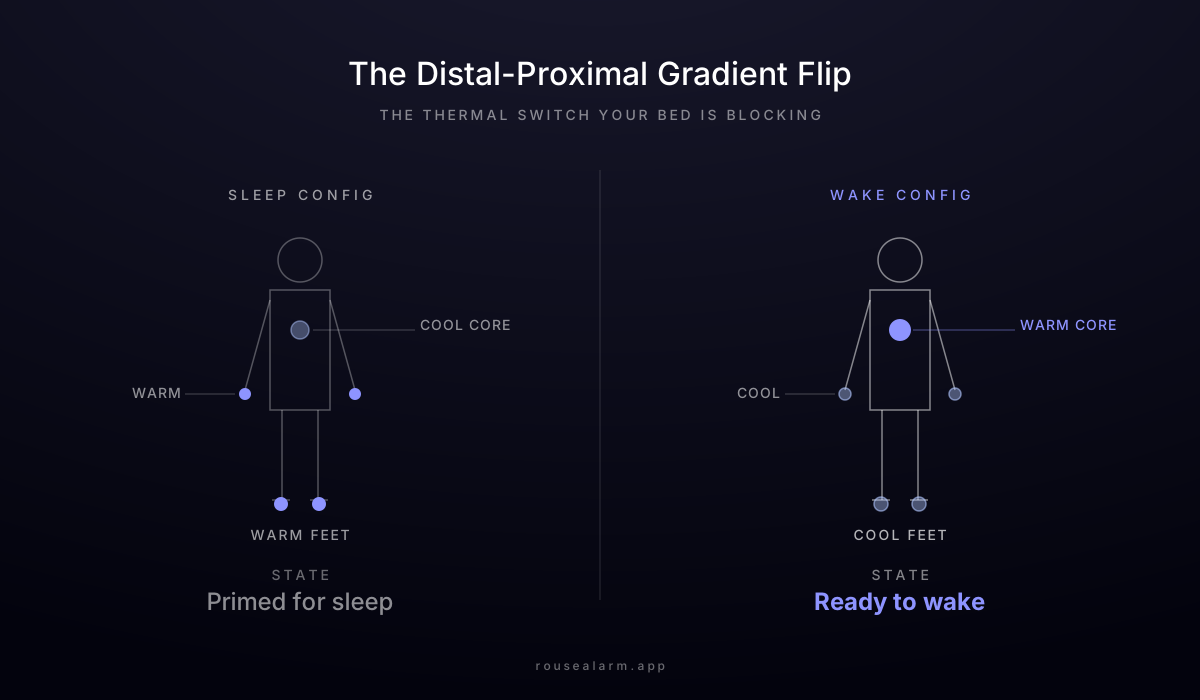
So stop and picture what a warm duvet is doing at 5 AM.
It's keeping your hands and feet warm. It's holding the sleep-config gradient in place. Your body can't flip the thermal switch because the bed is a device for preventing the flip.
A cold foot sneaks out at 5:07. It gets pulled back under within 30 seconds. That's not weakness. That's a body doing exactly what it's been designed to do, which is re-establish the sleep gradient whenever the environment allows.
That feeling of "I just need five more minutes"? That is, in part, your gradient still being wrong for wakefulness. Your brain is running a physically correct audit.
Sleep inertia keeps your executive function offline while you're trying to decide
Now layer the second problem on top.
Tassi and Muzet summarized it in Sleep Medicine Reviews back in 2000: the first 15 to 30 minutes after waking is a window of impaired cognitive performance called sleep inertia. Reaction time is slow. Working memory is fogged. Executive function, the part of the brain that picks between "gym" and "rest day," is still catching up.
A newer review by Hilditch and McHill in 2019 nails it harder: sleep inertia specifically impairs decision-making and goal-directed behavior. The brain areas that handle "do the hard thing I said I'd do last night" are literally the ones that aren't fully back online yet.
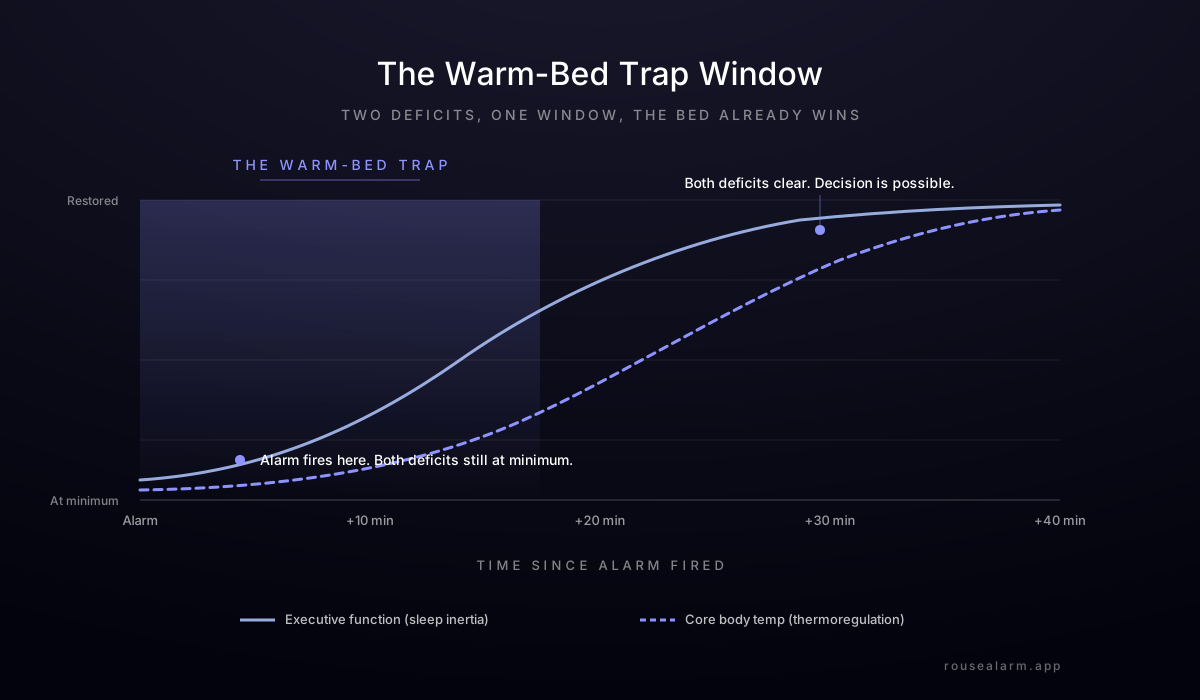
Stack this on the thermoregulation problem and look at what you've built for yourself.
- Your core body temperature is at its daily minimum.
- Your distal-proximal gradient is still in sleep configuration.
- Your executive function is offline for another 15 to 30 minutes.
- You are, in this moment, asking your brain to make the highest-stakes decision of its week.
This is the exact reason a fellow runner on r/running wrote the sentence that ate that thread alive: they spent 45 minutes negotiating a 35-minute run. They weren't weak. They were negotiating during a window when the brain is not capable of winning the negotiation on behalf of your goals. A comment further down put it even more cleanly: if you start thinking about the temperature while you're still under the covers, you've already lost.
The body that wanted to run last night and the body that is currently under the duvet are not the same body. One of them has a working prefrontal cortex and a core temp at daytime baseline. The other has neither.
The cold-shower trick is half-right. You just can't get to the shower.
Everyone in this genre has eventually told you to take a cold shower. They're not wrong about the biology. Cold exposure spikes sympathetic activation, accelerates the DPG reversal, and basically drags your body into wake config by force.
The problem is that the advice assumes you can get to the shower.
Which is the exact capability the dead zone is suppressing.
Same thing with "put the alarm across the room." Same thing with "open the curtains the moment the alarm rings." Same thing with "drink a glass of cold water you left on the nightstand." All of them require a version of you that's already won the thermal-cognitive lock-in to perform the action that breaks the thermal-cognitive lock-in.
It's the "you need money to make money" of wake-up advice.
You can also see this in the morning-meeting vs. morning-workout asymmetry. The 6 AM Zoom with your boss gets you up. The 6 AM workout doesn't. Same alarm, same bed, same body. The only difference is an external witness. Add social commitment and the dead zone is suddenly crossable. Leave the gym alarm unwitnessed and the duvet wins.
Whatever is going to get you out has to do one of three things: get you past the thermal lock before you've had to decide, occupy your cognition so you can't negotiate, or both.
What actually breaks the thermal-cognitive lock-in
The hack that always worked for me, accidentally, was a phone call from my dad. The one stimulus strong enough to pull me out of bed even on the worst morning wasn't a louder alarm. It was a voice. Because a voice isn't a thing I can dismiss. It's a thing I have to answer.
Think about what answering a phone call actually demands.
You have to sit up. You have to clear your throat. You have to speak in coherent sentences. Your tongue moves. Your breath pattern changes. Your posture changes. You have to form a memory of what the person on the other end said so you can respond to it.
Those micro-movements are not incidental. Sitting up changes your blood pressure and starts pulling heat away from your core's insulating position. Speaking coordinates breath, jaw, and diaphragm, all of which activate sympathetic tone. Orienting toward the phone rotates your body, which starts to open the thermal envelope the bed was holding shut.
By the time the call ends, your DPG has already started flipping. Your prefrontal cortex has been forced into a conversation, which is the single thing most likely to drag it online faster. You haven't "decided" to get out of bed. You've already done all the physical things that getting out of bed requires.
That's the mechanic I wanted every morning, without needing an actual person on the other end.
That's why Rouse uses a conversation instead of a button. You can't "dismiss" a voice asking you a question. Not with a swipe, not with a math puzzle, not by shaking the phone. Your tongue, breath, and posture are the first things that move. And those three movements are exactly what your body needs to flip the distal-proximal gradient before the sleep-maintenance system gets another chance to win.
Not discipline. Not motivation. Not willpower. Willpower at 5 AM is borrowing money from a bank that's closed anyway. The only thing that works is making the first thing your body does in the morning something other than lying perfectly still under an insulated thermal envelope.
Closing
Your duvet is engineered for the exact thing you're trying not to do. You do not need more motivation. You need a way to occupy the first sixty seconds of consciousness so the bed can't win the negotiation before your brain has shown up for it.
If the bed keeps winning the 5 AM fight, set Rouse for tomorrow morning and see if occupying your mouth first changes the outcome. I'd love to know if it lands.