You'll Wake Up for a 6 AM Meeting But Skip a 6 AM Workout. Here's Why.
Same person. Same 6 AM. Different outcome. Turns out it's not a discipline gap. It's a witness gap, stacked on top of the sleep inertia window.
April 18, 2026
You'll Wake Up for a 6 AM Meeting But Skip a 6 AM Workout. Here's Why.
Same body. Same sleep. Same 5:45 alarm. Different outcome. Turns out there's a name for this.
Set my alarm for 5:45 on a Tuesday. Gym bag already packed, shoes by the door, the whole operation.
5:45 came. I turned it off in the dark and slept another ninety minutes.
Two days later, same body, same sleep, same 5:45 alarm. This time it was a Zoom with a client in London. I was upright, coffee brewing, fake-awake voice locked in, before the second ring.
Same morning. Same me. Completely different outcome. And the difference had nothing to do with how much I wanted to go to the gym.
In this post, you'll learn:
- Why the bed-vs-gym call happens during a window when your brain can't actually make good calls
- The witness gap every meeting closes and every solo workout leaves wide open
- What collapses both forces at once, and why every "lay out your clothes" tip is treating the wrong thing
7 min read
The decision isn't getting made when you think it is
You think the decision got made at 9 PM, when you packed the bag.
It didn't. The real decision gets made at 5:52 AM, in the dark, by a version of you that's not fully online yet.
There's a name for that version. Sleep inertia. It's the 15-to-30-minute window after you wake up where your brain is running at a fraction of its normal capacity, the prefrontal cortex is slow to boot, and decision-making is, for practical purposes, offline.
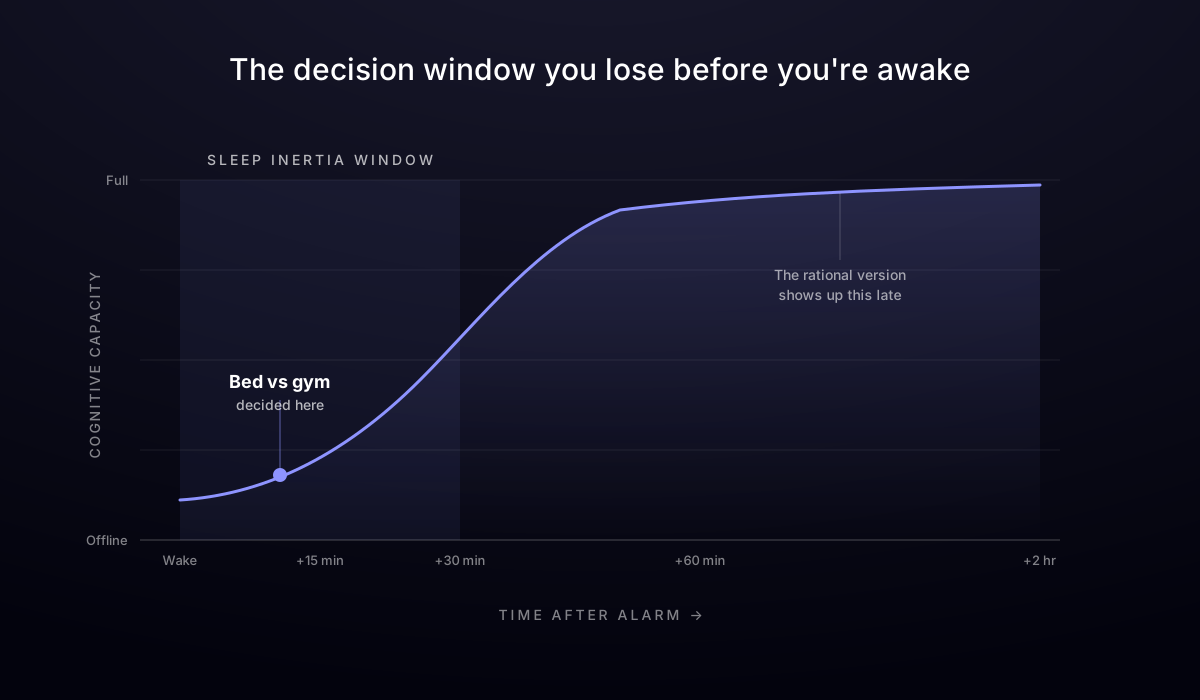 Motor control fine, sure. Judgment, not so much. Research (Tassi & Muzet 2000, Sleep Medicine Reviews) on sleep inertia has described post-wake cognitive performance on certain tasks as worse than the same people would perform after mild alcohol intoxication, which should give you a sense of the deficit. You're not making a sober call.
And this is where the bed-vs-gym negotiation happens. Not over dinner. Not while you're packing the bag. It happens at 5:52 AM when your monkey brain is running the math and coming back with "bed is warm, cozy, restful. The gym is none of those things."
Watch the negotiation in real time. I've done this one maybe four hundred times.
5:45 AM. Alarm.
5:46. "Five more minutes."
5:51. "I didn't sleep great, I'll go after work."
5:53. "Actually I should rest and go tomorrow morning instead."
5:54. Out.
That whole decision tree got run by a version of me operating at half capacity. The rational version of me, the one who packed the bag, never got a chance to weigh in.
If you've ever woken up an hour later and thought "what did I agree to back there," that's sleep inertia. The decision got made while the lights were off.
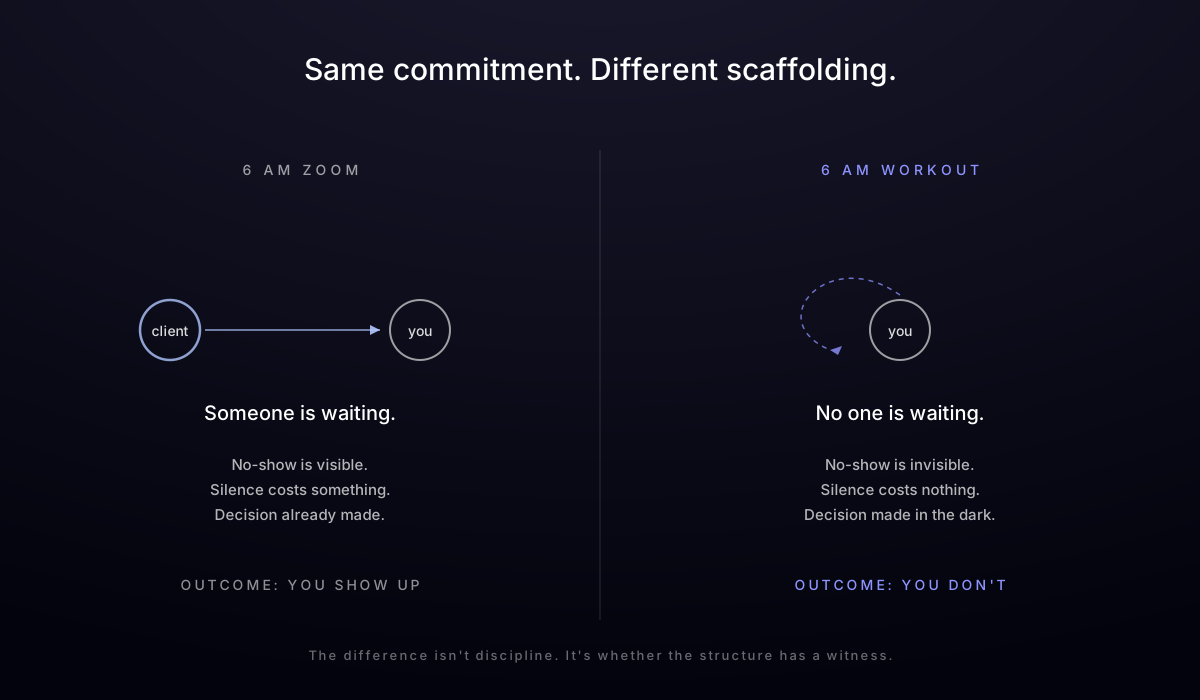
The 6 AM meeting has a witness. Your gym session doesn't.
Here's the part nobody writes about.
The Zoom with the London client wasn't beating the gym because it was more important to me, or because I cared about it more, or because I was somehow a more disciplined version of myself when the calendar invite said "1:1 sync" instead of "deadlift day." It was beating the gym for one unglamorous reason, and the reason was that someone was on the other side of it.
There's a name for this too. Commitment and consistency, which is Cialdini's entire first principle of persuasion. When a commitment is public, and somebody is expecting you to follow through, your brain treats it as a different category of commitment than the one you only made to yourself. Implementation-intentions research (Gollwitzer, 1999, American Psychologist) shows the same thing from a different angle. Plans with a specific trigger and a specific social context get kept. Plans without one drift.
A workout you committed to in your head has zero of those variables. Nobody is watching. Nobody will notice. Nobody's calendar has you in it. Nobody's going to ask tomorrow "where were you this morning."
Compare that to every other 6 AM commitment you keep. The flight with the check-in deadline. The job interview. The meeting with a new client three time zones east. Each one of those has a witness. Each one punishes a no-show. The decision at 5:52 AM, made by the half-online version of you, lands differently when there's a cost attached that you can feel.
The coach of a 6 AM strength class I used to go to said something I've been thinking about for a year. Every January a new batch of converts trickle in. By February, only one or two manage to stick. Why? My theory: early January, the coach notices who walked in. The people around you notice who walked in. There is, for a brief window, a witness. By February the crowd is thin and nobody's tracking attendance. You're back to a private commitment. Private commitments evaporate during sleep inertia.
This is not a discipline problem. This is a design problem. The gym session is the one commitment in your week that structurally removes the witness.
Which is why every conventional fix fails. Alarm across the room works for about three days, then the walk becomes procedural. Clothes laid out work for maybe two weeks, then they're furniture. Accountability buddy works until they flake in week four, because they're losing the same negotiation you are, at the same 5:52 AM. All three of these fixes are treating the sleep inertia side of the equation and ignoring the witness side completely.
The negotiation you're losing is a two-mechanism problem, and every generic morning-motivation post on the first page of Google is solving one half of it.
Two forces stacked, one actual solution
Here's what I figured out after about a year of losing this negotiation on repeat.
The only thing that consistently got me out of bed for a workout was a human being who was actively expecting me, in the room, at 5:55 AM, waiting for a response and not willing to accept silence as one. Not a buddy who texted the night before. A human on the other side of the room, at the other end of a hallway, asking a question out loud. My partner, one stretch, yelled my name across the apartment every morning for a week while I was still half underwater, and I got up every one of those mornings because she wasn't letting me renegotiate. Then she stopped yelling, and within three days I was back in the negotiation.
That's the whole pattern. Cortical load on one side (she was making me produce speech, which is an executive function), and an external witness on the other (she was actively there). Both mechanisms collapsed at the same time. No sound-based alarm does that, because sound is passive. It doesn't require a reply. It doesn't care if you reply.
That's what Rouse does. The alarm starts a conversation. You have to answer. And if you don't answer, the conversation keeps happening. It's not a sound to tune out. It's a voice waiting on a reply, which is the thing every morning meeting has and every solo workout is missing.
I'm not going to dress this up. It's the first thing I've used that treats the morning workout as a two-mechanism problem instead of a willpower problem. The conversation keeps the cortex loaded during the inertia window (try negotiating "five more minutes" with something that's asking you a question back). And because the voice is actively waiting on you, the witness effect is baked in. You can't silently no-show the conversation. Either you engage or it keeps going.
The thing that clicked for me, and the reason I'm writing this post at all, is that the alarm doesn't have to become a person. It just has to behave like one. It has to expect a reply and not accept silence as a reply. Once you see the problem as a witness gap, the fix isn't "try harder tomorrow." The fix is change the structure so there's somebody on the other end.
One last honest thing
The January-class dropoff isn't about fitness commitment. It's about what the 6 AM class had in early January that it stopped having in February. Somebody was watching. The watching stopped. The class emptied.
The version of yourself who shows up for the 6 AM Zoom is the same version who would show up for the 6 AM workout, if the 6 AM workout had the same scaffolding. The person you are when you know somebody is waiting is not a different person. It's the same person, in a different design.
If you've been losing the bed-vs-gym negotiation for longer than you'd like to admit, set Rouse for tomorrow morning and see what happens when the alarm talks back. I'd love to know if it lands.