You Spend 45 Minutes Negotiating a 35-Minute Run. Here's Why.
The pre-workout argument isn't weakness. It's a deliberation trap named in the psych literature, and your alarm drops you straight in.
April 20, 2026 · Updated April 20, 2026
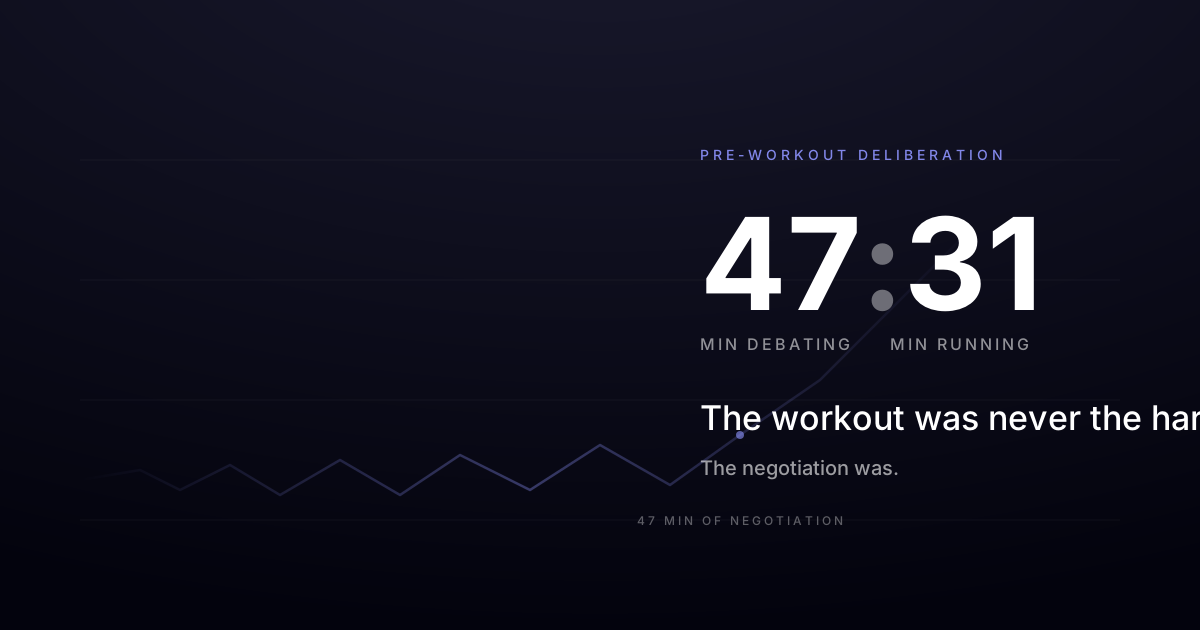
You Spend 45 Minutes Negotiating a 35-Minute Run. Here's Why.
The pre-workout argument is longer than the workout. It's also not a character flaw. It's a two-phase problem the psychology literature already named.
Last winter I set my alarm for 5:15 with my running shoes next to the bed. I woke up at 5:15. Got out the door at 6:02. Ran for thirty-one minutes.
I spent forty-seven minutes arguing with myself to do a thirty-one-minute run.
Turns out there's a name for this, and it's the same reason every pre-workout pep talk you've ever given yourself collapses.
It's called the deliberation trap, and your alarm drops you straight into it.
In this post, you'll learn:
- Why the negotiation before a workout is mechanically different from the workout itself
- The research that says you systematically predict the workout will feel worse than it does
- Why no "lay out your clothes the night before" tip has ever actually fixed the problem
7 min read
The workout was never the hard part
Every serious runner I've ever met describes the same loop. Alarm goes off. Brain starts the ledger. Too cold. Legs feel weird. Maybe tomorrow. One more minute. Then forty-five minutes later you're finally out the door, the run itself turns out to be completely fine, and you finish thinking "that wasn't bad, I should do this more often." And the next morning you get out of bed and run the exact same forty-five-minute negotiation before the exact same thirty-minute run.
There's a thread on r/running from a few months back with 1,731 upvotes and 271 comments where someone wrote this out almost word for word:
"Spent 45 minutes this morning negotiating with myself about whether to run. Finally got out the door. Finished the run in 35 minutes. The run itself is never the hard part. It's the 47 layers of mental excuses beforehand."
271 comments. All some version of "yeah, same." The top reply had thirty upvotes and one line:
"I can count on one hand the number of times I have felt motivated to run, and I can also count on one hand the times I have regretted a run."
One hand each. Thousands of people, one hand each.
That asymmetry is the clue. The run was fine. The negotiation was the thing that hurt. And the reason it keeps hurting on autopilot is that all the fitness content telling you to "just push through" is quietly treating the run and the negotiation as the same problem, when they are two completely different cognitive states running on two different pieces of hardware. They aren't the same thing and they don't break the same way.
Your brain has two gears and your alarm picked the wrong one
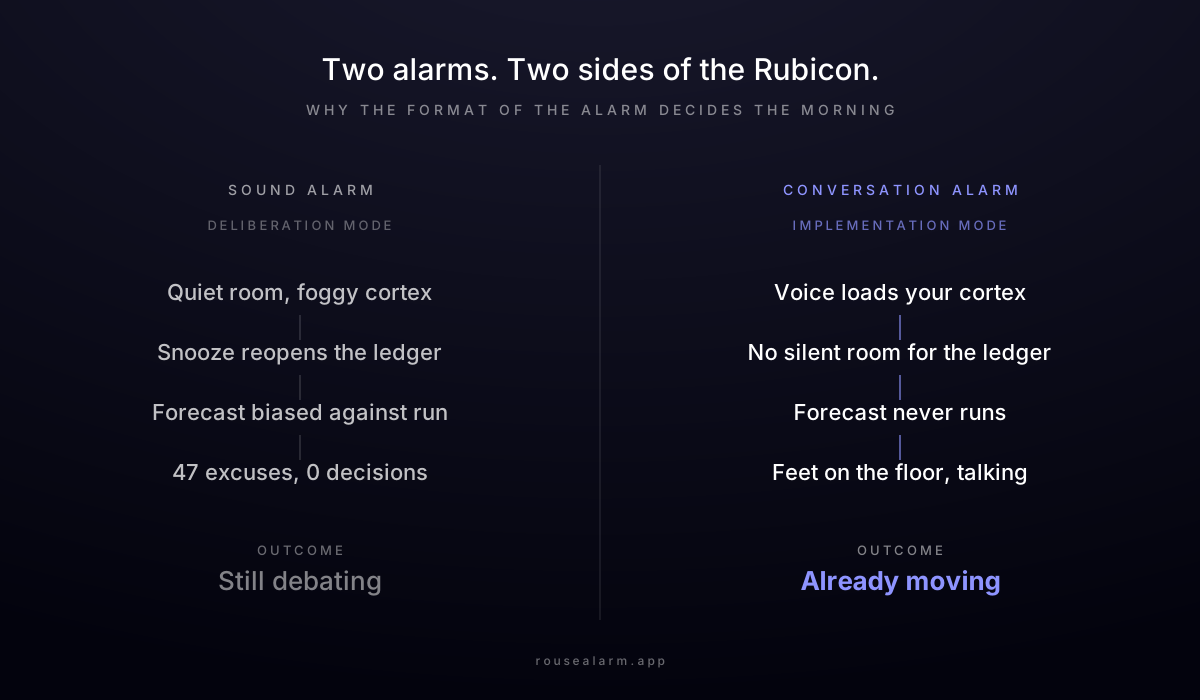
In the 1980s a German psychologist named Peter Gollwitzer mapped out what he called the Rubicon model of action phases. The short version: your brain has two very different modes. Deliberation mode (weighing goals, costs, alternatives) and implementation mode (already committed, now figuring out the how). Between the two sits a psychological Rubicon. Once you cross it, the ledger closes. You stop debating whether. You start executing.
Here's the part that wrecks the morning workout.
A regular sound alarm drops you in deliberation mode. Every time.
You wake up in a warm bed with the cortex still half-online, the alarm stops ringing and then disappears, and now you're lying there with a huge open question (should I go), soft sheets (cost: pleasant), a cold floor (cost: unpleasant), and absolutely no external pressure pulling you across the line into implementation. Your brain does the only thing it knows how to do in that configuration, which is deliberate. Weigh. Negotiate. Spin.
And the snooze button re-opens deliberation every time you hit it. You don't progress toward a decision. You reset to frame one.
This is why the five-more-minutes lie isn't a lie. Five more minutes is what it feels like, because in deliberation mode time doesn't move forward, it just keeps reloading the same question.
The forecast is broken in a very specific way
Now stack a second mechanism on top of that.
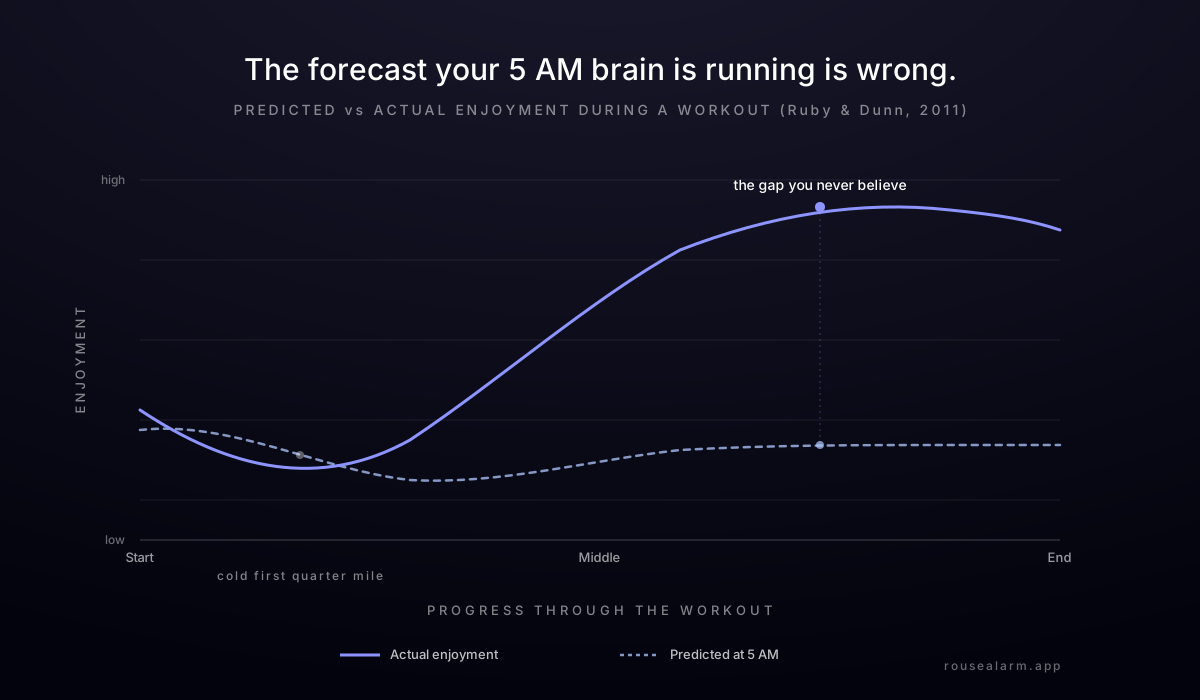
In 2011, Matthew Ruby and Elizabeth Dunn ran four studies with 279 adults at UBC. They asked people to predict how much they'd enjoy a workout, then had them actually do the workout, then asked again. Yoga, Pilates, cardio, weights. Didn't matter. Across every format, the prediction was significantly worse than the experience. People systematically underestimated how good exercise would feel.
The paper called it the invisible benefits of exercise. I'd call it the reason the morning negotiation is rigged.
Your brain is running a forecast at 5:15 AM. It's asking "how much is this run going to suck." The forecast is biased. It's focused on the unpleasant opening of the workout (the cold first quarter mile, the lungs burning) and it's systematically skipping the middle and end, where you settle in and feel great. This is a known cognitive pattern called the impact bias, and it's been replicated for decades.
So the ledger your brain is running in deliberation mode isn't even a fair ledger in the first place. The benefits get discounted, the costs get spotlit, and the whole debate runs on a forecast that's biased against the thing you actually want to do. No wonder it takes forty-five minutes to win an argument against yourself. You're arguing against a broken forecast with a foggy cortex.
Worth pointing out: this is also why the run itself almost never regrets itself. "I never regret going, I often regret skipping." You're remembering what actually happens. The you in bed is predicting what might. Those two brains don't share notes.
Sleep inertia is the reason the negotiation even starts
One more layer, because this gets asked a lot.
The first five to fifteen minutes after you wake up is called sleep inertia. Prefrontal cortex hasn't fully come back online. Decision-making, working memory, conflict monitoring. All degraded. Research on sleep inertia shows executive function can stay impaired for up to thirty minutes, and the impairment is worse when you wake from deeper sleep stages.
So picture what actually happens at 5:15.
Alarm fires. Cortex is offline. You're in deliberation mode with a broken forecast running on a half-lit brain. You're being asked to win a debate against a version of yourself that is, biologically, the least capable of debating you'll be all day.
You don't lose because you're weak. You lose because the deck is stacked. If you want to understand the full structure of that stack, I wrote about the two-self economics that stack the deck every single morning. And then the fitness content tells you the answer is to want it more, which is like telling someone with a 38-degree fever to just cheer up.
What the top-voted coping techniques are actually doing
Read enough r/running and r/fitness threads on this and the same three fixes surface:
- Just run for five minutes, then decide
- Put your shoes on, then decide
- Commit to a race or a training partner — this one works because of the witness-gap reason the same run has a 6 AM Zoom's outcome when a coach is waiting
Look at what they all have in common. They're not motivation tips. They're implementation intentions (if-then plans that Gollwitzer showed can double behavior follow-through) that smuggle you across the Rubicon before your brain notices. "If alarm goes off, then shoes on, no decision." "If I'm on the trail, then I run for 5, no decision." You're not winning the argument. You're moving the argument out of scope.
They work. But they all leak at the same place: the snooze. The second you hit snooze, deliberation re-opens — you're back inside the 15-minute window where any decision you make is made by the wrong version of you. The implementation intention gets a second vote. It has to keep winning, morning after morning, against a broken forecast and a foggy brain.
That's why the techniques work great for some people and then stop working the week work gets stressful or you slept five hours. The margin isn't big.
What actually collapses the deliberation phase
I built Rouse because I got tired of this exact loop. Not the running one. Mine is the gym one. Same mechanism. Alarm fires, warm bed, broken forecast, foggy cortex. Lost the argument more often than I won it.
The thing that finally flipped it wasn't motivation. It was removing the buffer.
When your alarm is a conversation (Rouse wakes you by starting a voice chat that you have to actually respond to), there's no silent room for the ledger to even open in the first place. Your cortex is already loaded with questions it has to process right now, in real time, out loud. You're not weighing "gym or bed" because you're busy answering the AI that just asked you what you're lifting today and whether your knee still feels weird from Tuesday. By the time the conversation ends you're already on your feet, talking, oriented, no longer in deliberation mode. You crossed the Rubicon without ever holding a vote.
This maps cleanly to both mechanisms. Conversation defeats deliberation (the ledger never opens). Conversation defeats the broken forecast (you never get quiet enough to run it). And because the exchange is always novel, the alarm doesn't habituate the way a repeated sound does.
It's not magic. It's just refusing to give your 5 AM brain the one thing it needs to talk itself out of going.
One practical thing you can try this week
If you've got a 6 AM workout tomorrow, here's the thing I'd test.
Before you hit snooze once, ask yourself out loud: "Am I deliberating, or am I executing." Say it out loud. It's an absurd-feeling sentence. That's the point. Saying it out loud forces your cortex to process language, which interrupts the silent ledger for about ten seconds. Long enough to get your feet on the floor. Once they're on the floor, you've crossed. The forecast doesn't matter after that.
It's a cheap hack version of what Rouse does automatically, and it'll work sometimes. It's the difference between flipping a coin ten times hoping for heads and flipping a coin weighted for heads. Same game, different odds.
By the way, if you've already tried every coping technique in the r/running thread and you're still losing most mornings, set Rouse for tomorrow. Give it a week. I'd love to know whether collapsing the deliberation phase does for you what it did for me.
The run was never the hard part. The negotiation was.