The Trade You Made When You Started Training: Deeper Sleep Bought With a Harder Wake-Up
Regular training rebuilds your slow-wave sleep. Slow-wave sleep has the highest arousal threshold in the cycle. The math is doing exactly what you'd expect.
May 1, 2026
The Trade You Made When You Started Training: Deeper Sleep Bought With a Harder Wake-Up
It was 5:42 AM and the alarm was on its fourth tone in a row when I finally registered it. I'd been training three days a week for nine months. My resting heart rate had quietly dropped from 64 to 52. My Garmin "deep sleep" graph had been climbing month after month and I'd been quietly proud of it.
I'd also missed every 5 AM alarm in the last two weeks.
Turns out the recovery I was building also moved the needle on how loud the world has to be before I notice it.
I assumed for a long time that this was a discipline problem on the back end of hard Sunday sessions. Read the journal. Set two alarms. None of it was the variable. The variable was that the same training pattern that was making me fitter was also making my deepest sleep deeper, and my brain was protecting that sleep harder than it had a year ago.
If you've started a real training block in the last twelve months and noticed your alarm has slowly stopped working, this post is about the trade you signed up for without reading the second page.
In this post, you'll learn:
- Why slow-wave sleep is the part of the night your brain protects hardest, and what that means for any tone trying to break through
- How regular training quietly rebuilds the architecture of your night, with the receipts from the published literature
- Why the gap between your alarm and your arousal threshold widens the fitter you get, and the one stimulus shape that doesn't get crowded out
7 min read
The deepest sleep you have is the sleep your brain refuses to leave
Sleep isn't one thing. It runs in cycles, and inside those cycles you pass through stages with very different physiology. Light NREM (N1, N2). Slow-wave sleep (N3, also called deep sleep). REM. Each one has a characteristic EEG signature and a characteristic arousal threshold.
The arousal threshold is exactly what it sounds like. It's how loud, bright, or physically intrusive a stimulus has to be before it pulls you out of that stage and into wake.
Here's the part most people don't know.
Slow-wave sleep has the highest auditory arousal threshold of any stage in the entire night.
The summary in StatPearls' Physiology, Sleep Stages is blunt about it. N3 has the greatest arousal threshold of all stages, and for some sleepers, sounds above 100 dB will not produce a wake state. A hundred decibels is roughly a chainsaw at four feet. The classic Bonnet auditory-arousal-threshold protocols going back to 1978 have measured this for decades using calibrated tone bursts. The thresholds are not quite as comically high for everyone, but the rank order is rock-solid: N3 is the wall, N2 is lower, REM is in between.
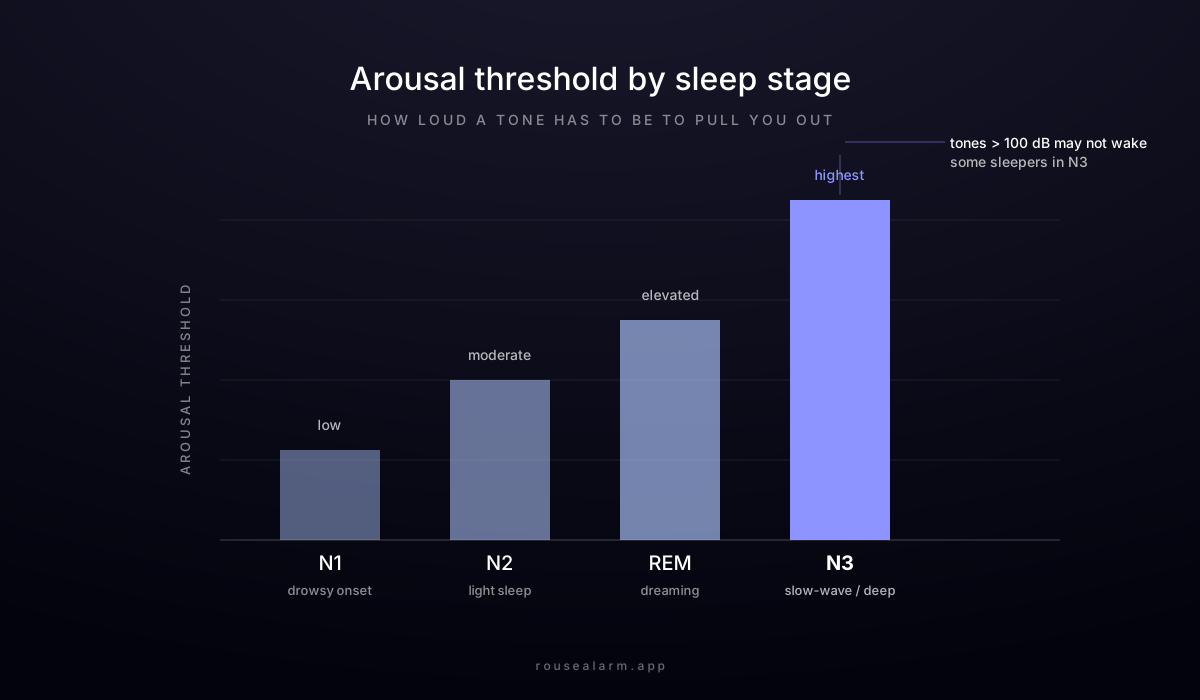
When the alarm fires at 5:42 AM and you're in the back half of an N3 cycle, the room can be loud and your brain can be busy not noticing. That isn't laziness or willpower. That's the central nervous system doing its job. Slow-wave sleep is when your body does heavy structural work (growth hormone release, glymphatic clearance, immune consolidation) and the threshold for breaking that work is dialed up on purpose.
I've laid in bed and watched my partner's face contort as the alarm crossed its third tone. She heard it instantly because she was in N2. I was three feet from the same speaker and I was not in the room.
When the tone hits during N3, your nervous system has a defended position. Volume is climbing a wall it didn't build.
Training quietly remodeled your sleep architecture, and no one warned you about that side of it
Here's where the trade gets sharper.
When you train consistently, your body changes how it sleeps. This isn't a vibes claim. The cleanest summary is Kredlow and colleagues' 2015 meta-analysis in Journal of Behavioral Medicine that pulled 66 studies through 2013 and ran the numbers. Acute exercise produces small beneficial effects across the board: total sleep time, sleep onset latency, sleep efficiency, slow-wave sleep. Regular exercise produces small-to-moderate beneficial effects on sleep quality. The signal is consistent and it points the same direction every time.
The mechanism for why you're sleeping deeper has been worked out in detail. Vyazovskiy, Riedner, Cirelli and Tononi's 2007 paper in Sleep and the broader synaptic-homeostasis line of work (Tononi & Cirelli) showed that slow-wave activity is a marker of how much synaptic load you accumulated during the day. Training is synaptic load. New motor patterns. Recruited motor units. Conditioning adaptations. The bigger the load, the bigger the slow waves your brain runs that night to consolidate it.
If you want a single concrete number from a single study, Kawabata, Karashima & Nakao's 2021 paper in Scientific Reports measured delta power inside N3 at 108.4 ± 13.9 μV² in the exercise condition and 92.0 ± 14.6 μV² in the no-exercise control. That's roughly an 18 percent jump in slow-wave amplitude, plus increased slow-wave stability across early sleep. Your N3 isn't only a little longer. The waves themselves are taller.
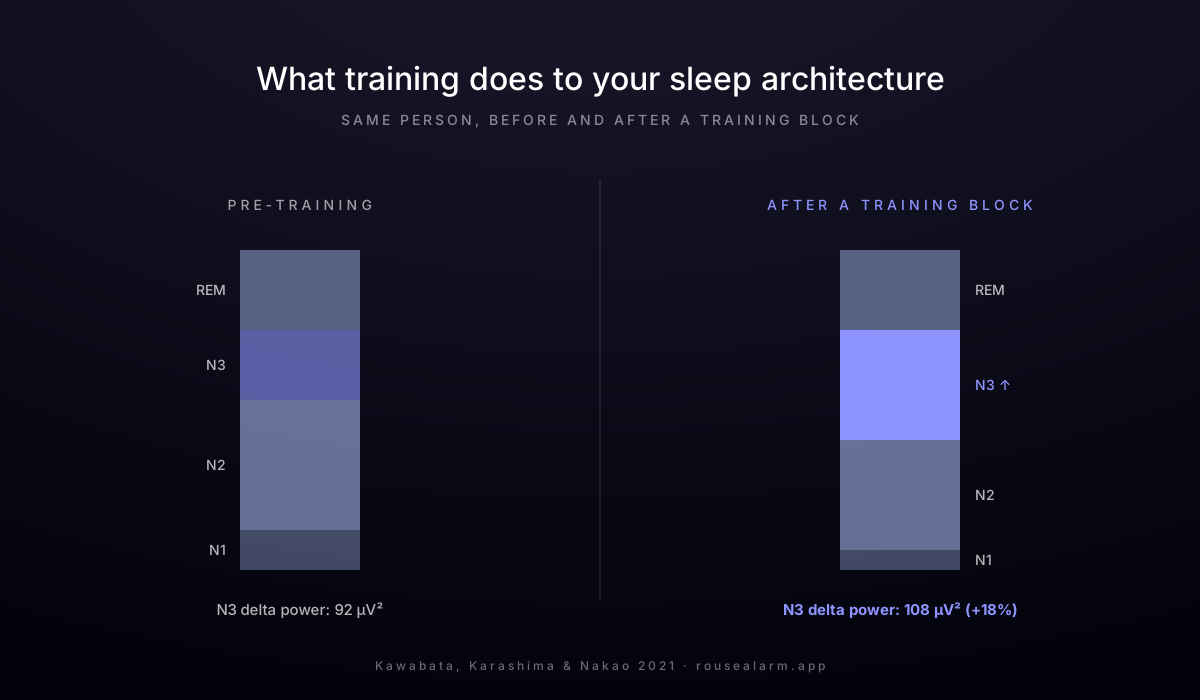
That Garmin "deep sleep" number you've been quietly proud of is measuring exactly this. The recovery score is real. The recovery score is also what's on the other side of the wall the alarm is trying to climb.
This is the same story I was telling about thermoregulation in the warm-bed trap I wrote about earlier this month. Trained bodies do things to themselves to make recovery cheaper, and most of those things make waking up harder. The duvet trap is the surface version. The slow-wave version is what's underneath it.
If you track training and sleep, look at the numbers. Your weekly volume is up. Your deep sleep score is up. Your morning misses are up. The lines move together. That's the contract.
Habituated tone, deeper sleep, and the gap that opens between them
Now stack the second mechanism.
Tones lose their grip with repetition. That's habituation, formalized by Thompson & Spencer in 1966 and folded into Sokolov's orienting-response framework. The brain has a filter that says "novel = pay attention, predictable = ignore," and any tone you wake up to every weekday gets reclassified into the second bucket fast. By the time a sound has fired into your bedroom for ten consecutive mornings, your nervous system has filed it next to the refrigerator hum and the radiator click. Same filter that lets you tune out a ceiling fan.
Most sound alarms try to fight habituation with volume. Buy a louder one. Buy a vibrating pad. Buy a Sonic Bomb. I tried this. I owned the Sonic Bomb. I owned a sunrise lamp and a vibrating pillow that cost a hundred and eighty dollars. Each one worked for about a week and then sat next to the rest of the alarm graveyard while I slept through the next thing.
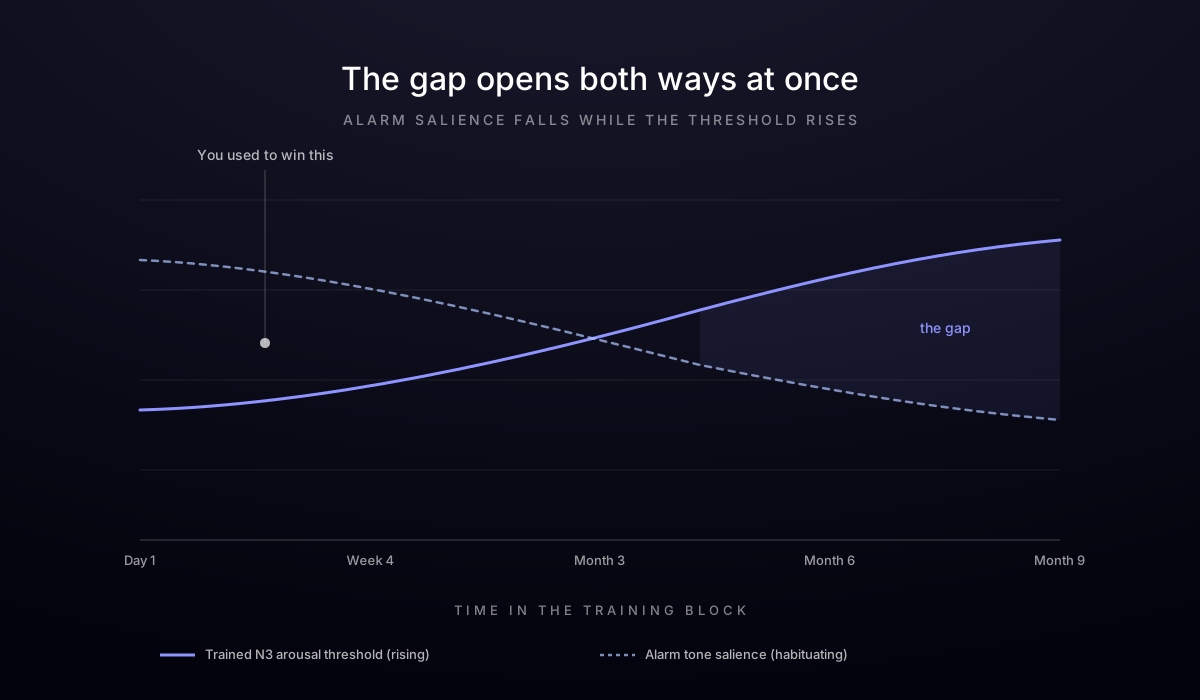
Volume isn't the variable. The variable is the gap between the stimulus your alarm is producing and the threshold the brain is currently defending. Habituation makes the alarm side of the gap smaller every week. Training makes the threshold side of the gap bigger every month.
You're losing on both ends.
And even when the alarm does break through and you do press dismiss, there's a third thing happening that nobody tells fitness people about. The first 15 to 30 minutes after waking is sleep inertia. The canonical reviews are Tassi & Muzet 2000 and Hilditch & McHill 2019. Both confirm the same picture: motor regions reboot fast, the brainstem is fine, but the prefrontal cortex (the part that would actually decide "okay, gym shoes, let's go") is the last region to come back online. Vallat 2018 in NeuroImage showed that during sleep inertia the brain looks more like the default-mode network than the task-positive network you'd want for goal-directed action.
So when the alarm finally pulls you out of N3, what comes online first is the part of your brain that can press a button without waking the rest of you up. The procedural-memory dismiss happens in roughly 0.8 seconds. You're back in N2 by the time your hand returns to the mattress. There's no record of the alarm in your morning memory because the part of your brain that records mornings was still booting.
The Sonic Bomb era taught me this without me knowing the words for it. I was turning up a tone my brain was filing as background, into a defended sleep stage that wasn't going to give it the time of day. The deeper my training got, the faster the trick stopped working.
You can't out-volume biology that's specifically designed to protect deep sleep. You can change the kind of stimulus you're firing into the room.
What does cut through
Once the bottleneck is named, the fix has a shape.
The stimulus that can break N3 and doesn't habituate is one that requires the prefrontal cortex to come online to handle it. Not just the orienting response. Not just a finger press. Cognition. Active retrieval. Language production.
The only thing that ever woke me up reliably in the Sonic Bomb era was a phone call from my dad. The phone call wasn't louder. The phone call required answering. My brain couldn't dismiss it on autopilot because there was nothing to dismiss until I'd put my mouth on it.
That's the same trick I described in moving before motivation wakes up: the morning is won by routing around the part of your brain that's still booting, not by trying to make it boot harder. A stimulus your prefrontal cortex has to answer pulls it online. Once the PFC is in the room, you're awake in the way the word actually means.
That's why Rouse uses a conversation. Not because talking is novel. Because generating language is the one thing your brain can't autopilot through during the dismissal window. The voice asks, you answer, the answer requires retrieval, retrieval requires the prefrontal cortex, the prefrontal cortex coming online is the actual definition of awake. The conversation is also different every morning, so the habituation filter has nothing to file it under.
The first morning I shipped Rouse to my own phone, I noticed something new. I remembered the moment of waking up. The tone era had no memory attached to it because nothing in the dismiss process required the part of my brain that remembers. Once the wake-up was a conversation, I had a conversation in my head an hour later. The PFC had been there. It had recorded the morning.
If you train hard and you're losing alarms, that's not a discipline problem. It's a math problem. You can't fix it on the volume side. You change the channel.
The takeaway
The fitter you get, the deeper your N3, the higher the wall a tone has to climb. Add habituation, and the wall goes up while the alarm goes down. Volume hits a ceiling. A different shape of stimulus doesn't.
If you've already turned the volume up twice and it's working less than it did six months ago, set Rouse for tomorrow morning and tell me whether the conversation actually pulls you out before the alarm gets to its fourth tone. That's the part I built it for.