You Don't Need Morning Motivation. You Need to Move Before Motivation Wakes Up.
Every 5 AM workout thread says "go before your brain wakes up enough to argue." There's a neurological reason that works, and nobody writes about it.
April 23, 2026
You Don't Need Morning Motivation. You Need to Move Before Motivation Wakes Up.
The top Reddit comment on how to survive a 5 AM workout is "go before your brain wakes up enough to argue with you." There's a neurological reason that works, and nobody writes about it.
I wasted a lot of mornings thinking I was broken.
Alarm at 5:15. Lie there running a full internal debate. Too cold. Legs feel weird. Thursday would be better. Forty minutes later either at the gym wondering why I'd burned half the morning in bed, or still in bed watching the window for "gym" quietly shut.
Then I started reading what the people who actually go at 5 AM say, and it knocked me sideways. They're not wiser. They're not tougher. They've just figured out not to think.
"I just have to show up and my brain is engaged the entire hour - no time to talk myself out of it!" — r/xxfitness
No time to talk myself out of it.
That exact phrase turns up in seven different Reddit threads across r/xxfitness, r/crossfit, r/orangetheory, and even r/ADHD. Hundreds of comments each. All variations of the same move: go before your brain is awake enough to stop you.
Turns out the 5 AM gym crowd has been teaching me neuroscience without knowing it.
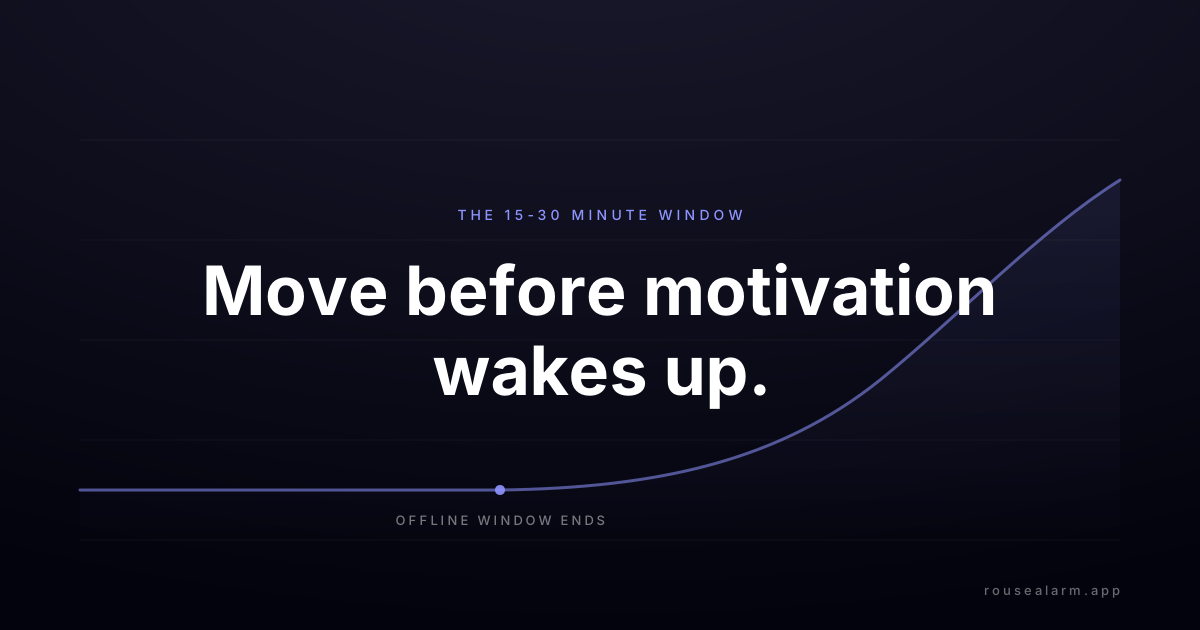
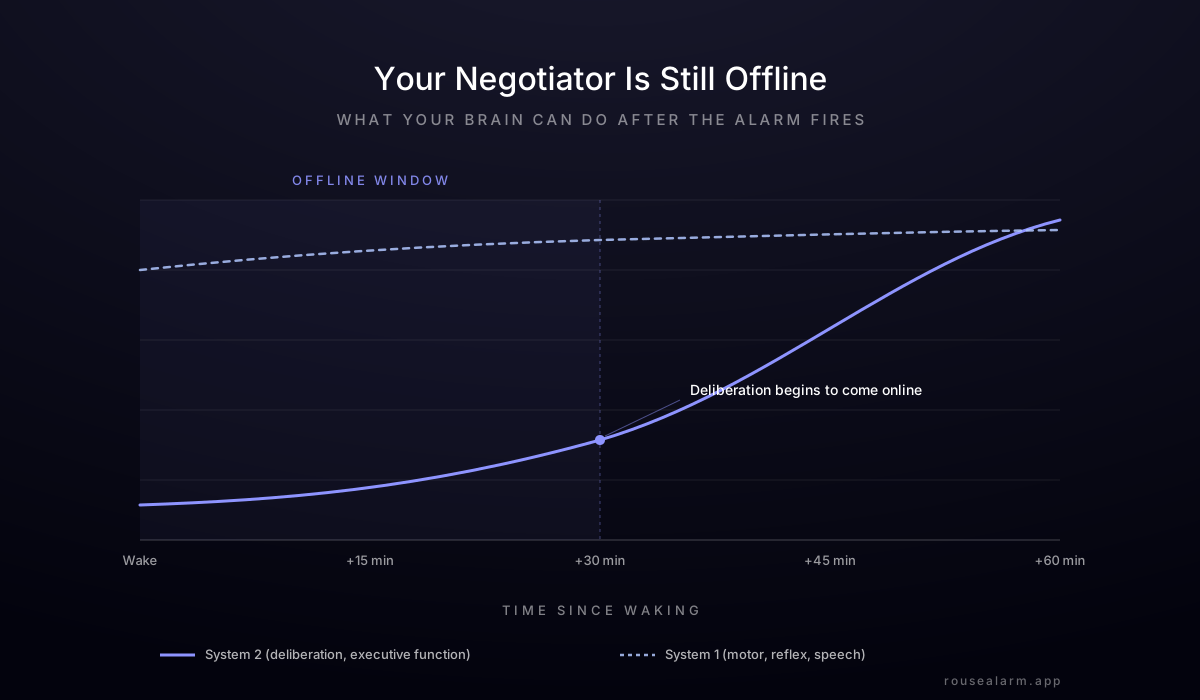
You can't win a morning workout argument against yourself because the argument isn't fair. For the first 15 to 30 minutes after your alarm fires, the part of your brain that executes a plan is already online. The part that negotiates against it is still booting. If you start moving during that window, you win by default.
In this post, you'll learn:
- Why your prefrontal cortex is functionally offline for up to thirty minutes after you wake
- The dual-process reason "don't think, just go" is the winning strategy, not laziness
- Why every "lay out your clothes" tip is really the same trick in different clothing
- How a conversation can hijack the window that raw willpower never reaches
7 min read
The 5 AM crowd is describing a real neurological window
Dig into r/xxfitness, r/crossfit, r/orangetheory, r/ADHD. Same phrase over and over.
"If I roll out and go, I have no time to talk myself out of it. Along the same lines, I found that if I plan my workout in advance, I can jump right in without thinking." — r/xxfitness
"6 am because I have no time to talk myself out of it!" — r/crossfit, "Crazy Crossfit at 5:30am people: How? Why?"
"So it's either morning or never. Also if I just get out of bed and go I have no time to talk myself out of it like I do all day at work!" — r/orangetheory, "People who exercise early morning"
"Exercise 1st thing in the morning. (no time to talk myself out of it). Have my clothes, items and everything else i need laid out night before." — r/ADHD
Nobody in those threads is selling anything. Nobody's a productivity guru. They're just people reporting what actually works. And what works isn't "find your why" or "visualize the finish line." It's the absence of thought.
Which is weird, because every listicle on morning workout motivation frames the problem as a thought deficit. Think harder. Want it more. Remember your goals.
The people getting out the door are telling you the opposite. Don't think at all.
If you know where to look in the sleep research, there's a very specific reason they're right.
Your prefrontal cortex doesn't wake up on the same schedule you do
The technical term is sleep inertia, and it's been studied for decades. Tassi and Muzet's 2000 review in Sleep Medicine Reviews put numbers on it: executive function is measurably impaired for 15 to 30 minutes after waking, and the impairment is worse when you wake out of deeper stages of sleep. Not "you feel groggy." Working memory, attention, conflict monitoring, decision-making. All dragging at once.
A 2019 review in Nature and Science of Sleep updated the picture. Performance deficits during inertia can rival or exceed the impairment of legal blood-alcohol intoxication. Pilots and emergency responders get explicitly trained around this window because it's dangerous to make important calls during it.
Then in 2018, Vallat and colleagues in NeuroImage put people in fMRI scanners during the inertia window and watched the actual mechanism. Two large brain networks that are normally anti-correlated in alert adults, the default mode network (associated with inward thinking and deliberation) and the dorsal attention network (associated with executive action), showed collapsed segregation. They were running together instead of trading control cleanly. Translation: the circuitry your brain uses to weigh options against each other just isn't online yet.
That paper is the one I wish every 5 AM motivation blog had read. It says the same thing the r/xxfitness thread says, only in more words: for the first 15 to 30 minutes after your alarm goes off, you are a physically different cognitive animal than you are at 10 AM. And you keep trying to negotiate with yourself using the 10 AM version's assumptions.
You have two systems. Only one of them is awake.
Daniel Kahneman made the framing famous in Thinking, Fast and Slow, though the psychology literature had been mapping it for decades before. Your brain runs two loose systems in parallel.
System 1 is fast, automatic, reflexive. It answers questions before you're aware you heard them. It responds to social cues without permission. It runs motor patterns you've rehearsed a thousand times.
System 2 is slow, deliberate, effortful. It does math. It weighs pros and cons. It runs the sentence "I could skip today and go tomorrow" and evaluates it against your goals.
Here's the part that actually matters for your 5 AM problem. System 1 is more or less online as soon as you can open your eyes. System 2 is the one that's degraded during sleep inertia. Which means the internal argument you're trying to have (should I go, is it worth it, would tomorrow be fine) is running on the subsystem that hasn't booted yet. And it's losing to a System 1 that wants to stay warm.
This is why the people who win say they "don't think." They're not being folksy. They've accidentally described the optimal strategy: refuse to run System 2 while it's compromised, and let System 1 execute the pre-committed plan.
"Lay out your clothes" is smuggling you across the same line
Every coping technique you've read on r/running or r/fitness is doing the same trick under different names.
Lay your clothes out the night before. Sleep in your gym shorts. "I'll just run for five minutes, then I can stop." "Put your shoes on, then decide."
They look like organizational tips. They're not. They're implementation intentions, the "if-then" plans Peter Gollwitzer showed can roughly double behavioral follow-through. A meta-analytic review by Webb and Sheeran traced the mechanism: implementation intentions work by offloading the decision from a deliberative System 2 process into an automatic System 1 trigger. The cue fires, the action runs, no debate required.
Look again at what those tips actually do. They pre-load a motor sequence that executes reflexively when the alarm goes off. Clothes go on. Feet hit floor. Car keys are where you left them. The plan runs during sleep inertia because it was built to not need the part of your brain that isn't there yet.
That's also why these tips work for some people and fail for others. They're margin-of-error moves. If the implementation intention is strong enough and you've repeated it enough mornings, it survives the inertia window and carries you out the door. If it's weak, System 2 staggers online mid-execution, grabs the controls, and the whole thing collapses into a snooze.
The same move shows up everywhere the morning workout actually works. It's the deliberation trap you fall into when your alarm drops you back into a warm bed. It's the thermal gradient that makes the first footstep the hardest decision of your day. It's the witness asymmetry that makes a 6 AM Zoom feel mandatory and a 6 AM workout feel optional. Every working strategy is really one strategy: keep System 2 out of the conversation until you're already moving.
What Rouse actually does during the offline window
I built Rouse after losing this fight too many mornings.
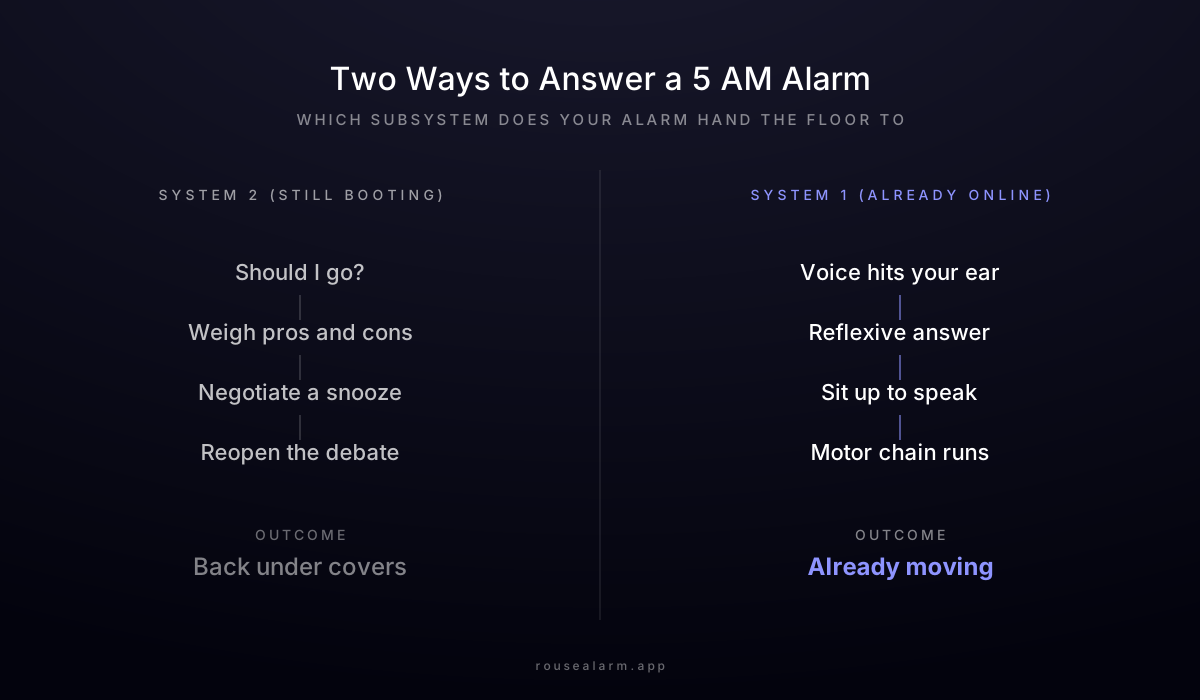
A sound alarm is a terrible match for the inertia window. It wakes you with a cue your System 1 has heard a thousand times, hands the floor to a System 2 that isn't online, and asks you to choose between "get up" and "snooze" using a subsystem that is physiologically degraded. You are being asked to deliberate with the part of your brain that hasn't shown up yet. No wonder the bed wins.
A conversation is a different kind of input entirely. When Rouse wakes you by opening a voice chat you actually have to respond to, it bypasses the deliberative pathway and lands on the reflexive one. Answering a question is System 1. A human voice asking "what are we doing first this morning" is the same cue your brain has been trained on since infancy to answer immediately, without weighing whether it wants to. You start talking. You sit up so your throat works right. You name your workout out loud. By the time System 2 stumbles online, you're vertical, oriented, and already speaking in the voice of someone who is going to the gym.
That's not a pep talk. It's a motor chain that runs before deliberation is even possible. The 5 AM Reddit crowd has been trying to describe it for years. The literature already has the mechanism. Rouse is the delivery vehicle.
One thing you can try tomorrow
Here's a cheap test you can run without installing anything.
Set your alarm as usual. When it goes off, don't touch it. Say one full sentence out loud. Not "ugh." Not "five more minutes." A complete sentence about what you're doing next. "I am getting up and going to the gym."
It will feel ridiculous. That's the point. Saying a full sentence forces System 1 to do motor work it hasn't done yet this morning: breath, voice, articulation. Once those are running, sitting up is the next link in the chain, not a separate decision.
This is the manual version of what a conversation alarm does automatically. It will work some mornings and not others, because you're still the one initiating the chain. But it is closer to the winning strategy than any "think about your goals" tip has ever been.
If you've tried the clothes-by-the-bed thing, the alarm-across-the-room thing, and the "just five minutes" thing, and you're still losing most mornings, the problem isn't your grit. It's the input. Set Rouse for tomorrow and tell me whether moving before your negotiator wakes up works for you the way it did for me.
The bed doesn't win because it's comfortable. It wins because it has a twenty-minute head start on the part of you that was going to drag you to the gym.