Your 9 PM Self Sets the Alarm. A Stranger Wakes Up to It. That's Why the Gym Loses.
Every note you leave for 5 AM you is a message to a stranger with veto power. Here's the neuroscience of the split, and the one intervention that survives it.
April 24, 2026
Your 9 PM Self Sets the Alarm. A Stranger Wakes Up to It. That's Why the Gym Loses.
I laid out my gym clothes at 9:45 PM feeling like an athlete. By 5:15 AM the same pile of clothes looked like a stranger's demand.
That is not a metaphor. Your brain, measurably, does not process those two versions of you as the same person, and every gym morning you have ever lost has started with the handoff between them failing in a specific, predictable way.
You're not losing the bed-versus-gym fight. You're losing a negotiation with someone you've never actually met.
7 min read
In this post, you'll learn
- Why your 5 AM self shows up in your brain scan looking more like a stranger than like you
- How "cold state" you at 9 PM systematically misreads what "hot state" you at 5:15 will actually feel
- Why every artifact you leave for tomorrow you (clothes, note, alarm tone, playlist) gets overridden, and what kind of intervention doesn't
Why your 9 PM self and your 5 AM self are measurably different people
There is a Stanford paper from 2009 that has lived rent free in my head since I read it at 1 AM after missing another 5:30 alarm.
Ersner-Hershfield, Wimmer, and Knutson put people in an fMRI, asked them to think about themselves now, themselves in ten years, and a stranger, and then compared the neural patterns their brains produced. Thinking about "future you" lit up a neural signature closer to thinking about a stranger than to thinking about current you, and the more stranger-shaped your future self looked in the scanner, the more you discounted the future in a behavioral task outside it.
Read that twice.
Your brain, at the level of medial prefrontal cortex activation, does not automatically treat tomorrow-morning-you as you.
Which is insane when you sit with it, because of course you "know" that 5 AM person. It is you in six hours. You set the alarm for them, laid out the shoes for them, told your partner not to wake you because they are going to the gym.
Except to your mPFC, they and you are not the same file.
Hershfield and colleagues did a follow-up that made this concrete in the other direction. They showed people age-progressed renderings of their own faces and then asked them how much to put in a retirement fund, and people who saw the older version of themselves put in more money, because the stranger had started looking like them. Reduce the stranger, reduce the discount.
Now flip the same finding toward the morning. You set a 5 AM alarm at 10 PM. You are, neurologically, setting an alarm for someone who lives down the hall, and at 5 AM that someone wakes up, finds an obligation left by a person they kind of know, kind of trust, and definitely have veto power over.
The cold-state trap: your 9 PM self is a terrible simulator of your 5 AM self
Here is the second paper, and this is the one that made me stop being mad at myself.
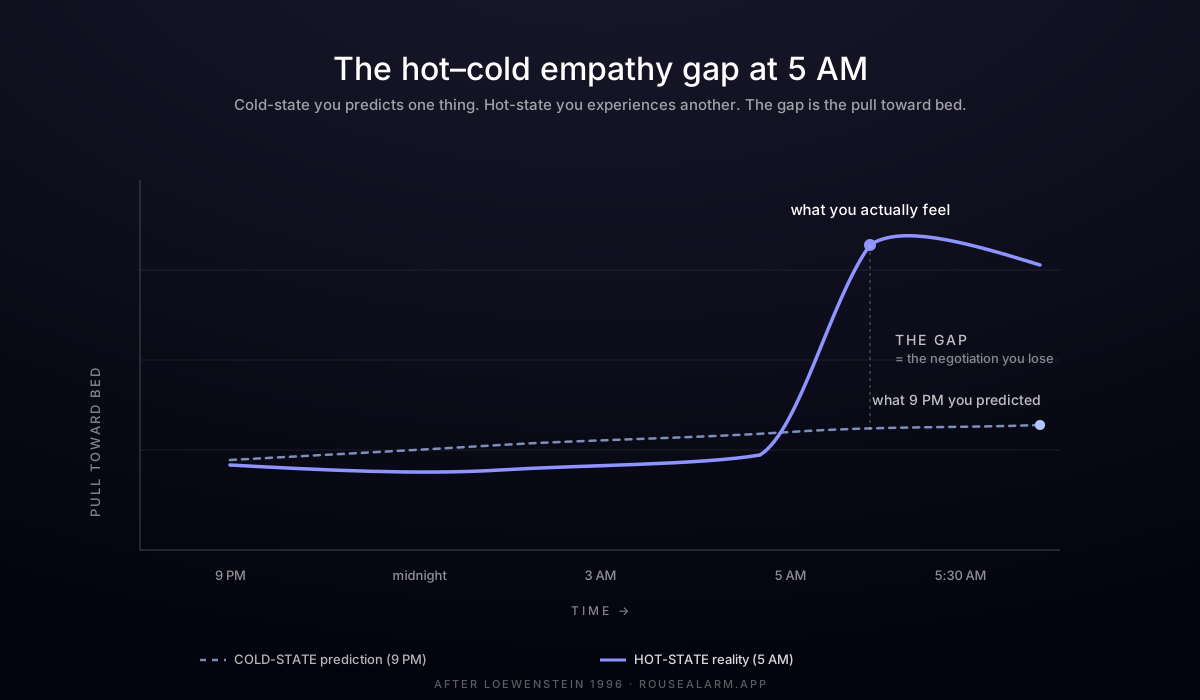
George Loewenstein, 1996. Out of control: Visceral influences on behavior. The paper that named the hot-cold empathy gap. The basic finding is that human beings in a calm, rested, well-fed, un-tempted state systematically underestimate how strongly their drives will pull them in a hot state, which is a fancy way of saying cold-state you is structurally bad at simulating hot-state you across pain, hunger, craving, fear, arousal, and exhaustion.
Loewenstein later applied the same gap to medical decisions. Patients agreeing at 2 PM in a clinic to "tough it out" through a procedure would reliably request more medication once the procedure started, not because they were weak in the moment, but because their 2 PM model of 3 PM was missing the part where the procedure actually hurt.
Mornings are the same shape.
Sunday 9 PM you is on the couch, fed, watched a YouTube video about Michael Phelps, feeling the 5 AM Club in your bones. Shoes by the door. Shaker bottle in the fridge. You are, at that exact moment, confident at a 9/10 that Monday 5 AM you will just get up.
Monday 5:15 AM you is in a 72°F duvet, with cold air outside the blanket, a cold-looking floor, sore hamstrings from Sunday's run, a slightly dry throat, and a phone that still says it is technically the middle of the night. Somewhere in the background, your brain has quietly priced in six entirely new variables that Sunday 9 PM you literally could not feel.
Sunday you did not lie about the gym. Sunday you just didn't have access to the data Monday you has.
And if you watch for this pattern, it's everywhere in the fitness-adjacent internet. One r/GetMotivated post that hit 598 upvotes said it plain: "Future me felt like a stranger, so why would I sacrifice for them?" That isn't an identity crisis. That is a pretty clean folk statement of the Hershfield result, written in a gym-adjacent accent.
The commitment you made in cold state was not fake. It was just made by someone who had never been in the hot state they were committing you to.
Sleep inertia is the amplifier that lets the stranger win
Here is where it gets worse, and also, honestly, kinder to you.
Tassi and Muzet's 2000 review showed that right after waking, human cognition is degraded for 15 to 30 minutes: reaction time, working memory, decision quality, risk assessment, all dragging. Hilditch and McHill's 2019 paper added the part that matters here: the region hit hardest during that window is the same executive-function machinery you would need to hold a commitment from six hours ago.
So stack the three findings the way the morning actually stacks them.
One. The future self your alarm is for shows up in your brain as a near-stranger.
Two. The cold-state you who set the alarm could not accurately simulate what the hot-state you would feel.
Three. The hot-state you has arrived with their prefrontal cortex on a dial-up connection for the next 20 minutes.
At 5:15 AM, a near-stranger is handed a plan they didn't personally build, under physiological conditions they couldn't have predicted, with the one brain system that could execute the plan running on 30% power. And then we act surprised that they renegotiate. This is the same offline-brain window I keep running into from every angle, which is the one I wrote about in the willpower post, and again in the move-before-motivation post, because the 15 minutes after the alarm is where every morning routine I've ever tried actually breaks.
When 5:15 AM you decides "I'll just close my eyes for two minutes," it is not really a decision. It is a stranger with executive function at a quarter strength acting on the most salient local data, which is a warm duvet and a cold room. The stranger is not evil. The stranger is functional, local, tired, and in charge.
Why every artifact you leave out the night before gets overridden
Now watch what this does to every commitment trick the fitness industry sells you.
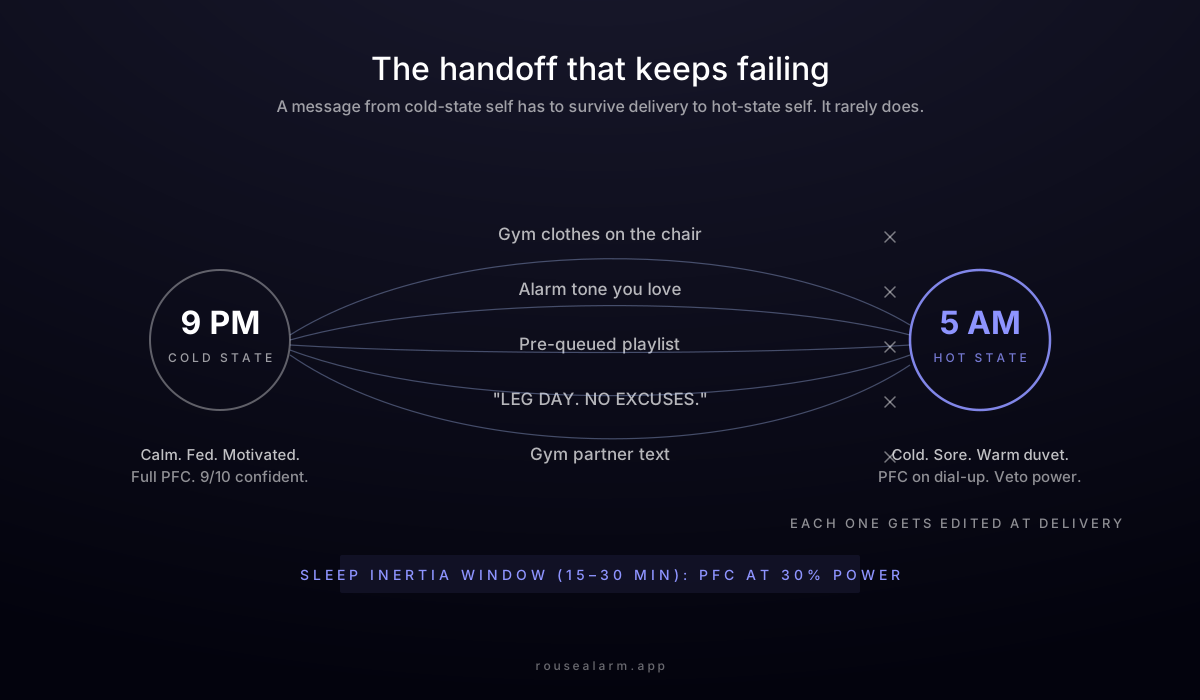
Laying clothes out. 9 PM you says "clothes on the chair means I'll put them on." 5 AM you sees the pile, reinterprets, decides "I'll wear them at lunch when I actually go." The note survives. The meaning doesn't. The stranger is the editor.
Pre-setting a playlist. 9 PM you queued up the exact session. 5 AM you has full authority to close the app, and no part of the cold-state message prevents the hot-state skip.
Alarm tone you love. 9 PM you picked one you won't ignore. 5 AM you, with sleep inertia and procedural memory, dismisses it, often without remembering.
Written intention on the phone. 9 PM you typed "LEG DAY. NO EXCUSES." 5 AM you reads it, feels slightly judged by a stranger, and puts the phone face down. Judgment from a ghost is still just a text notification.
Even a gym partner, the gold standard of commitment devices, is a cold-state promise you made to a third party. Bryan, Karlan and Nelson's review of commitment contracts shows social commitment works best when the cost of breaking it is visible and present. A text at 4:58 AM saying "not coming" delivers the cost to your partner, not to the stranger in your bed.
The pattern isn't that these tricks never work. They work some mornings, usually when the hot state is mild. What they have in common is that they are all messages left behind by cold state, to be picked up and executed by hot state, and the message has to survive the rewrite. The rewrite is happening inside a brain that has 20 minutes of sleep inertia and a stranger at the desk.
The one shape of intervention that does not require the cold-state message to survive is a message that arrives IN the hot state.
Which is why I ended up building an alarm that talks to you.
Rouse runs a voice conversation in the 5 to 15 minute window after the alarm fires, and I didn't pick that window for product reasons. It's the window every mechanism I just listed lives in. You cannot dismiss a conversation by rolling over, you cannot reinterpret it the way you reinterpret a clothes pile, and you cannot dispatch it with one hand. You have to actually answer, and answering lights up the same executive-function machinery sleep inertia had dimmed. By the time you've answered three questions out loud, the stranger has mostly booted back into being you, the hot-cold gap is collapsed because you are in the hot state and talking through it, and the commitment from last night doesn't need to survive a rewrite because the conversation is doing the commitment work in real time.
You can't autopilot past a question you have to speak the answer to. That is the whole mechanism, and it is also, as far as I can tell, the only one that doesn't get dismantled by a 72°F duvet.
Takeaway
The bed-versus-gym decision is not being made by the person who committed to the gym. It is being made by a near-stranger, running on 30% executive function, in a physical state your well-fed 9 PM self could not accurately imagine. Every commitment artifact you leave for them is a note that has to survive their edit, and most don't.
If you've been laying out the clothes and still losing the argument, set Rouse for tomorrow morning and let it talk to 5 AM you directly. Two weeks. I'd love to know whether the stranger starts acting more like you.