Your 5 AM Brain Can't Pre-Feel the Post-Workout High. That's Why 'Remember How Good You'll Feel' Fails.
The line that's supposed to save your 5 AM workout is asking your brain to do something it literally can't do for the first 15 to 30 minutes after you wake up.
April 29, 2026
Your 5 AM Brain Can't Pre-Feel the Post-Workout High. That's Why "Remember How Good You'll Feel" Fails.
Last Tuesday at 5:14 AM I tried the line on myself out loud. "Remember how good you felt after Sunday's run." It was true. Sunday's run had been one of the best in a year. I came back glowing. The line did exactly nothing.
I rolled over.
Turns out the reason isn't motivation. It's that the line is asking my brain to do a specific thing that my brain literally can't do at 5:14.
For a long time I assumed I was just bad at remembering the reward in the moment, and the fix was to remember harder. Read the journal entry. Look at the post-run photo. Visualize the endorphin high. None of it worked at 5 AM. All of it worked fine at 11 AM on Sunday, brewing coffee, deciding to lace up.
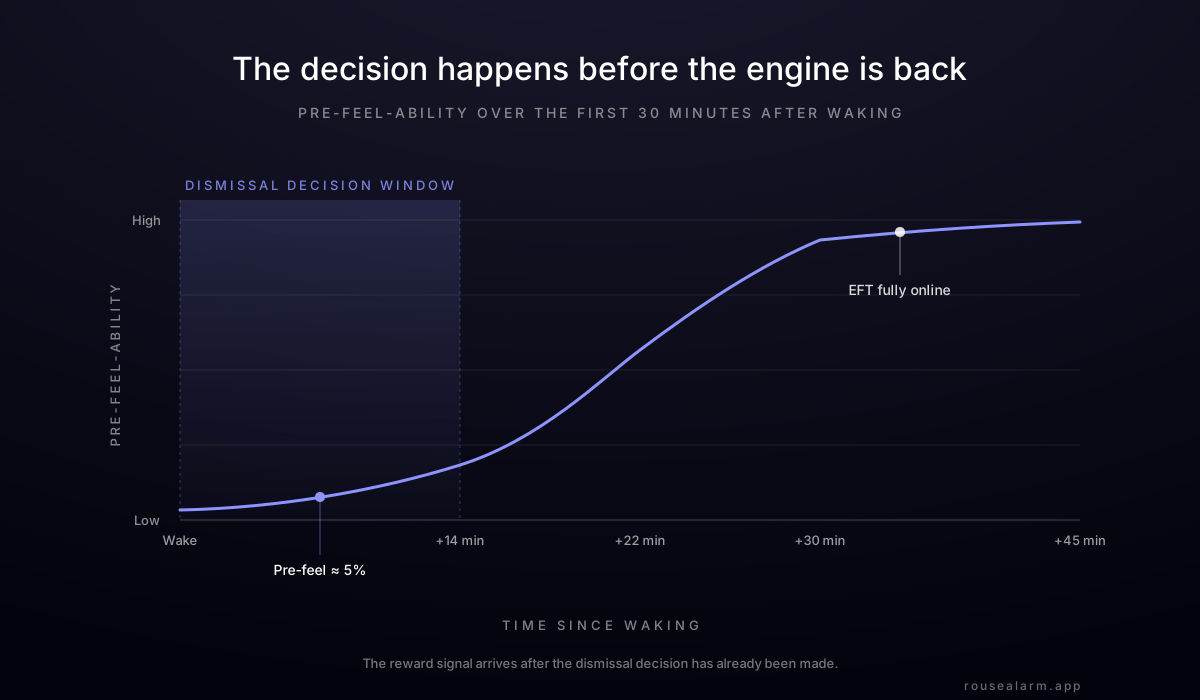
The asymmetry isn't about how badly I want it. The asymmetry is structural. There's a brain process that has to be online for "remember how good you'll feel" to do any work. Sleep inertia keeps it offline for the first 15 to 30 minutes after you wake up. That's the entire window where the dismissal decision gets made.
In this post, you'll learn:
- Why "remember how good you'll feel" doesn't motivate you at 5 AM (and what that thought actually requires)
- The brain process that pre-delivers a future reward to your decision circuit, and what disables it during sleep inertia
- Why a sound alarm can't restart it, and what kind of prompt can
7 min read
The thought that's supposed to save you isn't actually a thought
When you tell yourself "remember how good you'll feel after," you're not actually retrieving a fact. You're asking your brain to mentally simulate a specific future scene complete with the affect that comes with it. You're trying to pre-feel something.
There's a name for this. Cognitive scientists call it episodic future thinking, and the construct was coined and defined in Atance & O'Neill 2001, Trends in Cognitive Sciences. It's a specific faculty: the ability to project yourself forward into a vivid scene and momentarily inhabit it. It uses many of the same brain regions as remembering the past, but it isn't memory. It's simulation.
Here's what's wild. Episodic future thinking isn't a thought you can will. It's a process that runs or it doesn't. When it runs, the reward of a future event becomes psychologically present in the moment of decision. When it doesn't run, the reward stays in the file cabinet, the file cabinet stays closed, and the decision is made on whatever signal is present in the moment. At 5:14 AM, what's present is warmth, comfort, and gravity.
I had a partner who used to tell me, kindly, that my problem was I just didn't want it badly enough at 5 AM. She wasn't wrong about the timing. She was wrong about the variable. I want it the same amount at 5:14 as I do at 11:00. The amount I want it isn't the part that changes. The part that changes is whether the simulation engine that delivers the reward to my decision circuit is running.
If the line doesn't work, you're not weak. You're trying to access a function that's currently in maintenance mode.
The simulation engine is offline at 5 AM. This is research, not metaphor.
The first piece of the puzzle is what episodic future thinking actually requires neurologically. The seminal review was Schacter, Addis & Buckner 2007, Nature Reviews Neuroscience 8(9). They identified what's now called the "core network" for episodic simulation: the hippocampus, medial prefrontal cortex, retrosplenial and posterior cingulate cortex, and inferior parietal lobule. The hippocampus pulls the episodic fragments from memory. The prefrontal cortex recombines them into a coherent future scene and binds the affect.
Without the prefrontal recruit, you can have the memory and not the feeling. The fragments are there. The simulation never assembles.
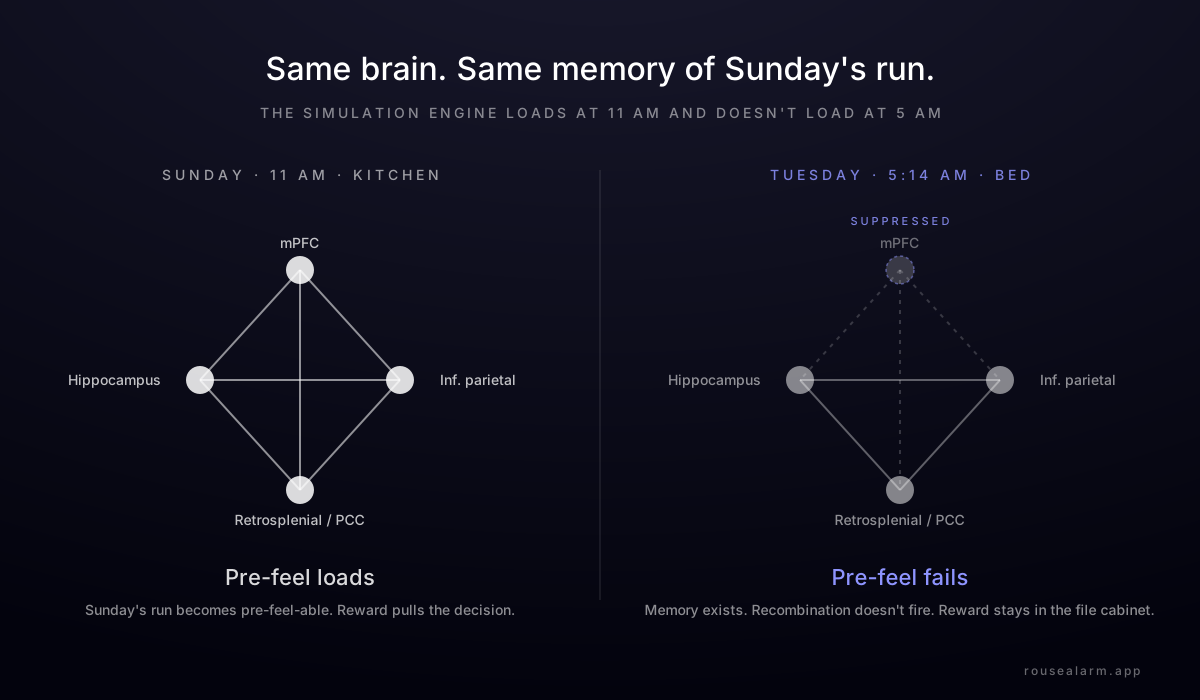
The second piece is what happens to that machinery during sleep inertia. Sleep inertia is the 15 to 30 minute window of impaired cognitive and motor performance after waking. The canonical review is Tassi & Muzet 2000, Sleep Medicine Reviews 4(4), and the contemporary expansion is Hilditch & McHill 2019 in Nature and Science of Sleep. Both confirm: motor regions reboot fast, the brainstem is fine, but the prefrontal cortex is the last region to come back online.
Vallat et al. 2018 in NeuroImage looked at this with fMRI and found that during sleep inertia the brain looks more like the default-mode network (the wandering, mind-drifting state) than the task-positive network you'd want for goal-directed action. The deliberation engine isn't just slow. It's running the wrong program. It's wandering. It's daydreaming. It's not great at pre-feeling a workout, but it's fantastic at finding a reason to stay in bed.
Stack the two facts.
Episodic future thinking requires hippocampal-prefrontal coupling. Sleep inertia selectively suppresses the prefrontal half of that coupling.
Therefore the simulation faculty that "remember how good you'll feel" depends on is exactly the faculty that's degraded during the first 15 to 30 minutes after you wake up. Which is exactly when the dismissal decision is made.
Peters & Büchel 2010, Neuron 66(1), showed the consequence directly. When researchers cued vivid episodic future cues in front of subjects, those subjects became more willing to choose long-term rewards over immediate ones. Future-thinking shrinks hyperbolic discounting. The post-run shower is more pre-feel-able, so the warm bed loses some of its grip. But the protocol that worked in the study assumed the simulation could fire. Theirs were awake subjects in a lab. At 5:14 in your bed, that assumption breaks.
The applied version of this exists too. Daniel and colleagues, in the PACE Trial and related programs, tested EFT prompts during weight-loss maintenance and found measurable downstream effects on exercise behavior. The intervention works when the engine is running. The challenge for morning exercise specifically is that the engine doesn't fire on its own at 5 AM.
A 2022 paper by Yamashita and colleagues put this exact problem on paper. They were studying digital interventions for morning behavior change and found, in their own words, that most failures of morning-targeted behavior were tied to "the characteristics of morning hours such as limited time and lowered ability due to sleep inertia, which limits the level of human ability immediately after waking and lowers motivation." They tested wake-up tasks designed to nudge cognition out of the inertia window so the rest of the morning behavior chain could run. The framing matches perfectly: motivation isn't the lever. Cognition coming back online is.
Sunday morning at 11, the line works. Tuesday morning at 5:14, the line is firing into a network that isn't there to receive it.
I have a folder of unused screenshots from my Garmin showing the post-run heart rate decline, perfectly framed sunrise photos from the trail, voice memos from minute 43 of last week's run where I told myself "this was the right call." I look at them at 9 PM. They make me want to go tomorrow. By 5:14 they might as well be in another language.
Sound alarms can't restart the engine. A prompt that requires speech can.
Once you see the bottleneck clearly, the fix has a shape.
You don't need to want it more. You need the cognitive process that turns memory of the reward into pre-feeling of the reward to come back online before the dismissal decision. That's a cognition problem. The prompt has to drive cognition.
A sound alarm doesn't drive cognition. It drives an orienting response and a button press. The button press takes 0.8 seconds. The cognition that would let you pre-feel Sunday's high doesn't get touched. Worse, the alarm shutting off returns the room to silence, which is exactly the state that lets the default-mode network keep doing its thing.
The trick that works is one that successful early-morning exercisers have reverse-engineered without naming. Casey Gueren wrote about her morning workout system in BuzzFeed and described literally talking herself through it: "I gave myself a talking to. I tell that little voice in my head to shut up. I remind myself of how much better my day will go if I go to the gym."
The reason that works is the generation effect (Slamecka & Graf 1978). Producing language about a topic activates deeper retrieval and recombination than passively hearing it. When you talk it out, you're not asking your brain to receive a fact. You're asking it to construct one. Constructing requires hippocampal retrieval and prefrontal recombination, which is the same hardware EFT runs on. Talk it through, and the simulation engine has no choice but to start firing.
Kross et al. 2014 in J Pers Soc Psychol showed that self-distanced self-talk recruits prefrontal control beyond what passive thinking does. The verbal generation pulls the slow-rebooting region into the room. I wrote a whole post on this called the morning gym people aren't more disciplined, they're more verbal. The mechanism is the same. The reason this post is a different post is that this one names the target: what the verbal generation is restoring is the simulation that lets the future reward become pre-feel-able. Self-talk isn't the cure. EFT is. Self-talk is the route to it.
The catch with solo self-talk is that the negotiator is the same brain doing the talking. The first thing the negotiator says, often, is "we don't have to do this today." Talking yourself into it works when it works, and breaks the moment the negotiator wins the first sentence.
That's why Rouse uses a conversation. Not because talking is novel; because generating language in response to another voice is the cognitive scaffolding EFT requires, and a conversation isn't a thing your brain can auto-pilot through. The other speaker keeps moving the topic. You have to track. You have to retrieve. You have to recombine. By the third or fourth exchange, you're constructing a vivid scene of the workout you're about to do. What you're putting on. What you're heading toward. What last week's session felt like. The simulation comes online while you're still in bed. The reward starts pulling. The dismissal decision lands inside a brain that has the reward loaded.
The first morning I shipped Rouse to my own phone, I tried to negotiate. The voice asked what workout I had planned and what shoes I was putting on. I answered. I felt my brain reach for last Tuesday's session and pull the affect forward like a cup of water. By the time I'd answered the third question I was already running the post-shower scene. The negotiator never got the floor. I won the argument by changing what argument we were having, which is the same trick I described in moving before motivation wakes up and the same trick that works for the bed-vs-door window. Different post, same lesson: the morning is won by bypassing the part of your brain that loses these arguments, and routing through the part that makes them moot.
If Sunday's run is real and "remember how good you'll feel" still doesn't pull you out of bed, the gap isn't in your memory. It's in the channel between memory and decision.
The takeaway
You aren't failing to want the workout at 5 AM. The simulation that delivers the reward to your decision circuit is structurally offline. You can't out-discipline a missing brain process. You can prompt it back online. But the prompt has to be one your prefrontal cortex actually has to answer.
If "just remember how good you'll feel" has stopped working on you, set Rouse for tomorrow morning and tell me whether the conversation actually loads the reward back into the decision. That's the part I built it for.