The Morning Gym People Aren't More Disciplined. They're More Verbal.
Every successful 5 AM gym person uses the same weird trick: they talk to themselves out loud. Here's the neuroscience of why it works, and why most of us can't deploy it at 5 AM.
April 26, 2026 · Updated April 26, 2026
The Morning Gym People Aren't More Disciplined. They're More Verbal.
I spent two years assuming the people who get out of bed at 5:15 for the gym had something I didn't. Better childhoods, better thyroids, better moms. Then I started actually reading what they wrote about how they did it, and the same word kept showing up.
They talk.
Out loud. To themselves. In the dark, half-conscious, with the duvet still pinning their legs.
The 5 AM gym people don't have more willpower than you. They have an internal monologue you can't access at 5 AM, because at 5 AM your brain literally hasn't finished booting the part that runs internal monologues.
7 min read
In this post, you'll learn
- The pattern across r/xxfitness, r/running, and morning routine blogs that nobody is connecting: the people who win at 5 AM are talking to themselves
- Why verbal self-instruction works (the generation effect, third-person self-regulation, and what those have in common with hitting the gym)
- The cruel sleep-inertia paradox: self-talk requires the exact executive function that's offline during the window you need it
- Why an externalized voice fixes what "lay out your clothes" can't
The 5 AM gym crowd is all doing the same weird thing
Go read the morning workout threads. Not the influencer ones. The actual people.
"I gave myself a talking to." "I tell that little voice in my head to shut up." "I shame myself into waking up." "I still battle that voice in my head."
That language shows up in r/xxfitness, r/running, and r/getdisciplined so reliably that I started copy-pasting it into a notes file just to confirm it wasn't confirmation bias. It wasn't. The pattern's there.
The clearest version I've seen is from Casey Gueren, the woman who wrote the BuzzFeed piece "Here's How I Actually Became A Morning Workout Person." Her exact line: "I know that 6:30 a.m. Casey will find literally any excuse to keep sleeping. So I needed to trick that sleepy bitch."
That sentence is a tiny psychology textbook. She's named two selves. She's referred to one of them in the third person. She's framed the morning as a negotiation between them. And she says it out loud.
Now stack that against every morning routine listicle you've ever read. "Lay out your clothes." "Put your alarm across the room." "Find your why." None of those mention talking. None of them mention that the people who actually do the thing are running a verbal script in their heads (and frequently with their lips moving) the entire time they're getting vertical.
I missed this for two years. I think most morning routine content misses it on purpose, because "talk to yourself in the dark" doesn't sell a $400 sunrise lamp.
Why talking to yourself actually works
Self-talk is one of the most studied tools in sports psychology. Tod, Hardy, and Oliver did a systematic review of 47 studies in 2011, published in the Journal of Sport and Exercise Psychology, and the headline finding was unambiguous: positive, instructional, and motivational self-talk reliably improves performance. They went looking for moderators and mediators, and the cognitive and behavioral pathways were the most consistent. In plain English: when athletes verbalize what they're doing or what they want to do, they perform better, and the mechanism runs through their thinking.
The 5 AM gym is a performance task. It's just a performance task you're doing in the dark with no audience.
Here's where it gets sharper. Ethan Kross and his collaborators at Michigan ran seven studies in 2014, published in the Journal of Personality and Social Psychology, on a very specific kind of self-talk. They had people refer to themselves in the second or third person ("Kuba, you can do this") instead of the first person ("I can do this"). Across 585 participants, the non-first-person group performed better on stress tasks, reported less distress, and rated upcoming challenges as more challenging-but-doable rather than threatening. The mechanism is called self-distancing. You step outside the panicked first-person voice and address yourself like a slightly older friend giving instructions.
Casey Gueren did this without reading the paper. "I know that 6:30 a.m. Casey..." is textbook self-distanced self-talk. Her better-rested 9 PM self is talking to her tired 6:30 AM self in the third person, and the framing is doing real cognitive work.
There's a third piece, and it might be the one that matters most for the wake-up window. In 1978, Slamecka and Graf published a study in the Journal of Experimental Psychology that established what's now called the generation effect. They had people learn lists of words in two conditions: read the word, or generate the word from a clue. The generated condition won by a wide margin on every memory measure they ran. The act of producing the response, instead of receiving it, recruits more cognitive engagement.
For the 5 AM gym person, that's exactly what verbalizing your plan does. You're not reading a sticky note. You're not hearing an alarm. You're producing the sentence "I'm getting up now, putting on the shorts, walking to the kitchen for the pre-workout." The output recruits cortex. The cortex recruits the body.
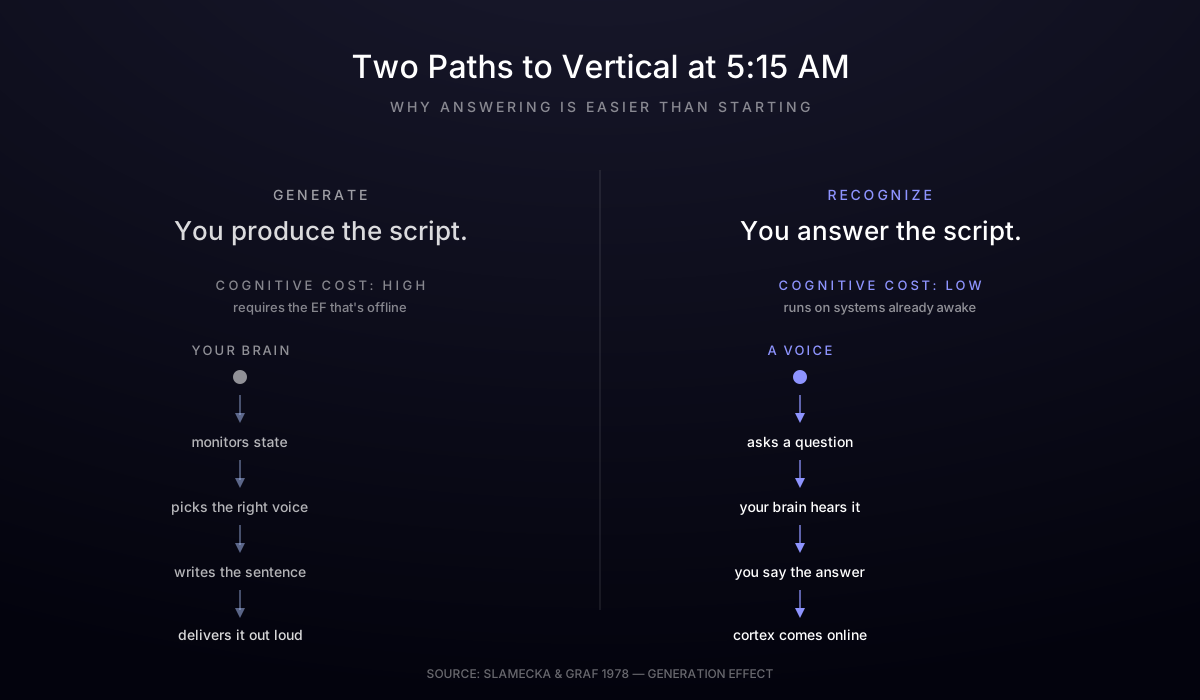
Generation > recognition. That asymmetry is the whole game.
The sleep inertia paradox: you can't talk to yourself at 5 AM
Here's where the wheels come off for most of us.
Self-talk is a high executive-function task. You have to monitor your own state, generate the right kind of sentence, and deliver it in the right voice. Meta-cognition stacked on meta-cognition. It's the kind of thing your brain does effortlessly at 10 AM with coffee in your bloodstream.
It is not the kind of thing your brain does at 5:15 AM.
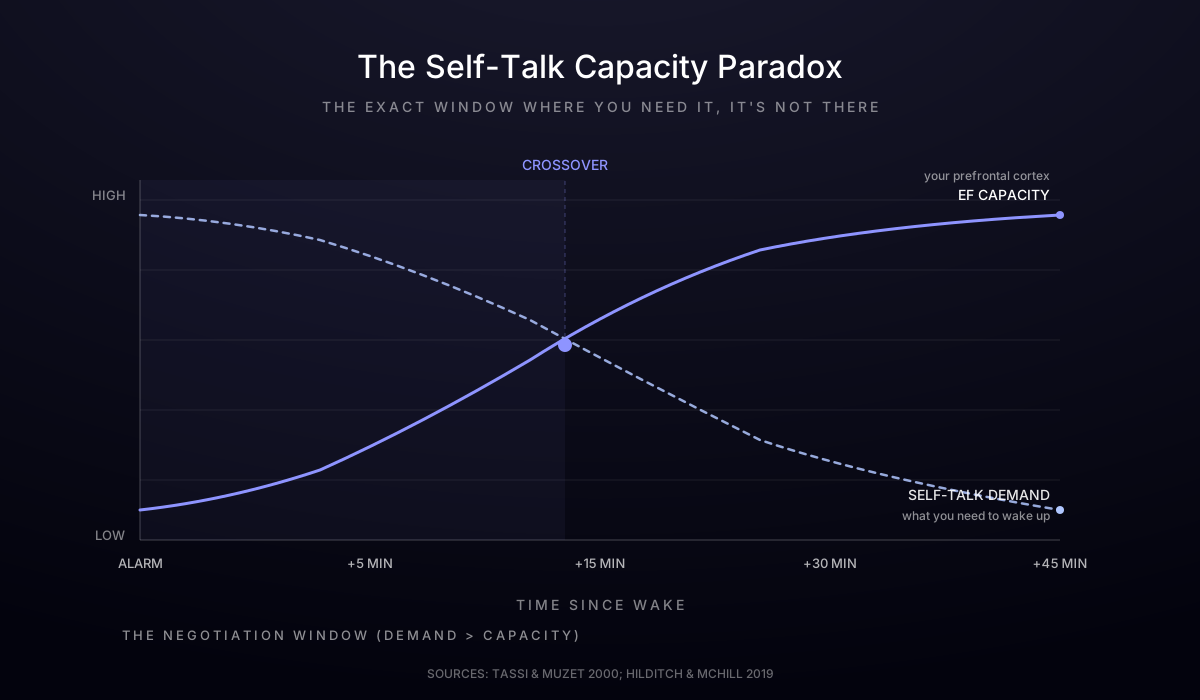
Tassi and Muzet's 2000 review in Sleep Medicine Reviews put numbers on this. For roughly 15 to 30 minutes after waking, executive function is measurably impaired. Working memory, attention, decision-making, conflict monitoring, all dragging at once. The technical term is sleep inertia. The lived term is "I have no idea what I'm doing right now."
Hilditch and McHill's 2019 review in Nature and Science of Sleep updated the picture and added the part that breaks the self-talk plan: the brain region hit hardest during the inertia window is the prefrontal-cortex machinery that runs deliberate, monitored, self-instructed thought. The exact circuitry you'd need to talk yourself out of bed is on dial-up.
Which means the 5 AM gym people aren't using a tool you forgot. They're using a tool you can't use at 5 AM. Their inner monologue at the alarm is loud, verbal, and already negotiating. Yours is fragmented, silent, and being out-voted by a duvet.
This is the part nobody writes about. The motivation listicles assume you're a calm, rational, well-rested person at 5:15 AM. You aren't. You're 30% offline, and the strategy that works for the people who succeed (verbalize, instruct, third-person yourself out of bed) requires the exact 70% you don't have access to yet.
Reading this on a Sunday at 1 PM, you can do the self-talk move just fine. "Tomorrow I'm getting up, walking to the gym, doing the workout." It feels easy because you're online. The cruel trick is that the 5 AM version of you can't run that same sentence. The recipe doesn't survive the conditions.
I went down this rabbit hole the same way I go down all of them, which is sleeping through my own alarm one too many times and deciding the problem was worth understanding rather than blaming on weakness. The negotiation isn't the problem. The negotiator is just disabled.
Why an external voice fixes what "lay out your clothes" can't
Now look back at the standard advice with this lens.
Lay out your clothes. A static visual cue. Your half-awake brain sees the pile, recognizes it, and moves on. Recognition is cheap. It does not recruit the verbal-generative system that gets you vertical.
Put your alarm across the room. A motor task. You walk to the alarm, you turn it off, you go back to bed. The walk doesn't speak. Nothing in that loop forces you to produce a sentence about what you're doing next.
Find an accountability partner. Mostly works at the gym, not before. They're not in your bedroom at 5:15 talking to you. The most accountability-partner content I've seen confirms it: the partner is a commitment, not a presence at the wake-decision.
Pre-workout on the nightstand. Caffeine takes 30 to 45 minutes to peak. The negotiation will be over before the receptors clear. You'll be back asleep by the time it kicks in.
What none of those interventions do is make you talk. They're all silent inputs trying to nudge a silent decision. And the people who win that decision are loud.
This is the part where I have to admit the obvious bias. I built Rouse because of exactly this gap. The alarm fires, and within seconds it's running a voice conversation with you. You don't have to generate the script. You only have to respond. That's the whole trick.
Generation is high-EF, which you don't have at 5:15. Recognition is low-EF, which you do. The conversation shifts the cognitive cost from your offline prefrontal cortex onto a system that's already awake (the LLM), and gives you back the cheap version of the move (just answer the question). By the time you've answered three or four exchanges out loud, the same vocal-motor and cortical activation that happens when 5 AM Casey gives 5 AM Casey a talking-to is happening to you, except you didn't have to author the talking-to. You only had to participate in it.
You can hear this in what people who succeed at the morning describe wanting and never finding. They want a coach in the room. They want the version of themselves who set the alarm to actually be there. They want, basically, an externalized version of the inner monologue that the people who already make it have, and they don't.
That externalization is what conversation does to the wake-up window. It's the same neurological trick (verbalize, recruit cortex, override the duvet), except the verbalizing isn't on you. The system speaks first. You answer. Cortex comes online for the same reason Slamecka and Graf's subjects remembered the generated words better than the read ones: producing speech is a deeper cognitive act than receiving it. And it doesn't require the executive-function machinery that sleep inertia has dimmed, because the AI is providing the prompt and you're just responding inside the conversation.
This is the same offline-window I keep running into from every angle, the one I wrote about in the post on moving before motivation wakes up and the one about the stranger who sets your alarm at 9 PM. Different mechanism each time, same window.
Takeaway
The morning gym people aren't more disciplined than you. They are using a verbal self-regulation strategy that they can run at 5 AM because, for some combination of trait, practice, and biology, their inner monologue is online when yours isn't. The fix is not more discipline. The fix is moving the conversation out of your head and into a voice that's already awake.
If you've already laid out the clothes, set three alarms, and told your gym buddy you'd be there, set Rouse for tomorrow morning and let it do the talking. You only have to answer. I'd love to know if the negotiation flips.