The Worst Part of Your Workout Is Getting Out the Door. Your Alarm Is the Hardest Set of Your Day.
A 207-upvote Reddit comment redrew my map of where morning workouts are actually won and lost. The rack isn't where you quit.
April 27, 2026
The Worst Part of Your Workout Is Getting Out the Door. Your Alarm Is the Hardest Set of Your Day.
I've laid in bed at 5:43 AM with gym clothes already on, phone in my hand, watching myself negotiate my way to 6:30. I won that argument. I also lost.
A guy on r/running put words to what was happening. He'd been asked what made winter running finally stick for him after years of falling off, and his whole answer was one sentence:
"When I realized the worst part was just getting out the door."
That comment got 207 upvotes in a thread of runners who had been trying to fix the wrong thing for years. I've been thinking about it ever since.
In this post, you'll learn:
- Why the bed → door window decides almost every morning workout (and why your rack number doesn't)
- The neurology of the negotiation: what's actually broken between alarm and threshold
- Why sound alarms can't carry you across that window, and what can
7 min read
Most of your workout happens before the workout
Map a 5:30 AM workout from end to end. Don't start at the rack. Start at the alarm.
Alarm goes off. You decide whether to keep your eyes closed. You decide whether to sit up. You decide whether to put your feet on the floor. You decide whether to walk to the bathroom. You decide whether to go to the kitchen. You decide whether to drink the water you already poured the night before. You decide whether to put on the shoes that are already laid out. You decide whether to open the door. You decide whether to start the car. You decide whether to walk into the gym. Then you decide which set to start with.
That's eight to ten decisions before the first rep.
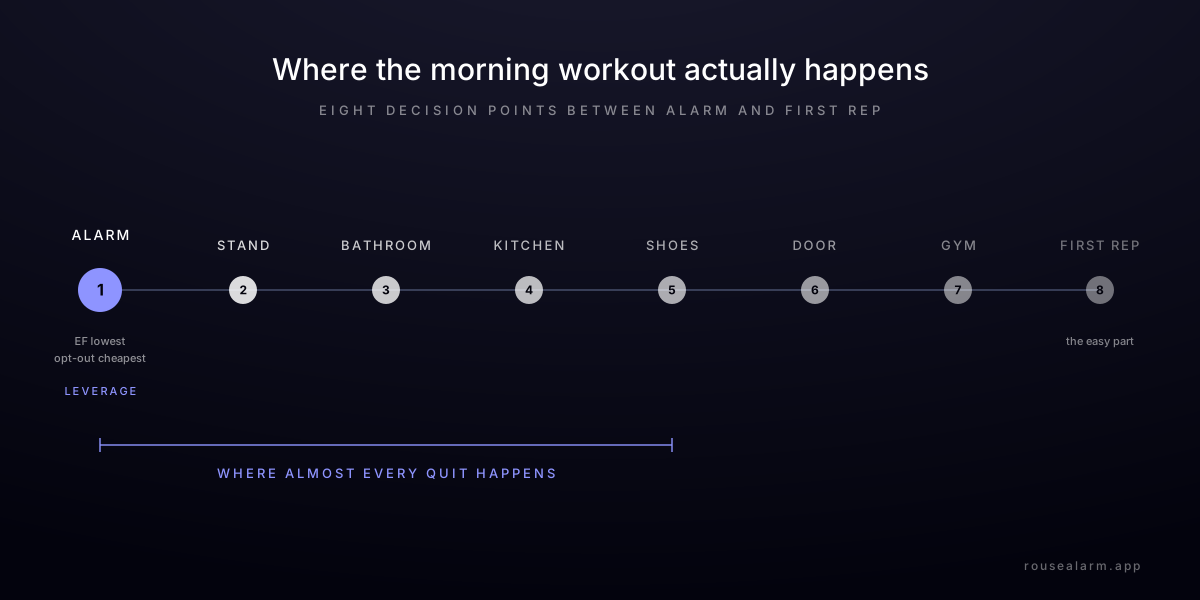
The strength of will required at each one isn't equal. By the time you're at the rack, the weight is the easy part. You already negotiated past nine no's. The reward circuits are warming up. The body is moving. The set is just the receipt.
The decisions are stacked at the front. So is the difficulty.
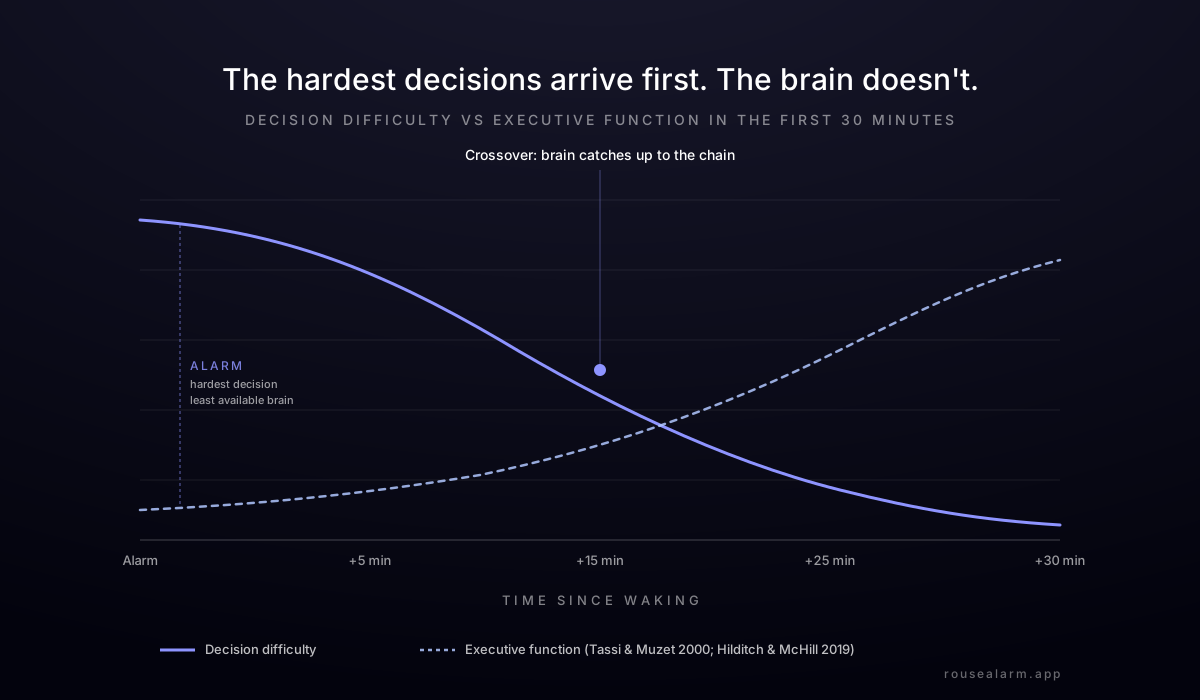
Here's the part nobody benchmarks. There's a 5 to 15 minute window after waking where executive function is degraded and decision-making is impaired, and it can persist up to 30 minutes if you're fragmented or sleep-deprived. The research calls it sleep inertia, and it's been replicated and characterized for decades (Tassi & Muzet 2000, Sleep Medicine Reviews; Hilditch & McHill 2019, Nature and Science of Sleep). The prefrontal cortex, the part of your brain you'd want online to overrule "two more minutes," is the last region to come back. Motor regions reboot fast. Brainstem is fine. The deliberation engine takes a while.
Now overlay the two graphs. Decision difficulty stacked at the front of the morning. Executive function offline at the front of the morning. The hardest decisions are being made by the part of your brain that's still buffering.
I have a folder of laid-out gym clothes I never put on. Three different pairs of running shoes by the door. The clothes aren't the variable. The shoes aren't the variable. The eight-decision walk to the door is the variable.
Try this: write out your own bed → first-rep chain. Count the decision points. The one with the lowest "how easy is it to opt out" rating is almost always the alarm. That's where to put the leverage, not in better gear.
The neurology of the negotiation
A guy on r/orangetheory said something I haven't been able to unhear:
"I'm about 3/4 of the way through the workout before I wake up enough to realize this sucks."
That's the secret. The morning workout works because you don't have a fully online prefrontal cortex to argue with you.
Vallat et al. (2018, NeuroImage) showed that during sleep inertia, the brain looks more like the default-mode network than the task-positive network it would normally be in for goal-directed action. Translation: the deliberation engine isn't just slow, it's running the wrong program. It's wandering. It's daydreaming. It's not great at planning a workout, but it's fantastic at finding a reason to stay in bed.
Behavioral activation research has been telling us this from the other direction for decades. Action precedes mood, not the reverse (Jacobson, Martell & Dimidjian 2001, Clinical Psychology: Science and Practice). The "I'll feel like it once I'm there" instinct is correct in direction. Once you're moving, mood and motivation re-recruit around the action. They don't show up first and chauffeur you to the rack. They show up after, having missed the meeting.
This is the same mechanism behind a finding I keep coming back to: the negotiation phase costs more than the workout itself. A r/running thread of 1,731 upvotes had the title "the mental gymnastics of convincing yourself to run vs actually running." That's the pattern. The internal debate is the part that makes you tired. The run is fine.
And then there's the gap that runs the whole show. Half of stated intentions translate to behavior, give or take, depending on context (Sheeran 2002 meta-analysis, European Review of Social Psychology). The implementation side closes when you specify the when, where, and how (Gollwitzer 1999, American Psychologist), which is what gym clothes by the bed are trying to accomplish. The specification works. But only if the prompt that fires the chain actually fires.
Last Thursday I set a 5:00 alarm. By 5:14 I'd negotiated my way out, even though I'd packed the bag at 10:30 the night before with a clear plan and the shoes by the door. The plan was fine. The plan didn't fail. What failed was the part of the morning where the plan was supposed to take over from the negotiator, and the negotiator stayed at the table because the prompt that should have ended the negotiation went silent.
The negotiation isn't a willpower problem. It's a window where the part of your brain that should be saying "no, you decided this last night" is offline. The fix is bypassing the negotiation, not winning it.
Why sound alarms can't bridge it (and what can)
Sound alarms have one job and they do it for about three seconds.
Alarm sounds. You press a button. The room is silent again. The negotiation starts.
The conversation in your bed isn't "should I get up." That's not what's actually happening. What's happening is "I'll just rest my eyes for two more minutes," which is the same trap dressed up. Two minutes is the negotiator's opening offer. Two minutes is how the morning ends.
BJ Fogg has a behavior model that's been around for over fifteen years and it explains the whole problem in one equation: Behavior = Motivation × Ability × Prompt (Fogg 2009, Persuasive '09; expanded in Tiny Habits, 2019). The alarm is the prompt. If the prompt fires once and dies, behavior depends on motivation, which is exactly the variable that's offline at 5:00 AM. Sound alarms are a one-shot prompt. They were built for someone whose motivation is high and steady at the moment of firing. That's not who's in the bed.
The other piece is behavioral momentum. Once a behavior chain is in motion, it resists disruption proportional to the prior reinforcement of the chain (Nevin & Grace 2000, Behavioral and Brain Sciences). Standing up matters. Walking to the kitchen matters. Each step makes the next step more likely. The way out of the bed → door window is to get the chain moving and let momentum carry it. The way to get the chain moving is a prompt that doesn't quit.
That's the bridge a conversation alarm can build that a sound alarm can't.
A conversation doesn't shut up when you press snooze. It keeps escalating, keeps requiring a response, and the fact that you're answering means your prefrontal cortex is being asked to do something other than negotiate against the morning. By the time the conversation has carried you to standing, the chain is moving on its own. The alarm has done the hardest set of the day.
The first morning I shipped Rouse to my own phone, I tried to negotiate. The voice in my ear was running its own agenda. I lost the negotiation. Won the morning. Felt like cheating, in the same way that moving before your motivation wakes up feels like cheating, or getting up before the room temperature wins feels like cheating. It's not cheating. It's recognizing where the actual game is being played.
If you've tried the gear and the wake-up hacks and you still skip more mornings than you keep, the gap isn't in the gear. It's in the part of the morning before the gear matters.
The takeaway
The decision points where workouts get won are the ones nobody talks about. The alarm is the first and the hardest. Most morning-workout quitters never quit at the rack. They quit in bed.
If you've laid out the clothes and packed the bag and still find yourself in bed at 5:43 negotiating to 6:30, set Rouse for tomorrow morning and tell me whether the conversation carries you to the door. That's the part I built it for.