Your 5 AM Brain Is a World-Class Excuse Generator. The Part That Catches Excuses Isn't Online Yet.
Your 5 AM brain manufactures skip-rationales faster than the part that evaluates them can boot. Here's the wiring, and the one fix that lands.
May 12, 2026
Your 5 AM Brain Is a World-Class Excuse Generator. The Part That Catches Excuses Isn't Online Yet.
5:14 AM, gym clothes folded on the chair since 10:30 the night before, and my brain said: "knee felt a little off yesterday, today's the day to be smart about it." I was back asleep before I'd evaluated the sentence.
The knee was fine.
The brain that generated that excuse and the brain that would have caught it weren't online at the same time.
In this post, you'll learn:
- Why your 5 AM brain is structurally good at fabricating skip-rationales, and the prefrontal evaluator that would catch them is still 20-ish minutes from booting
- The default-mode-network window where motivated reasoning runs unedited, and why every 5 AM excuse sounds suspiciously well-argued
- The one move that recruits the evaluator faster than coffee or laid-out clothes, and why it has to be verbal
7 min read
The brain that makes the excuse and the brain that catches it aren't online at the same time
The first time I clocked this pattern was after I built a halfway decent night-before setup. Clothes on the chair. Pre-workout pre-dosed in the shaker. Shoes by the door. Alarm across the room. I had done everything the "5 AM gym morning" listicles told me to do.
Last Tuesday I walked past all of it.
What I caught, slowing the morning down later that day on the train, was that I hadn't even decided to skip. I'd had a thought. The thought sounded reasonable. The thought won. There was no deliberation. The whole thing took less than a sentence.
Turns out there's a name for what's happening in those first few minutes.
Sleep inertia is a 15-30 minute window after waking where executive function is degraded, sometimes longer if you're sleep-deprived. It's been characterized for decades (Tassi & Muzet 2000, Sleep Medicine Reviews, PMID 12531174; Hilditch & McHill 2019, Nature and Science of Sleep, PMC6710480). The prefrontal cortex, the part you'd want online to evaluate a sentence like "knee felt a little off," is the last region to come back. Motor regions reboot fast. Brainstem is fine. The deliberation engine takes a while.
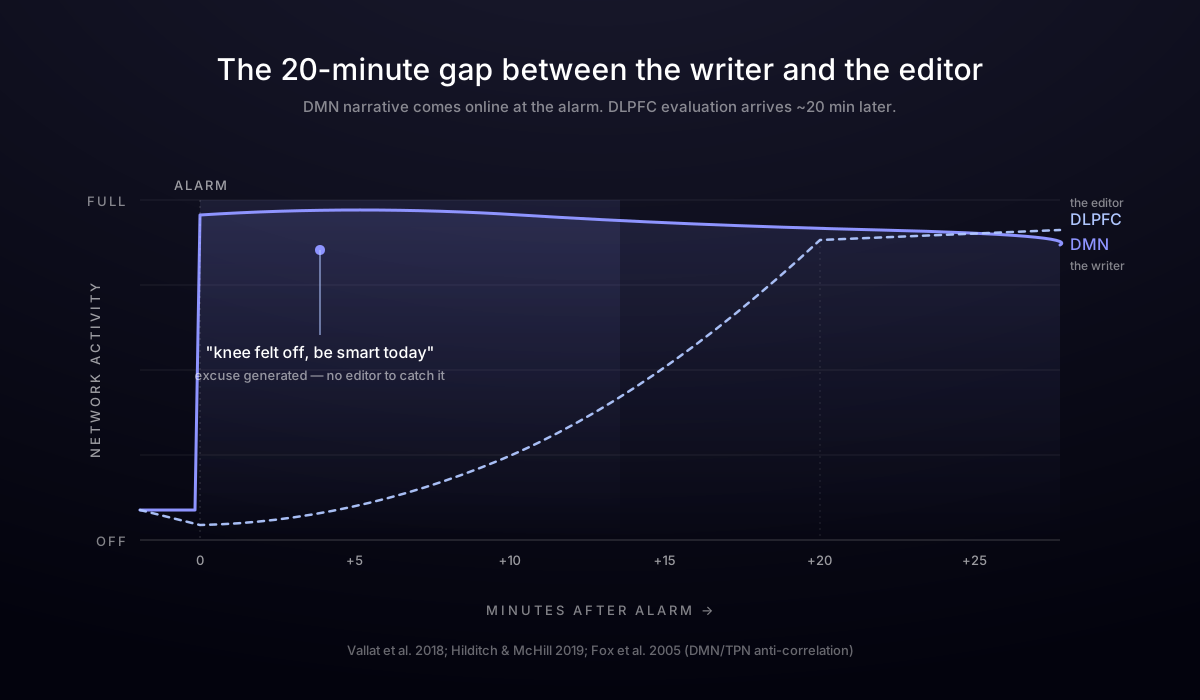
Vallat et al. 2018 (PMID 30223060) put people in an fMRI right after waking and showed the brain was running closer to the default-mode network than the task-positive network during the inertia window. The DLPFC, the deliberator, wasn't just slow. It was running the wrong program.
There's a second piece. The default-mode network and the task-positive network are anti-correlated (Fox et al. 2005, PMC1234034). When the DMN is loud, the DLPFC is quieter. Not by accident. By architecture.
Which means at 5:14 AM, when my brain produced "knee felt off, be smart today," the network that authored the sentence was at full volume and the network that would have edited it was barely on. The excuse and the absence of the editor were the same neural condition.
I wasn't talking myself out of the gym. I was being talked out of it by a brain with no editor.
Why the excuses sound so plausible: the DMN writes, the DLPFC edits, and they don't share a shift
The DMN isn't the villain. It's just doing its job. Buckner, Andrews-Hanna & Schacter 2008 (PMC2899150) reviewed a decade of work and described the DMN as the brain's self-referential narrative machine. Autobiographical memory. Mental time travel. Counterfactual simulation. The voice in your head that imagines scenes, replays moments, generates plausible explanations for things. It runs constantly. It runs especially well at rest and during the wake-up window.
If you wanted a network designed to produce a fluent, self-favoring, story-shaped justification for staying in bed, you would build the DMN. Which we did. Evolution did.
The DLPFC's job is to push back. To evaluate. To run the is this sentence actually true check. When it's online, the editor catches "knee felt off, be smart today" and asks which knee, when, how off, are you sure you're not just cold. The story doesn't survive the question.
But at 5:14 AM the editor is in the bathroom.
There's a second layer. Kunda 1990 (Psychological Bulletin 108(3), doi 10.1037/0033-2909.108.3.480) made the case that motivated reasoning, the tendency to construct beliefs that serve a goal, actually intensifies when cognitive resources are depleted. The brain doesn't reason worse when it's tired. It reasons more motivatedly. It still produces explanations. The explanations just get bent harder toward whatever the depleted brain wants. And the depleted brain, at 5:14 AM, wants warmth.
Mercier & Sperber 2011 (Behavioral and Brain Sciences 34(2), doi 10.1017/S0140525X10000968) take it further with what they call the argumentative theory of reasoning. The thesis is uncomfortable: reasoning didn't evolve primarily to find truth. It evolved to argue, to justify positions to others and to yourself. Most of the time, reasoning is in lawyer mode, not judge mode. With the DLPFC online, the judge can override. With the DLPFC offline, the lawyer wins by default.
Somebody on r/running called it "47 layers of mental excuses." I think they were underselling. 47 is the number you can recall after the fact. The actual number is the count of sentences your DMN produced in the first three minutes that you never even surfaced to evaluation because there was no evaluator to surface them to. The same wiring that makes the founder default to email instead of the real work shows up here. The brain picks the least-effort path before the evaluator is online to ask whether it's the right path.
This is also why the "remember how good you'll feel" trick fails. The regret happens in the evaluator. The skip happens before the evaluator wakes up. The two events aren't even in the same brain.
Sheeran 2002 (European Review of Social Psychology 12(1)) showed something the intention-behavior literature has replicated for twenty years: roughly half of stated intentions don't translate to behavior. The gap isn't motivation. It's the timing mismatch between the brain that set the intention (10 PM you, DLPFC fully online, planning) and the brain that acted on it (5 AM you, DMN dominant, lawyer-mode reasoning, judge in the bathroom).
The companion to all of this, on the action side, is the piece I wrote about how moving before motivation wakes up is the only fix that survives sleep inertia. That post is about bypassing the deliberation. This one is about why the deliberation, when it does happen, is rigged.
A laid-out gym outfit doesn't help here. The clothes don't talk back to the excuse. The shoes by the door don't say which knee. The pre-workout in the shaker is silent. None of them are the editor.
The fix that lands at 5 AM has to be verbal. Specifically.
I keep coming back to one moment from years ago, before any of this was a product idea. I had set an alarm for the gym. The alarm fired. I was negotiating my way out of it inside my own head, half-asleep, no friction, no resistance, the usual lawyer-without-a-judge thing.
Then my dad called.
I picked up on the second ring sounding like a fully awake human being. He asked something. I answered. The whole performance took maybe forty seconds. I noticed, hanging up, that I was now actually awake. Not "alarm awake." Awake-awake. The negotiation was gone. I went to the gym.
I told myself for years it was the adrenaline. The phone ringing. The novelty. I now think those mattered less than I thought.
What mattered was that I had to generate language.
The generation effect (Slamecka & Graf 1978, Journal of Experimental Psychology: Human Learning and Memory 4(6), doi 10.1037/0278-7393.4.6.592) is the finding that information your brain produces is encoded and acted on more strongly than information it reads. Reading the note that says "go to the gym" is a recognition task. Saying "I am going to the gym, I am getting up now, I am putting the left shoe on" out loud is a generation task. Different networks, different effort cost, different wake-up signal.
Verbal generation specifically recruits Broca's area, the left DLPFC, and motor speech regions (Indefrey & Levelt 2004, Cognition 92, PMID 15037129; Hickok & Poeppel 2007, Nature Reviews Neuroscience 8, PMID 17431404). The left DLPFC is exactly the region that's offline during sleep inertia. Forcing yourself to produce a sentence out loud is, mechanically, a boot signal for the editor. Not a bypass. A boot.
Self-distanced self-talk goes one step further. Kross et al. 2014 (Journal of Personality and Social Psychology 106(2), PMID 24467424) showed that talking to yourself in the second or third person ("Kuba, get up, the knee is fine") recruits prefrontal cognitive control more than talking in the first person. There's a sport-psychology literature stacked on top of it (Tod, Hardy & Oliver 2011 meta-analysis, Journal of Sport & Exercise Psychology 33(5), doi 10.1123/jsep.33.5.666) showing verbal self-regulation reliably improves performance.
This is the through-line in the morning-gym interviews. A trainer interviewed by BuzzFeed said the people who actually make the 6 AM switch have a specific internal monologue going from the second the alarm fires. The r/xxfitness regular said "I tell that little voice in my head to shut up." The r/orangetheory 5 AM person said "I gave myself a talking to." The other Casey she's tricking is a sentence-generator. Persona research I dug through last spring kept landing on the same thing: the morning gym people aren't more disciplined, they're more verbal.
That's the bet behind Rouse. The alarm fires, an LLM asks you something you have to actually answer in words to make it stop. Every sentence you produce pulls the left DLPFC online a few seconds earlier than it would have come up on its own. The editor isn't booting because the alarm rang. The editor is booting because you said the word "actually" out loud and your brain had to assemble a verb after it.
The clothes don't ask anything. The shoes don't ask anything. The phone with the alarm-stop button doesn't ask anything. The conversation does. And the conversation's job, mechanically, is to keep the lawyer from running the whole 5 AM courtroom.
Closing
You don't have an excuses problem. You have a timing problem. The lawyer is fluent at 5:14 AM. The judge is still asleep until 5:30. Between those two timestamps your day gets decided by a system with no editor, and your bed wins every coin flip.
If you've already done the clothes, the alarm position, the pre-workout in the shaker, and the gym still loses three mornings a week, the next lever is probably language. Try saying out loud what you're about to do, in the second person, before the lawyer gets a sentence in. Or set Rouse for tomorrow morning and let it run the conversation that pulls the editor online. I'd love to know if it lands.