Your Brain Picks the First Task Before It's Online. That's Why You Default to Email.
The most important task-selection decision of a solopreneur's day happens when prefrontal cortex is offline. Here's the mechanism, and what to do instead.
May 5, 2026
Your Brain Picks the First Task Before It's Online. That's Why You Default to Email.
Most mornings I open my laptop, glance at the project I told myself last night I'd start with, then somehow find my finger already on the inbox tab.
I'm not even mad about it. I just watch myself do it.
Turns out the first decision of my day is being made by a brain that isn't fully online yet, and it's making it the same way every time.
In this post, you'll learn:
- Why your prefrontal cortex stays offline for the first 30 to 60 minutes after wake
- Why solopreneurs eat the full cost of that window where most people don't
- What the brain actually does when it has to pick between hard work and email under cognitive depletion
- The one move that pre-loads the decision before the choice menu opens
7 min read
Your prefrontal cortex doesn't wake up at the same time you do
There's a Thursday I keep going back to. I sat down at the desk at 7:14 AM with a customer proposal half-drafted from the night before. By 8:47 I had answered eleven emails, replied to a Slack DM about logo colors I had never picked, and triaged a Stripe dispute that had auto-resolved itself.
The proposal was untouched.
I hadn't decided not to do it. I just hadn't decided.
And it took me an embarrassingly long time to figure out why that kept happening, because the obvious explanation, "I'm undisciplined," was wrong in a specific and useful way.
Sleep inertia is not just a heaviness in your legs. It's a measurable lag in the parts of your brain you most need for hard decisions. Tassi and Muzet's 2000 review in Sleep Medicine Reviews lays it out plainly: working memory, cognitive flexibility, and executive control are impaired for 15 to 60 minutes after wake (PMID 12531174). Hilditch and McHill's 2019 update extends and reinforces it with newer data (PMC6710480). Vallat and colleagues actually scanned brains during the inertia window and found the default mode network running the show while the dorsolateral prefrontal cortex was still underactivated (PMID 30223060).
The DLPFC is the part of your brain that picks between options when none of them are screaming at you.
It's offline. For the first hour. Every morning. It's not a personal flaw, it's the architecture.
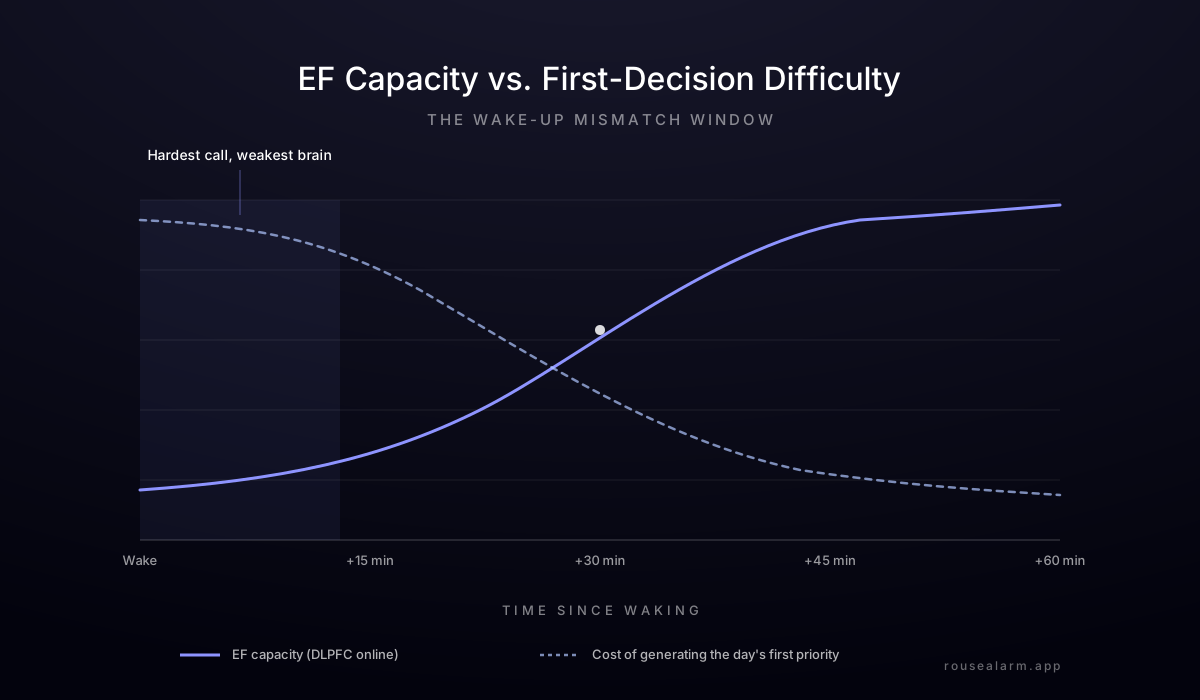
So the brain that opens your laptop at 7:14 is genuinely not the brain that's going to ship your hardest project. It can't be.
Recognize the window. The first hour after wake is not the brain that picks well.
Solopreneurs eat the full cost of that window
Here's where it gets specifically painful for founders, freelancers, and indie hackers.
If you have a job, the priority gets generated for you. Your manager flags the top item. Your inbox is already triaged by urgency from the people upstream. Your calendar has a 9 AM standup that forces the agenda. By the time your prefrontal cortex catches up, the decisions that needed it have already been made by someone else's prefrontal cortex.
A solopreneur's morning is the inverse. You wake up to a blank slate and you have to generate the priority list from nothing. No manager. No upstream queue. No standup at 9. Just you and a laptop and forty things you could plausibly work on.
There's a name for why this is so much harder than picking from a list someone else made. It's the generation effect (Slamecka and Graf, 1978). The catch is what gets cited less often: the same act of generation that makes a memory stick is also more cognitively expensive in the moment than recognizing one. Generating is a DLPFC task. The DLPFC is offline. So the hardest cognitive task of the morning lands at the worst cognitive moment of the morning.
That's a structural condition, not a discipline failure.
I keep a saved Reddit thread that captures it perfectly. u/Sensitive_Gold_6266 wrote in r/getdisciplined:
"I wake up already tired, can't start even simple tasks, overthink every decision, no motivation at all… Starting feels heavy, deciding feels exhausting, and doing nothing feels scary."
460 upvotes. 1.0 ratio. 90 comments. Most of the people nodding along were solopreneurs and freelancers who didn't realize that "deciding feels exhausting" was a literal description of the cognitive load they'd accidentally taken on by working alone.
If you've read the first 2 hours after you wake up are your sharpest, the irony is that this same window is where your recovered cognition will eventually be at peak. The CAR-driven lift is real. You just can't access it until the inertia lifts. And by the time it lifts, you've spent the front edge of the window deciding what to do with the back edge of it.
Name the structural condition. "No manager forcing my priority" is a description of your work, not a verdict on your character.
When generating fails, the brain takes the default
So what does the brain actually do when it has to pick a priority and can't?
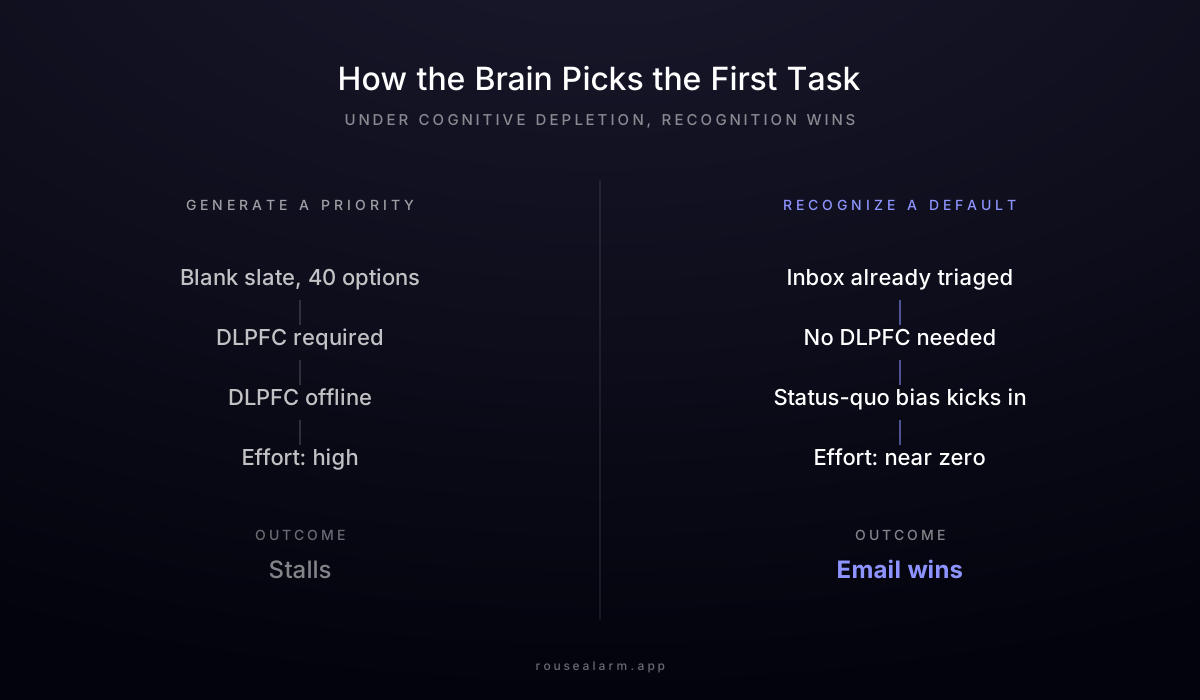
It takes the path of lowest deliberative cost. The technical name for this is status-quo bias, sometimes called default-option bias, and the canonical paper is Samuelson and Zeckhauser's 1988 piece in the Journal of Risk and Uncertainty (article). Replicated across organ donation, retirement plans, jam aisles, and every other domain humans pick under load. When deliberation is expensive, the option that doesn't require any further deliberation wins.
For a solopreneur sitting at a laptop at 7:14 AM, the option that requires no further deliberation is the inbox.
Email feels like work. It's adjacent to work. It satisfies the urge to "be doing something." Each message is a tiny pre-defined task with an obvious shape. You're not generating a priority, you're just recognizing the priority someone else (the sender) has already encoded for you. Recognition is cheap. Generation is expensive. The brain picks recognition every time.
By the time you close the inbox tab, ninety minutes are gone, the cognitive window has lifted, and you're in the second hour of the day, working on stuff that was urgent for someone else and not important for you.
I once sat down to ship a feature, and 53 minutes later I'd answered four emails that didn't need answers, two Slack threads I could have left alone, and re-read a Stripe disputes notification three times before noticing it had already auto-resolved. I closed the tabs and stared at the actual project file. The DLPFC was online by then. It was also tired. The hardest cognitive window was gone.
This isn't an Inbox Zero problem. Inbox Zero is the LARP version of the trap. Bullet journals, Notion dashboards, "system hopping" between Pomodoro and time-blocking and the Eisenhower matrix all fail in the same place. They all require a working DLPFC at the moment of selection, and at the moment of selection, the DLPFC is asleep.
u/Lj_Artichoke_3876 in r/productivity captured it with more rage than I've ever managed:
"You have a decision paralysis meets dopamine addiction meets perfectionism wearing a bullet journal as a costume problem. You're making dashboards instead of decisions."
Status-quo bias × cognitive depletion = the inbox, every time. Spot the pull tomorrow morning instead of riding it.
The fix isn't a system. It's deciding before the choice menu opens.
The thing that finally moved the needle for me wasn't a productivity app. It was moving the priority decision earlier in the morning, to a moment where the choice menu hadn't opened yet.
There's a name for this too. Implementation intentions, Gollwitzer 1999 in American Psychologist (paper). If-then plans that bind an action to a specific cue, so when the cue fires, deliberation isn't required. The point of implementation intentions is exactly that they bypass decision-time deliberation, which is helpful precisely when deliberation is broken.
The cue for me was the alarm. Before I touched my laptop, before I scrolled my phone, before the choice menu of forty things existed, I would say one sentence out loud:
"The thing I'm shipping today is X."
Five seconds. One sentence. Out loud.
The "out loud" part isn't a stylistic flourish. Verbalization recruits inner speech, and inner speech engages prefrontal control circuits more reliably than silent rumination (Vygotsky 1934/1986; Kross et al. 2014, J Pers Soc Psychol, PMID 24467424). Saying it pulls the DLPFC partway online for the moment it takes to commit. The commitment then sits in declarative memory for the rest of the morning, accessible via recognition. By the time my laptop opened, I wasn't generating the priority anymore. I was recognizing it from a sentence I'd spoken to myself ten minutes earlier.
This is the same lever that runs through why your founder brain boots cold every morning, where the GTD open-loop fix works by pre-staging the recognition list outside the brain. Same mechanism, different surface.
(This is also why I built Rouse to talk to me at the alarm instead of letting me thumb through a notification list. The alarm conversation forces the priority commitment before I can drift into the inbox. The AI asks one direct question, I have to answer it out loud to dismiss, and the recognition I need at 7:14 is already loaded by the time I open the laptop. It's an implementation intention with a forcing function attached.)
You don't have to use Rouse for this. You can write the sentence on a Post-it the night before. You can record a 5-second voice memo. You can text it to a co-founder. The mechanism is the move, the product is just one way of binding it.
Pre-load the priority before the choice menu opens. Whatever method gets one verbalized commitment locked in before the laptop is the right one.
What changes when you stop blaming yourself
The reason you keep losing your first hour to email isn't discipline.
It's that you're picking your most important task with the brain that's least equipped to pick.
Move the decision earlier, before the choice menu opens, and the morning fixes itself. Not by adding a system. By removing the decision from the worst possible moment to make it.
If you've been blaming yourself for opening Slack first every morning, try moving the priority decision to the moment before you're fully awake. Set Rouse for tomorrow, tell it the one thing you have to ship, and see if your laptop session lands somewhere different. I'd love to know if it lands.