Your Founder Brain Boots Cold Every Morning. The Alarm Doesn't Hand Off the Stack.
Solopreneurs lose 30 minutes every morning reloading yesterday's mental stack. Here's the working memory mechanic and the one stimulus shape that warm-starts it.
April 30, 2026
Your Founder Brain Boots Cold Every Morning. The Alarm Doesn't Hand Off the Stack.
I sat at my desk at 7:14 AM with coffee in front of me and could not tell you what I had been working on the day before.
Not "couldn't remember the next task." Worse. I knew it was something about onboarding. I knew there were three open tabs I'd had a strong opinion on at 11 PM. I had to sit there and re-derive it. The whole stack. From scratch. The version of me at 7:14 AM was a stranger walking into a room my 11 PM self had been mid-sentence in.
This is also when I finally stopped pretending the problem was discipline.
Solopreneurs aren't lazy in the morning. They're cold-booting a server with no warm cache.
If you've ever sat at a laptop at 6:43 AM, fully dressed, fully caffeinated, and read the same Notion doc title four times before any of it made sense, this post is for you. There's a name for what's happening. There's also a fix that doesn't require you to become a different kind of person.
In this post, you'll learn:
- Why your brain at 7 AM is technically online but functionally cold-booted
- The reason employees don't have this problem (and why solopreneurs always will until they fix it deliberately)
- The one stimulus shape that warm-starts the working-memory stack inside the dismissal window itself
7 min read.
The first 20 minutes after the alarm aren't sleep inertia. They're something else.
I used to think morning brain fog was just sleep inertia, the well-documented 15-to-30 minute window where your prefrontal cortex is still booting. Tassi and Muzet's 2000 review in Sleep Medicine Reviews is the canonical reference. Hilditch and McHill 2019 measured the executive-function lag cleanly in field conditions. I'd already written a whole post about this in why your body wakes at 6 but your brain wakes at 7:30.
But sleep inertia is only half of what's wrong at 7:14 AM.
By 7:14, the EF lag was technically clearing. I could string a sentence together. I could decide whether to put oat milk in the coffee. The PFC was online. What I couldn't do was tell you which of yesterday's ten open loops was the one I was supposed to start with.
That's not sleep inertia. That's a separate problem that gets stacked on top of it.
Sleep inertia is the CPU booting. Working-memory cold-start is the application not having loaded its state yet.
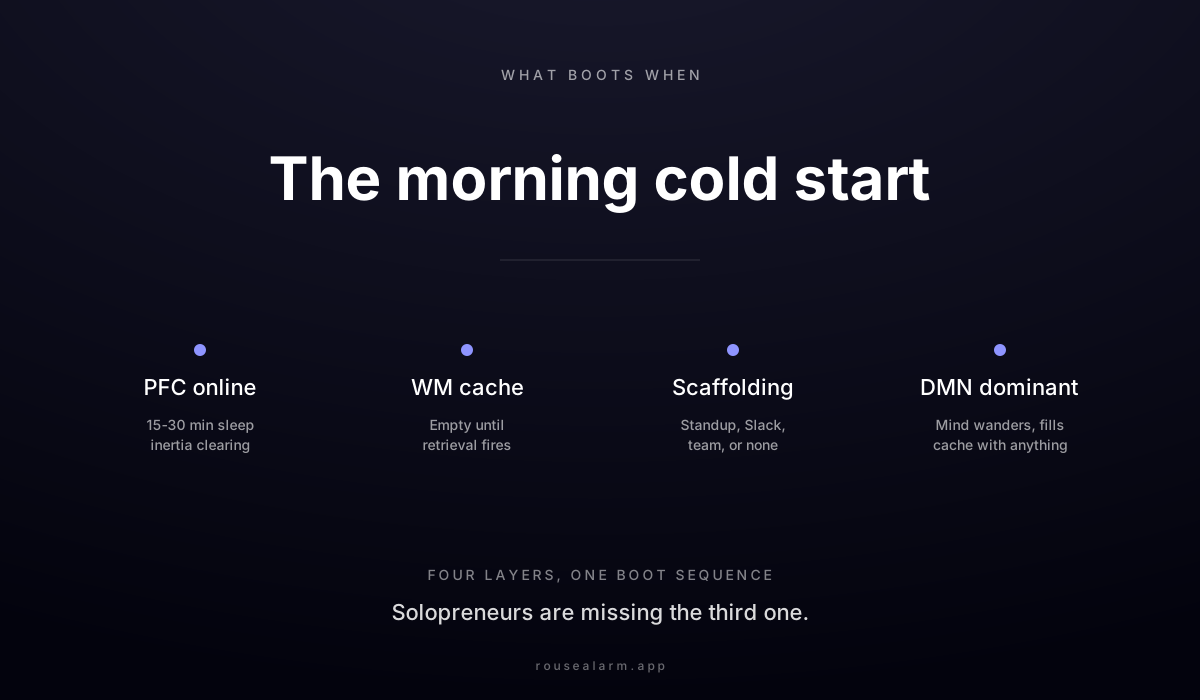
Every founder I've talked to has felt this and assumed it was the same thing. It's not. They're additive. Your prefrontal cortex came online around 7:00. Your working-memory stack (the seven-ish chunks of context Baddeley's model says you actually use to think) is still empty. The CPU is up. There's nothing in the cache.
Why employees don't have this problem (and why solopreneurs do, structurally)
Here's the part that stopped me cold the morning I figured it out.
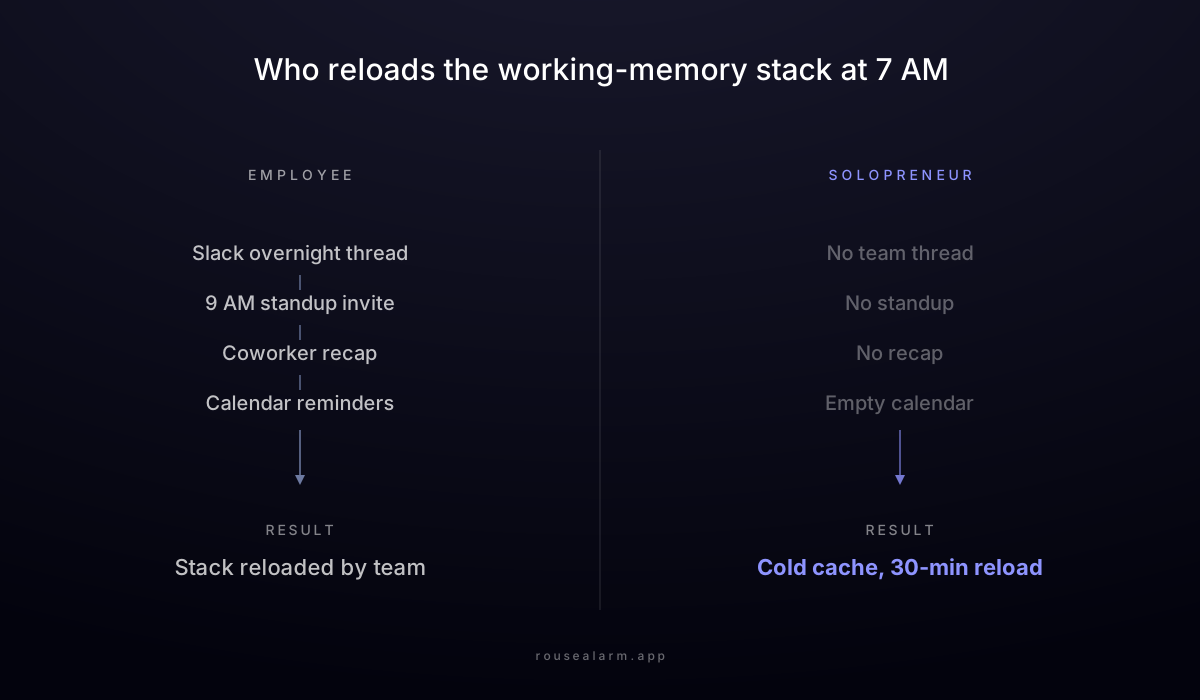
Pull up a default employed person's morning. Alarm at 6:30. Shower. Train. Walk in. Slack opens itself. The first three messages they read are: a calendar reminder for the 9 AM standup, an overnight thread from someone in another timezone about the thing they were working on yesterday, and a "good morning" from a coworker referencing what they shipped yesterday.
In about 90 seconds, their working-memory stack got reloaded by the environment. They didn't reload it. The team did.
The stand-up that you've heard people complain about for the last decade? That ritual is doing real cognitive work. It is forcing each person to verbally restate what they did yesterday, what they're doing today, and what's blocking them. That's not just process theater. That's Slamecka and Graf's generation effect in action. Information you generate and speak out loud is encoded and retrieved more strongly than information you only read or think about silently. The standup is a forcing function for active retrieval at the exact moment the brain is most willing to accept a refresh.
Solopreneurs don't have one.
There's no Slack catch-up because there's no Slack. There's no overnight thread because there's no team. There's no morning meeting because there's no one else on the org chart. The entire context lives in one head, and that head is the one that's been offline for eight hours. You wake up to a system whose only memory of yesterday is yours, and yours is currently a cold buffer.
David Allen's Getting Things Done names this without realizing it. He calls them "open loops": unfinished tasks that occupy mental bandwidth until they're either completed or externalized into a trusted system. Allen's whole argument is that the brain is bad at storing open loops, so you should externalize them. Employees externalize them automatically into the team. Solopreneurs have to externalize them deliberately, into a system that doesn't exist by default.
Most don't. Most just keep the stack in their heads, sleep on it, and then re-derive it every morning at 7:14 with coffee and four open tabs.
The default-mode reload trap
There's a specific way this fails that I want to name, because it took me months to spot it in my own mornings.
When working memory is empty and the prefrontal cortex is still warming up, the brain doesn't sit politely waiting to be loaded. It defaults to the default mode network. That's the same broad set of regions Vallat and colleagues 2018 in NeuroImage showed dominates EEG activity during the sleep inertia window. The DMN is great at mind-wandering, autobiographical recall, and rumination. It's terrible at goal-directed task selection.
So you wake up, you sit down, and the first thing your brain does isn't "what was I working on yesterday." The first thing it does is the morning version of opening the fridge with no plan: it scrolls. It checks email. It opens X. It re-reads a Notion doc you wrote three days ago. It loads something into the cache, just not the something you needed.
I've watched myself do this for forty minutes. I'd close the laptop, get up, make a second coffee, sit back down, and finally remember at 8:03 AM that the actual priority was the onboarding flow. The first 49 minutes were the brain trying to fill an empty stack with whatever was easiest to grab.
This is also adjacent to but distinct from the DMN-driven founder dread I wrote about earlier. Founder dread is your DMN feeding you anxiety about the day ahead. Cold-start is your DMN feeding you anything because the working-memory stack is empty and it's looking for inputs. Sometimes the input is dread. Sometimes it's a YouTube short. Either way, the actual work doesn't get loaded.
What actually warm-starts the stack
The annoying answer is: nothing passive. You can't think your way out of an empty cache by trying harder. The cache is empty because no information has entered it yet. The fix has to be a stimulus that forces retrieval into working memory.
Three things actually do this, ranked by how reliably they work in the dismissal window:
1. Active verbalization of the day's top items. This is the generation effect. Saying "today I'm finishing the onboarding video script and emailing the three beta users" out loud activates the working-memory chunks that contain those concepts and locks them into active rehearsal. Silent thought doesn't do this as well. Reading a Notion doc doesn't either, because you're recognizing words rather than generating them.
2. Conversational answer-back to a specific prompt. A question like "what are you working on first this morning?" forces retrieval into language production. You can't answer it by mind-wandering. You have to fish a chunk out of long-term memory and put it in your mouth. That's the active part.
3. A literal standup, alone or with anyone. Founders with co-founders have this. Solo founders sometimes hack it with body-doubling apps or a 9 AM check-in with another founder. It works, when it works, because someone external is forcing the retrieval at the right time.
The first two work in the first three minutes after waking, before you've even gotten up. The third requires you to already be vertical and on a call, which means it lands at minute 30 or 60 of the morning. By then, you've already spent the cold-start window scrolling.
Which is the point I built around.
What Rouse does with this
Rouse is an iOS alarm app, but the part that matters here isn't the alarm. It's the conversation that runs from the moment the alarm fires until the user is verbally engaged enough to dismiss it. The user has to actually talk back. That's the dismissal mechanism.
Once you have a forced conversation in the first 90 seconds, you can put any prompt inside it. The one I keep coming back to for solopreneurs is the founder standup version: "What's the one thing you want to ship today?" Voice question. Voice answer. The generation effect fires while the rest of your brain is still warming up. By the time you're vertical, the stack is warm because you spoke into it.
It's not a productivity hack. It's the standup the team you don't have can't run for you.
What to try this week
If you've been blaming the 30-minute morning fog on discipline, swap the diagnosis. You have a cold cache and no warm-start ritual. Pick one of these:
- Talk out loud to yourself in the first three minutes. Top three priorities. Even if it feels insane.
- Get on a 7 AM founder check-in with one other person. Forced retrieval, externalized.
- If you've already tried everything else, set Rouse for tomorrow morning and let the conversation do the warm-start. I'd love to know if it lands.
The goal is to load the stack while the system is still booting, not after. Otherwise the DMN will load it for you, and the DMN doesn't care about your roadmap.