Founder Dread Has a Time of Day. It's the 30 Minutes Between Alarm and First Email.
The dread you blame on your business has a time of day. It's the 30 minutes between alarm and first email. Here's the brain mechanism, and the only thing that closes it.
April 27, 2026
Founder Dread Has a Time of Day. It's the 30 Minutes Between Alarm and First Email.
Around 6:14 AM, before I'd opened my laptop, I'd already lost a deal that didn't exist, fired a contractor I hadn't hired, and watched my runway burn down to the dollar in a spreadsheet I hadn't built. None of those things happened. My eyes were closed. My phone was face-down on the floor. The boulder was already on top of me.
I noticed something else, though.
It always stops the moment I start typing the first email of the day.
That isn't because the email is good news. Most mornings the email is "we'll get back to you next quarter" or "the demo's been pushed." The dread doesn't end because the day went well. It ends because something in the way my brain works at 6:14 stops working at 6:47.
Turns out there's a name for the window. It's mechanical, not vibes. A brain state with a curve and a known start and end. I started building Rouse because I refused to keep paying that 33-minute tax, and then I started reading the research to figure out what I was actually paying for.
The Reddit post that finally put it in language I recognized was u/Foreign_Cricket_7558 in r/Entrepreneur, 798 upvotes:
"Every morning feels like pushing a boulder uphill. There's no one I can turn to and say 'I have no idea what I'm doing' or 'I'm exhausted'... I dream about sending a resignation email TO MYSELF."
The boulder isn't the company. The boulder is the 30 minutes.
In this post, you'll learn:
- Why founder dread shows up at 6:14 and disappears by 7:00 (it's not your business)
- What your brain is doing in that window while your prefrontal cortex is still booting
- Why scrolling and "checking email in bed" make it worse, and what actually collapses it
7 min read.
The 30 minutes between waking and triaging
Two things happen on different schedules when your alarm goes off.
The first one is fast. Your motor cortex, your brainstem, the parts that stand you up and shuffle you toward the kitchen, those are online within seconds. Sleep researchers call this motor wake. It's why you can dismiss an alarm, walk across the apartment, and pour water before you can hold a thought.
The second one is slow. Your prefrontal cortex (the part that triages threats, decides what's urgent, and tells you which of the seven things on your mind actually matters) takes 15 to 30 minutes to fully come online, sometimes up to two hours on bad sleep. Tassi and Muzet's 2000 review in Sleep Medicine Reviews is the canonical reference, and Hilditch and McHill 2019 measured it cleanly in the field. Sleep inertia is real, mechanical, and unrelated to your discipline.
Now layer the second thing.
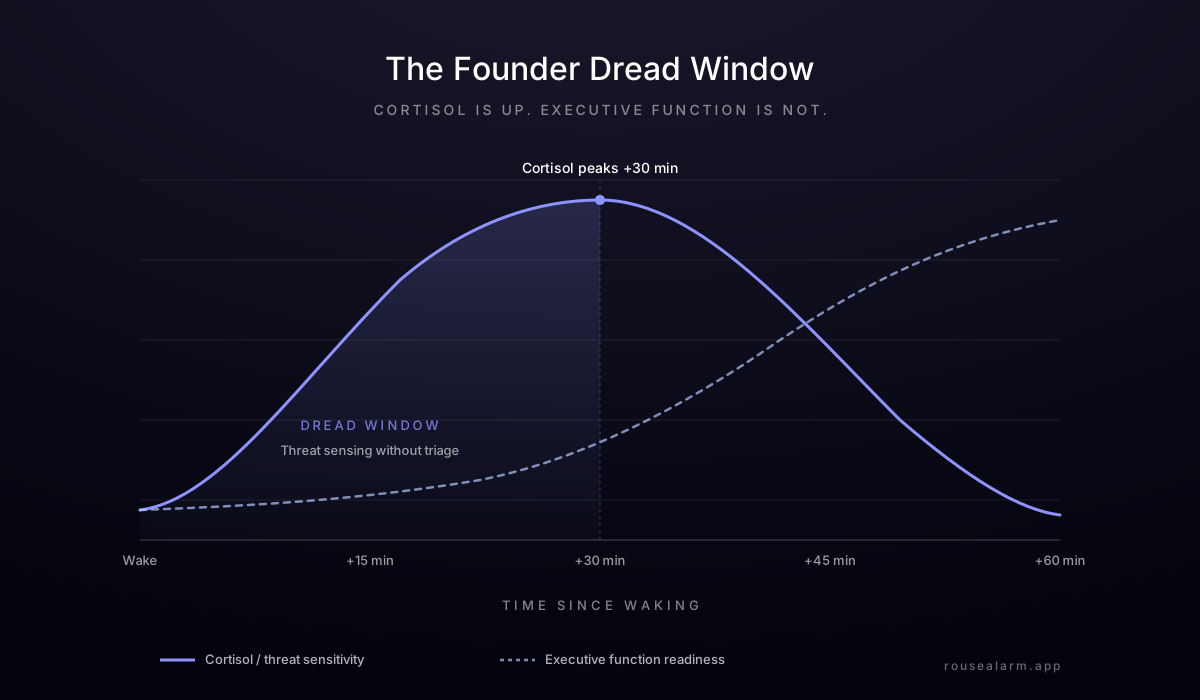
Right around the same window your PFC is booting, your cortisol levels are spiking. The cortisol awakening response (CAR) is a 30 to 75 percent jump in cortisol that peaks roughly 30 minutes after you wake and then settles. Clow et al. 2004 and Fries et al. 2009 both treat it as a normal, useful pulse. It mobilizes energy, it gets you moving, it's part of the wake-up machinery.
But cortisol is also the body's primary threat hormone. When it spikes in someone whose week looks like five sales calls and a runway spreadsheet, it doesn't just provide energy. It raises the brain's threat-detection sensitivity at exactly the moment the prefrontal triage system isn't ready to do anything about it.
Energy without judgment. Threat-sensing without a triage layer. That's the founder-dread window, and it has a mechanism, not a moral. (I went deeper on the cortisol curve in the ADHD morning anxiety post. Same pulse, different threat library.)
By 7:00 your PFC is online. Same fears, but now you can rank them, dismiss two, do something about a third, and ignore the rest. By 7:30 the boulder is gone.
It was never the day. It was the half hour.
Why your brain runs the worst-case scenario before it can triage one
The dread isn't generic anxiety. It's specifically the replaying kind. The "what if I miss payroll" loop. The "what if my best customer leaves" loop. Same five threats every morning.
The brain has a circuit specialized for that behavior, and it's most active when the brain isn't doing anything else.
Neuroscientists call it the Default Mode Network. Buckner, Andrews-Hanna and Schacter 2008 maps it well. The DMN is the network that runs when you're not focused on the outside world. It handles self-referential thinking, mental time travel, simulation of past and future scenarios, and the kind of looping internal monologue that feels like "thinking" but isn't actually solving anything. When you're staring at the ceiling and your mind drifts to the same five worries, that's DMN activity.
Here's the part that maps onto the dread window. Vallat et al. 2018 imaged the brain during sleep inertia and showed that the DMN and the dorsal attention network haven't finished re-establishing their normal anti-correlation yet. Translation: the network responsible for unfocused mental looping is still running, and the network responsible for focusing on something external isn't fully online to interrupt it.
You wake up in DMN-only mode, with cortisol pumping threat-sensitivity into the room.
The clinical literature on rumination, Watkins 2008 and Nolen-Hoeksema, Wisco and Lyubomirsky 2008, is built around this exact loop, just studied in depression and anxiety populations. Repetitive negative thinking gets stuck because the brain isn't engaged in anything that demands the alternative network. Rumination is what the DMN does when the task-positive network has nothing to do.
Founders at 6:14 AM aren't depressed. They're just running the rumination playbook with no other task on the stack.
This is also why the most popular "fix" makes it worse. u/ArtThreadNomad described it on r/getdisciplined, 189 upvotes:
"Every morning, I'd open my laptop, see the thousand pending notifications, the emails, the to-do list, and I'd immediately get hit with a wave of decision fatigue... I'd resort to the classic coping mechanism: scrolling my phone for 30 minutes to get a quick hit of dopamine before facing the real work."
Scrolling at 6:14 is DMN paradise. It's input, not generation. You're not producing anything, you're not committing to a thought, you're not engaging task-positive circuitry. Same with checking email in bed. Same with "let me just answer that one Slack" before getting up. The cortex stays in default mode and the dread stays loud.
The interventions that work share one property. They force generation.
What collapses the window from 30 minutes to 90 seconds
Three properties separate "I went through the motions of waking up" from "I actually moved my brain into a state that can triage threats":
- A real input you didn't predict. Something has to enter your attention from outside that the brain has not modeled in advance. A novel question. An unexpected reply. The DMN can't keep simulating the day if something keeps pulling attention back to a fresh external stimulus.
- A required generated response. Recognition (tap green, say "yes," nod) runs on procedural memory and leaves the DMN running. Generation (forming a coherent sentence in answer to a question you haven't heard before) requires left prefrontal language areas, working memory, and executive function by definition. You cannot ruminate and assemble a novel sentence in the same brain at the same time. One of them has to give.
- A loop that doesn't end until the other side is satisfied. A static challenge ends the moment you "produce." A real forcing function only ends when the other side accepts your engagement. You can't tap-to-dismiss a person.
This is also why "talking it out" interrupts a rumination spiral. It isn't the catharsis, it's the cognitive geometry. While you're forming a sentence in response to another mind, your DMN cannot simultaneously run the worst-case scenario, because both processes need overlapping prefrontal resources. Anti-correlation between the two networks has been the consistent finding in the imaging literature since Fox et al. 2005. When the task-positive network is engaged, default-mode has to step back.
A friend calling you at 6:14 closes the window in about 90 seconds. So does a real conversation with a partner. So does anything that asks for novel verbal output and won't accept silence as an answer.
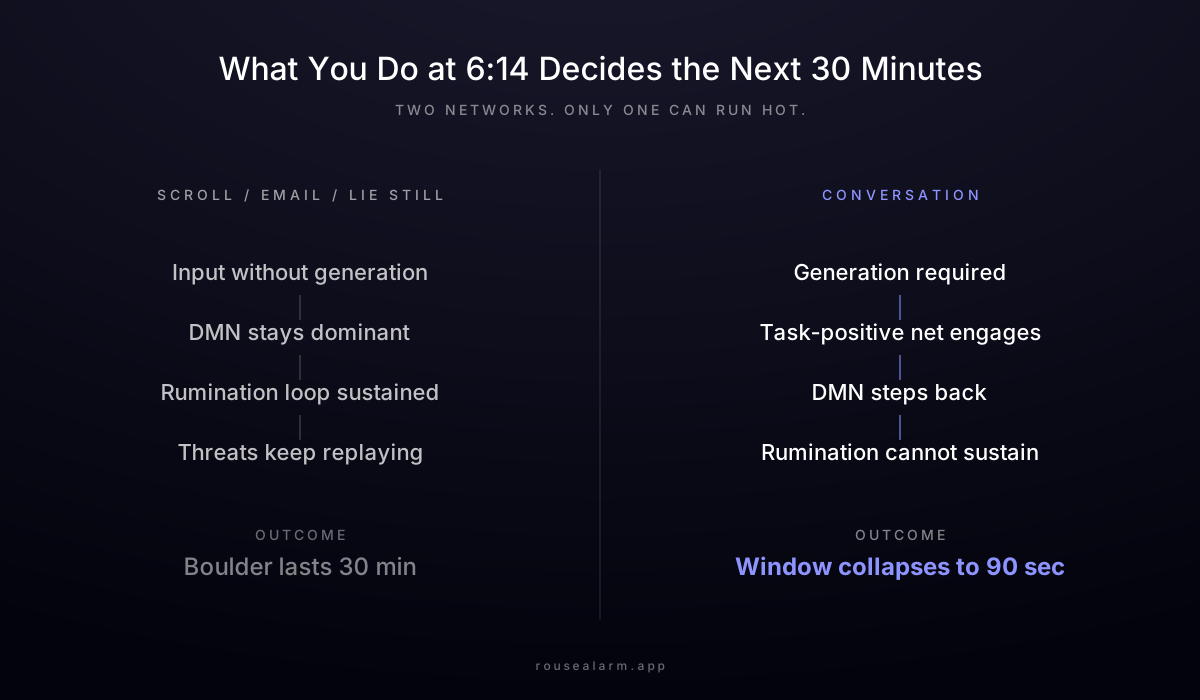
That's why Rouse uses conversation. The alarm fires. The LLM speaks first. You answer, out loud, in actual sentences. The content differs every morning so you can't memorize a route through it, and the alarm only ends when the model is satisfied your responses are coherent enough to count as awake. Coherent, in this context, means generated, which is the same thing as "your prefrontal cortex is online and your DMN is suppressed enough to let it work."
It isn't therapy. It's not pretending to be. What it is is the only stimulus shape I could think of that bridges the body-awake-brain-offline window with active generation, on the bedside table, without requiring another human at 6 AM. (I went deeper on the body-vs-brain wake mechanic in the previous post if that part is interesting on its own.)
When I switched on my own phone last summer, the first thing I noticed wasn't that I woke faster. It was that the boulder didn't show up. By 6:08 the deal that doesn't exist had stopped existing, because I was busy explaining what my actual first task of the day was to something that asked me a follow-up I hadn't planned for. The dread didn't have the network bandwidth.
The window doesn't get bridged. It gets collapsed.
Run the diagnostic tomorrow morning
Don't trust me. Test it.
For the next seven mornings, write two times in a phone note. The first is the moment your motor cortex says you're up. Feet on floor, walking, kettle on. The second is the moment you produce a real generated sentence to another person. A reply to a partner that isn't "yeah." A Slack message to a co-founder that took more than four words. The first email of the day where you actually composed something.
The gap between those two times is your dread window.
Under 5 minutes? You have an external forcing function. A kid, a partner, a dog, a 9 AM standup, a commute. Don't change anything. The thing that's supposed to be doing this for you is doing it.
Twenty to ninety minutes? You're paying daily founder tax to a known mechanism with a known fix. The fix isn't a louder alarm and it isn't more meditation, because both of those leave the brain in default mode. The fix is the one stimulus shape that forces generation when willpower is at zero. (I wrote about the same gap from a different angle, framed around what corporate jobs were doing for you that you didn't notice.)
The boulder isn't the business. The boulder is the half hour where your brain is wired to ruminate and not equipped to triage. Once you see it, you can't unsee it. Once you can name it, you can build around it.
If you've already tried the louder alarms, the colder showers, the 6 AM journaling, the meditation app, and the boulder still shows up at 6:14, set Rouse for tomorrow morning. Talk to it. See what happens to your kitchen at 6:15. I'd love to know if it lands.
FAQ
Is "founder dread" real or am I just anxious? The 30-minute window is real. Sleep inertia (Tassi & Muzet 2000, Hilditch & McHill 2019), the cortisol awakening response (Clow et al. 2004), and DMN dominance during that window (Vallat 2018) are all documented. Whether you'd also pass a generalized-anxiety screen is a separate question. The morning window affects every brain. Founders just have more business-specific material to feed it.
Why doesn't checking email first thing fix it? It engages me. It engages your visual cortex and threat-detection circuitry. It does not require you to generate anything. Reading is recognition, not generation. You're feeding the rumination loop input, not interrupting its network.
Does Rouse claim to treat anxiety? No. Rouse is an alarm. It bridges a 30-minute neurological window by forcing verbal generation. If your morning anxiety is rooted in something larger than wake-up mechanics, an alarm app won't fix it, and I'm not going to pretend otherwise.
Kuba builds Rouse, an iOS alarm that wakes you up by holding a real conversation with you until you're actually awake. If you've already tried the louder, smarter, harder versions and your boulder still shows up at 6:14, set Rouse for tomorrow morning and tell me how it goes.