Your Hype Playlist Wakes Your Body. It Doesn't Wake Your Brain.
Eminem at 5 AM gets your heart rate up. He doesn't get your decision-maker up. The brain region music doesn't reach is the one your alarm needs.
May 6, 2026
Your Hype Playlist Wakes Your Body. It Doesn't Wake Your Brain.
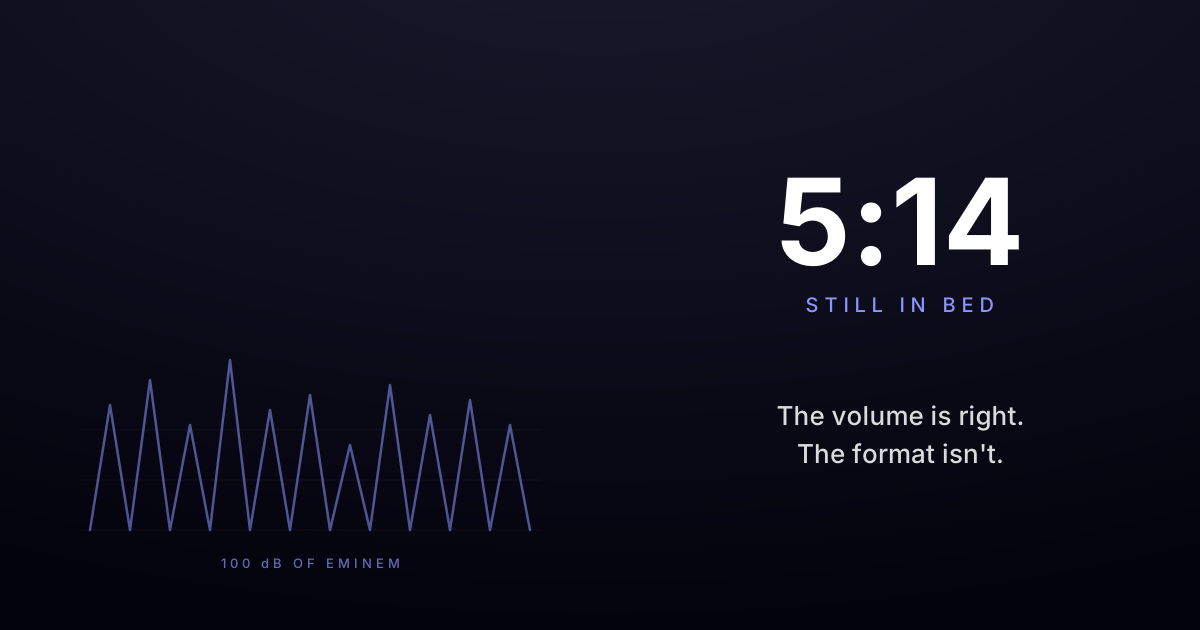
5:14 AM. The Bluetooth speaker on my dresser hits the drop in Till I Collapse. Eminem is, technically, in the room. My heart rate has jumped from 54 to 71. My eyes are open. I'm awake by every metric you can put on an Apple Watch.
I am also still in bed twenty-eight minutes later, having let the same playlist roll through three more songs while I "rested my eyes."
The hype playlist did exactly what it was supposed to do. It got my body up. It just doesn't touch the part of my brain that decides to stand up.
I used to think this was a discipline problem. It isn't. There's a clean neurological reason it keeps happening, and once you see it, you stop blaming yourself for the song choice and start asking whether any song was ever going to do this job.
In this post, you'll learn:
- Why "set a hype song as your alarm" is the most repeated piece of bad advice in fitness, and what your nervous system is actually doing when the song hits
- The brain region music can't reach (the one that decides whether your feet go on the floor)
- Why generating a sentence engages that region and receiving a sentence does not
- What this means for every passive-audio wake-up trick you've ever tried (sunrise alarms paired with lo-fi, smart speakers playing news, Spotify "Morning Hype" playlists)
8 min read
The 5 AM gym world is built on a wake-up trick that doesn't actually wake your brain
Open r/Fitness and scroll to the Bi-Annual Music Megathread. The same ritual repeats every six months: people swap pre-workout songs the way climbers swap routes. Trampled Under Foot. Animal I Have Become. Tupac vs. Gramatik mashups. The unspoken assumption underneath all of it is that the right song will get you out of bed.
r/CrossFit runs the same threads. The orangetheory crowd traffics in playlists for the 5 AM class. Spotify publishes a "Wake Up Happy" playlist that has eight million followers, and Apple Music maintains thirty-plus morning-hype playlists curated by humans whose actual job that is. The wake-up-with-music ritual is the most universally repeated piece of fitness advice on the internet.
Now read any "I keep snoozing" thread on r/getdisciplined. The user has tried all of it. Loud music. Multiple speakers. Three devices. One commenter in a 51-comment thread on r/GetMotivated wrote: "My alexa is on my nightstand right next to my bed (arms length, so I don't have to get up to turn it off)... But I ALWAYS hop back in bad." She was using a hype song. The hype song lost. (source)
The contradiction is obvious once you let yourself see it: if hype music were actually a wake-up tool, the people making the most aggressive use of it would have the fewest snooze problems, and they have the most. Something about the mechanism doesn't match the ritual.
What music actually does to your brain (and the one neighborhood it skips)
Music is processed across an unusually wide network of the brain, which is part of why it feels so big. The auditory cortex picks up the sound. Right-hemisphere temporal regions handle melody and contour. Limbic structures (amygdala, nucleus accumbens, ventral striatum) handle emotional tagging and reward, and Valorie Salimpoor's 2011 Nature Neuroscience paper showed that peak emotional moments in music produce nucleus-accumbens dopamine release in the same reward circuit that lights up for food and drugs. The chills you get from a drop are a real biochemical event.
Stefan Koelsch's 2014 review in Nature Reviews Neuroscience maps the rest of the network: music engages the limbic system, the autonomic nervous system, and the auditory pathway. Heart rate accelerates. Cortisol shifts. Your sympathetic nervous system gets tapped on the shoulder. All of that is real, and all of it is happening when the bass drops at 5:14 AM. None of it is what's wrong.
The thing music doesn't reliably engage is the dorsolateral prefrontal cortex (DLPFC). That's the part of the brain that runs executive control, working memory, and "should I do this thing or not" decisions. It's the seat of the morning vote.
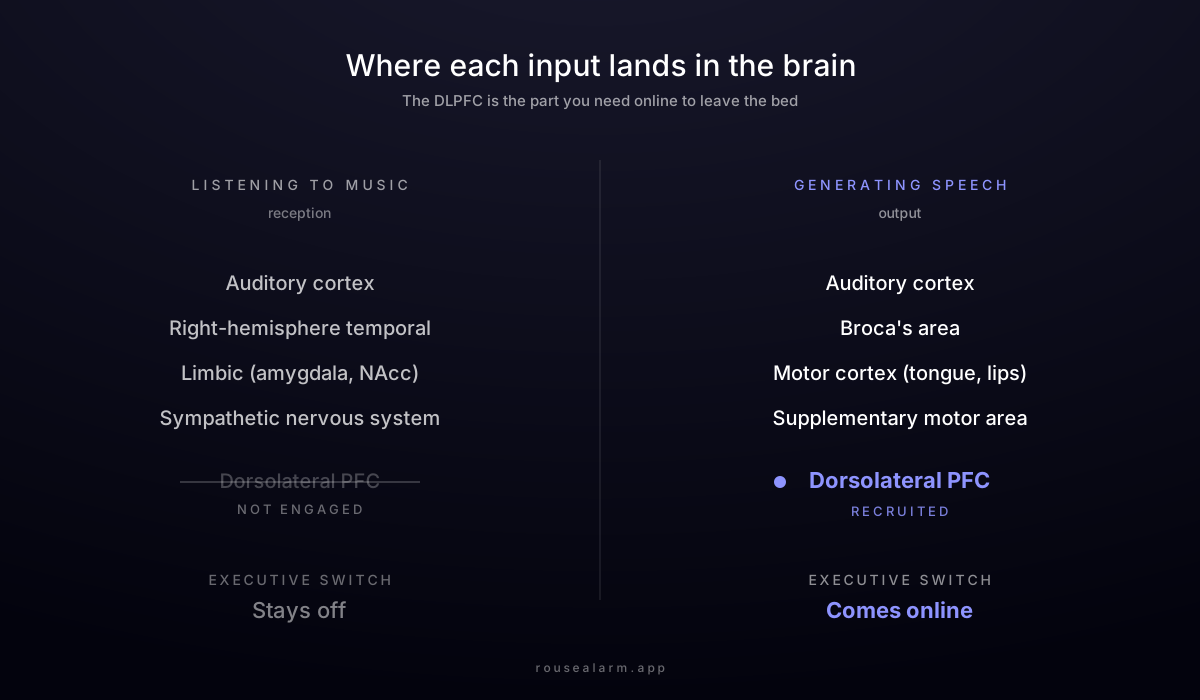
Music doesn't require DLPFC. You can listen passively, tap your foot, have an emotional response, all without engaging the executive switch. The brain treats music more like a sensory wash than a problem to solve, which is why it works beautifully in the gym (the executive is already online and you want the limbic boost) and fails as a bridge between asleep and awake.
I wrote about the "asleep but awake" gap separately in Your Body Wakes at 6, Your Brain Wakes at 7:30. When an alarm fires, your DLPFC isn't online yet. Vallat and colleagues' 2018 NeuroImage paper showed Default Mode Network dominance and reduced PFC activation during sleep inertia, with the executive functions of the DLPFC arriving last; Tassi & Muzet 2000 and Hilditch & McHill 2019 both put the executive deficit window at 5 to 30 minutes, sometimes longer.
So at 5:14 AM, while Eminem is in the room: your auditory cortex is processing him, your limbic system is having a feeling about him, your sympathetic nervous system is putting your heart rate up, and your DLPFC is still booting. The volume isn't the problem. The format is. Music skips the meeting where the decision gets made.
What generating a sentence does that hearing one doesn't
Reception and generation are not the same neurological event. You can listen to a sentence with a different brain state than you can produce one, and the difference is exactly the variable we're chasing. Indefrey & Levelt's 2004 Cognition meta-analysis of word-production studies mapped the network: producing a single spoken word recruits Broca's area, the left inferior frontal gyrus, the supplementary motor area, the motor cortex for tongue and lips, and the dorsolateral prefrontal cortex for word selection and monitoring. Hickok & Poeppel's 2007 dual-stream review in Nature Reviews Neuroscience maps it the same way: the dorsal stream handles speech production and pulls heavily on frontal regions that comprehension alone doesn't need.
Listening lights up auditory cortex and parts of temporal cortex. Producing speech lights up auditory cortex and a much wider frontal network including the executive scaffolding.
The same asymmetry shows up from the memory side. Slamecka & Graf's 1978 Journal of Experimental Psychology paper ran the experiments that became known as the generation effect: items you generate yourself are remembered substantially better than items you read passively, even when the underlying word is the same. Generation pulls in deeper processing, more frontal engagement, more executive scaffolding. Reception is cheap. Generation is metabolically expensive, which is exactly why it works.
The brain region you need online to leave the bed is the same brain region that comes online when you have to construct a sentence. Hearing one doesn't get you there. Producing one does.
This is the missing variable in the morning routine industry. Every "listen to a podcast as you wake up" hack, every "play Tony Robbins as your alarm," every sunrise-and-bird-sounds combo is a reception trick. The brain doesn't wake by input. It wakes by output, and that's also why self-talk shows up so reliably in successful 5 AM gym people: they're forcing the DLPFC online by generating language at it.
Why this kills every passive-audio alarm hack you've already tried
Once you see this, a bunch of confused observations from the alarm graveyard fall into line. The Sonic Bomb wakes you and you turn it off. The songbird sunrise app wakes you and you turn it off. The smart speaker reading the morning news wakes you and you turn it off. The Spotify "Wake Up Hype" playlist wakes you and you turn it off. The format is identical: they all stream input at you, and none of them require output from you.
Habituation makes it worse. I've written about why every alarm tone stops working after roughly seven days: the orienting reflex (Sokolov 1963; Thompson & Spencer 1966) downgrades repeated stimuli into the "background" bin, and a song you wake up to every morning gets filed next to the refrigerator hum inside two weeks. The volume can be 95 dB. Your brain has already moved on.
So you do what every fitness Reddit thread eventually does. You buy a louder thing. A vibrating bed pad, a second speaker, a smart bulb that strobes. You're attacking the volume axis when the variable was never volume. The variable is whether the format requires you to produce anything.
This is also why the loud-puzzle alarm apps (Alarmy, the barcode-scan ones) work for some people for a week and then stop. Solving a puzzle does require some cognition, but most of these puzzles can be done as procedural tasks. The same way you can dismiss a swipe-to-stop alarm in your sleep with no memory of doing it (procedural memory, same mechanism), you can solve a "scan this barcode in the bathroom" task without ever bringing the executive online. The puzzle becomes a habit. The brain delegates it.
What doesn't get delegated is producing a coherent sentence about something the prompt actually asked you. Your tongue and your DLPFC are on the same circuit, and if the prompt requires a sentence and won't accept silence, you can't dismiss it without coming online. That, mechanically, is what an LLM voice conversation does: the alarm fires, an LLM asks you something specific that requires a real answer, and producing the answer pulls Broca's area, motor cortex, and DLPFC online in the same gesture. By the time you've finished the sentence, the executive switch is on, and the deliberation that used to happen four minutes after the alarm now happens during it.
That's the only auditory format I know of that gets the right brain region into the right state at the right minute.
What to do tomorrow morning
The takeaway isn't "stop using music." Music is good for the gym, the run, and everything that happens after you're vertical. It's just not the right tool for the alarm-to-floor gap, because that gap requires output, not input.
A few moves to try tomorrow:
- If you have a hype playlist as your alarm, switch the alarm role to something that requires you to speak (a real conversation, a journaling-out-loud habit, a partner who asks you a question). Keep the hype playlist for the actual workout warm-up, where it works.
- Notice the difference between "I heard the alarm" and "I responded to the alarm." If you can dismiss it without producing language, the format isn't doing the work.
- Next time you scroll a "what's your wake-up song" thread, ask the better question: what did I have to say out loud before my feet hit the floor? That's the variable.
That's why Rouse uses a conversation. The alarm fires, the LLM starts a real exchange, and the only path through the dismiss is your own tongue. The mechanism is doing the same thing the morning gym people are doing on their own (talking themselves vertical), except the conversation is started for you, so you don't need DLPFC online to initiate it. You need it online to participate, which is a much shorter activation step.
If you've been blaming your song choice or your willpower for the fact that loud music doesn't get you out of bed, it's neither. You've been trying to solve a generation problem with a reception tool.
If you're in for the experiment, set Rouse for tomorrow morning. I'd love to know whether the first time you have to actually answer something at 5:14 AM lands the way it's been landing for me.