You Laid Out Your Gym Clothes. You Walked Past Them. Here's What Friction Removal Can't Fix.
Clothes on the floor, coffee ready, alarm across the room. You still didn't go. The friction removal industry has been solving the wrong layer.
May 9, 2026

You Laid Out Your Gym Clothes. You Walked Past Them. Here's What Friction Removal Can't Fix.

I have a folder of laid-out gym clothes I never put on. Three pairs of running shoes by the door. A pre-workout shaker on my nightstand at 4:50 AM with the powder pre-dosed in the lid the night before, just shake and drink, no thinking required.
I walked past all of it on Tuesday and went back to bed.
The advice industry that told me to do this prep is solving for the wrong layer.
In this post, you'll learn:
- Why every "5 AM gym morning" article tells you the same five friction-removal tricks, and which axis of behavior they're actually aimed at
- The 15-30 minute window where the prep your 10 PM self set up doesn't reach the brain that's supposed to execute it
- What successful morning exercisers actually do that isn't friction removal, and why it's almost always verbal
7 min read
Every "5 AM gym tip" list is the same five tricks
Open any of them. They say variations of the same five things.
Lay out your clothes the night before. Put your alarm across the room. Pre-make your coffee. Fill a glass of water and put it on your nightstand. Sleep in your gym clothes if you have to.
I've done all of it. Three pairs of running shoes by the door is not a metaphor. The clothes get folded on the chair the night before. The pre-workout sits in the shaker. I once filled the kettle and put a teabag in the cup at 11 PM so all the 5 AM version of me had to do was hit the button.
Turns out there's a name for what every one of those tips is doing.
BJ Fogg's behavior model says a behavior happens when three things show up at the same time: motivation, ability, and a prompt. Behavior = M × A × P (Fogg 2009, Persuasive '09 conference proceedings, doi 10.1145/1541948.1541999). If any one is missing or low, the behavior doesn't fire.
Friction removal is the Ability lever. If the clothes are halfway across the apartment, ability is low. If they're already on a chair beside you, ability is high. Same with the alarm position, the coffee, the shoes by the door. Every "morning routine" listicle is solving for the same axis.
There's a second mechanism stacked on top. Laying out clothes is what behavior researchers call an implementation intention. Gollwitzer 1999 (American Psychologist 54(7), doi 10.1037/0003-066X.54.7.493) showed that "if-then" plans, anchored to a specific cue in the environment, dramatically increase follow-through compared to plain goals. The folded clothes ARE the if-then. If you see them when the alarm goes off, then you put them on and go.
Both mechanisms are real. Both have replicated for decades. The Webb and Sheeran meta-analysis pooled 47 studies and showed implementation intentions move the needle on actual behavior, not just stated intent.
So why did I walk past them on Tuesday?
This is where the listicles end, and where the actual mechanism starts.
Sleep inertia is the layer the prep can't reach
There's a 15-30 minute window after waking where executive function is degraded and decision-making is impaired, and it can stretch longer if you're sleep-deprived or fragmented. The research calls it sleep inertia. It's been characterized for decades (Tassi & Muzet 2000, Sleep Medicine Reviews, PMID 12531174; Hilditch & McHill 2019, Nature and Science of Sleep, PMC6710480).
The prefrontal cortex, the part of your brain you'd want online to take a cue and convert it to action, is the last region to come back. Motor regions reboot fast. Brainstem is fine. The deliberation engine takes a while.
Vallat et al. 2018 (PMID 30223060) put people in fMRI right after waking and showed that during sleep inertia, the brain is running closer to the default-mode network than the task-positive network. The DLPFC, your deliberation engine, isn't just slow. It's running the wrong program. It's wandering. It's daydreaming. It's not great at translating "the clothes are on the chair, put them on" into the act of putting them on.
Now overlay that on the Fogg model.
Friction removal raises Ability. The cue is set. The prompt fires when the alarm goes off. What's missing isn't the M, A, or P of the behavior model. What's missing is the cognitive stage that converts the prompt into the action. The implementation intention requires someone to read the if-then and execute the then. At 5:14 AM that someone is offline.
The intention-behavior gap turns out to be one of the better-replicated effects in social psychology. Roughly half of stated intentions translate to behavior (Sheeran 2002, European Review of Social Psychology 12(1)). The Sheeran and Webb 2016 review followed up with a thirty-year retrospective. The gap doesn't close because of bad planning. It closes when the deliberator that translates plan into action is actually online when the cue fires.
Sleep inertia is the gap.
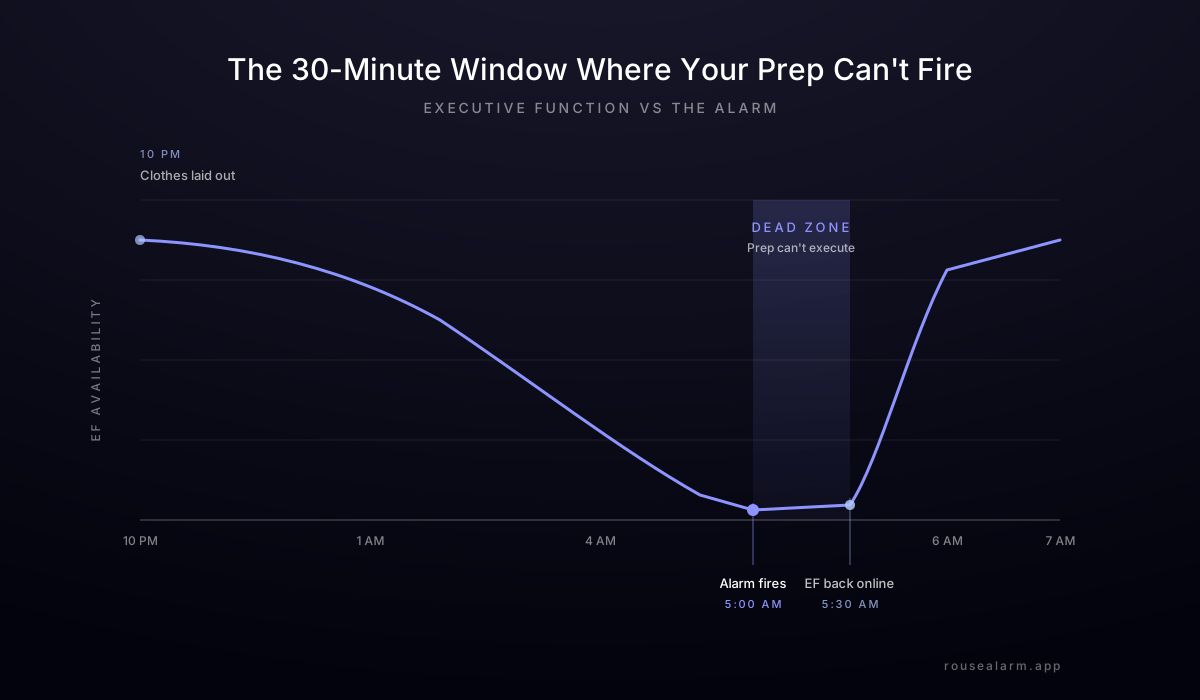
Last Tuesday I set a 5:00 alarm. By 5:14 I'd negotiated my way out of going, even though I'd folded the clothes at 10:30 the night before with a clear plan. The plan was fine. The shoes were fine. The shaker had powder in it. What failed was the part of the morning where the plan was supposed to take over from the negotiator, and the negotiator stayed at the table because the deliberator that should have ended the negotiation was running the default-mode network instead. Same week I wrote about how moving before motivation wakes up is the only fix that survives sleep inertia, and that piece is the companion to this one.
A laid-out gym outfit is a perfectly drafted memo on a desk that nobody is sitting at.
What morning exercisers actually do, and why it's almost always verbal
Here's the part that surprised me when I started reading the persona research.
The successful morning exercisers in the qualitative interviews and Reddit threads I went through don't talk about clothes or coffee. They talk about talking to themselves.
A morning runner from r/xxfitness said "I tell that little voice in my head to shut up." A 5 AM gym person on r/orangetheory said "I gave myself a talking to." A trainer interviewed by BuzzFeed said her successful morning clients "remind themselves out loud how much better the day will go." A long crossfit thread had two top comments where the people who actually showed up at 5:30 said almost the same thing: they have an internal monologue going from the second the alarm fires.
This is not a coincidence and it isn't a personality trait. It's a mechanism.
The generation effect (Slamecka & Graf 1978, Journal of Experimental Psychology: Human Learning and Memory 4(6), doi 10.1037/0278-7393.4.6.592) shows that information your brain generates is encoded and acted on more strongly than information it reads. Reading "go to the gym" written on a sticky note is a recognition task. Saying "I am going to the gym" out loud is a generation task. The two recruit different networks.
Generation pulls in Broca's area, the left DLPFC, and motor speech regions (Indefrey & Levelt 2004; Hickok & Poeppel 2007). And the DLPFC is exactly the region that's offline during sleep inertia. Forcing yourself to generate language gives the deliberator a reason to come online. It's not a bypass. It's a boot sequence.
Self-distanced self-talk goes a step further. Kross et al. 2014 (Journal of Personality and Social Psychology 106(2), PMID 24467424) showed that talking to yourself in the second or third person ("Casey, you've done this before, get up") recruits prefrontal cognitive control more than talking in the first person. There's a sport-psychology literature on top of it (Tod, Hardy & Oliver 2011 meta-analysis, Journal of Sport & Exercise Psychology 33(5)) showing verbal self-regulation reliably improves performance.
The morning gym people aren't more disciplined than you. I wrote about this in more depth in the morning gym people aren't more disciplined, they're more verbal. They've stumbled onto the lever that boots the deliberator. The clothes on the chair didn't do it. The coffee didn't do it. The alarm position didn't do it. The thing that did it was forcing themselves to generate words, out loud or in their heads, in the first 30 seconds after the alarm.
That's the bet behind Rouse. The alarm fires, an LLM asks something specific back, and you have to actually answer in words to make it stop. It's not friction. It's not motivation theater. It's a forced generation event in the first 30 seconds, when the deliberator needs the most help coming online and the laid-out clothes have nothing to say.
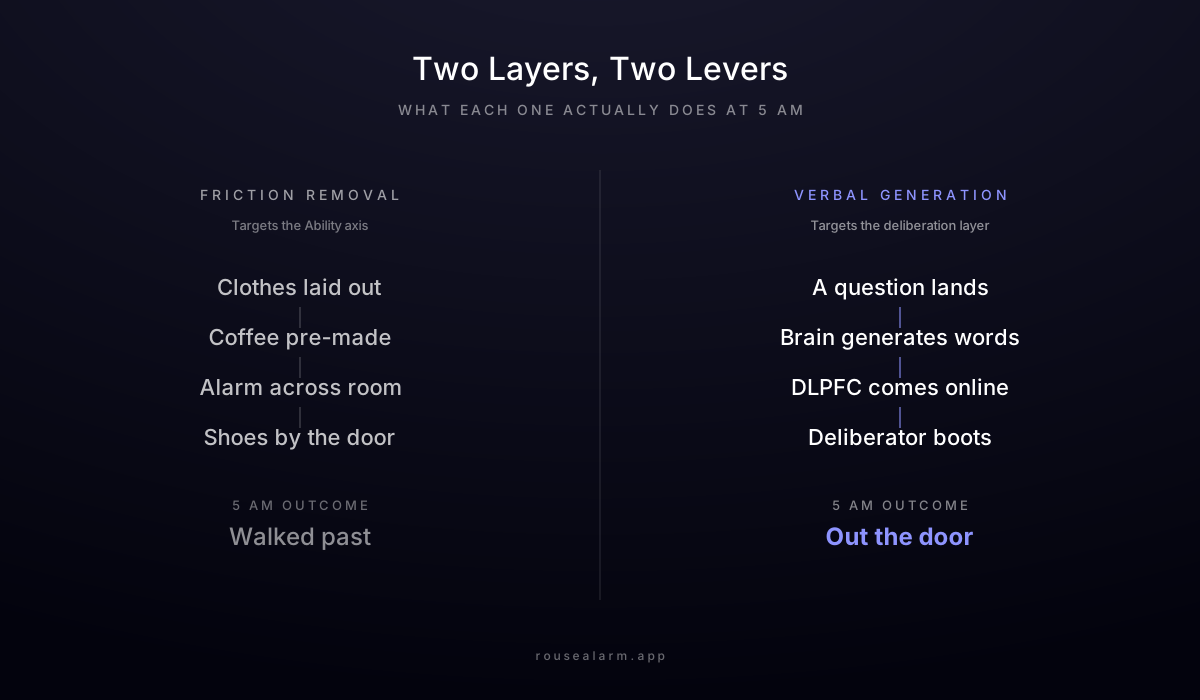
The clothes don't ask you anything. They sit there. They wait. The morning version of you walks past them.
Closing
Friction removal handed your 5 AM brain a perfectly arranged scene. The 5 AM brain doesn't have a problem with the scene. It has a problem with the deliberator. That's the layer the listicles can't reach, and it's the layer your laid-out clothes were never built to fix.
If you've already laid out the clothes and put the alarm across the room and the gym still loses three mornings a week, the missing piece is probably language, not logistics. Try saying the next thing out loud the next time the alarm fires. Or set Rouse for tomorrow morning and let it do the asking. I'd love to know if it lands. Same conversation continues in the bed-to-door decision chain piece if you want to see where the decision points actually stack.