You're Paying $12 to NOT Work Out. The Cancellation Fee Can't Beat Your Bed at 5 AM.
Why the $12 cancellation fee that worked in theory loses to your bed in practice. A behavioral-economics explainer for fitness brains.
May 15, 2026
You're Paying $12 to NOT Work Out. The Cancellation Fee Can't Beat Your Bed at 5 AM.
Why loss aversion, the most powerful lever in behavioral economics, goes quiet exactly when you need it.
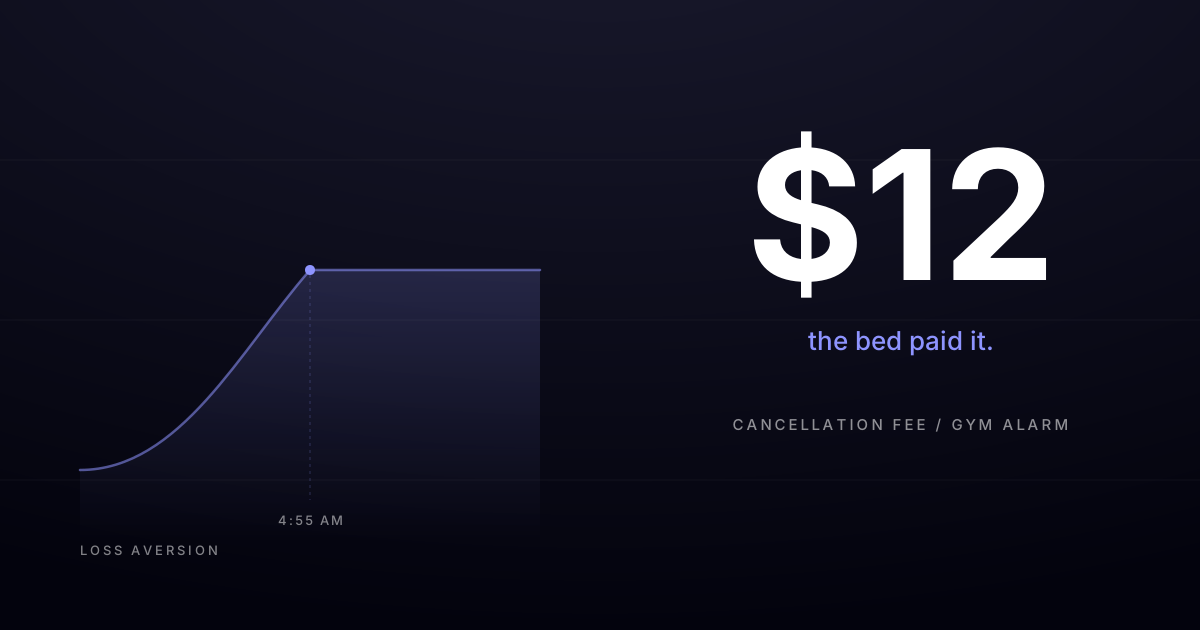
Last winter I paid $12 to lie in bed for an extra hour.
Not on purpose. I'd booked a 5:30 AM Orangetheory class the night before, partly because I wanted to go, partly because the cancellation fee was supposed to lock me in. I'm a cheapskate. The fee was supposed to be the variable. Future-me had checked the math, and future-me had agreed: $12 of guilt > 60 minutes of sleep. Easy.
The alarm rang at 4:55. I had the phone in my hand. I tapped "late cancel" before my feet ever touched the floor.
The $12 didn't even enter the decision. It was like it wasn't there.
Turns out there's a name for what just happened, and it's not laziness. It's the most-replicated finding in behavioral economics, and it can't fire at 5 AM.
In this post, you'll learn:
- What loss aversion actually is, and why behavioral economists call it the strongest lever in their toolkit
- Why your brain can't run the loss-aversion math during the first 15 minutes after the alarm
- The "two-people-on-your-credit-card" problem: why future-you and now-you are negotiating against each other
- What actually works when the fee doesn't
7 min read
Loss aversion is the most reliable bias in behavioral economics. Mostly.
Quick refresher. In 1979, Kahneman and Tversky published the paper that became prospect theory. The headline finding: losses hurt about twice as much as equivalent gains feel good. Losing $20 stings roughly twice as much as winning $20 feels great.
That asymmetry is loss aversion, and it's been replicated for forty-five years across labs, lotteries, retirement plans, and gym memberships. It's the reason "lose 100 points if you skip a workout" beats "earn 100 points if you do" in behavior-change studies. It's the reason your credit card company sends you a "you'll lose your status" email instead of a "keep your status" one. It works.
Orangetheory, ClassPass, F45, SoulCycle, every boutique studio. They all built late-cancel fees on this foundation. The fee is a commitment device. You pre-commit by booking. Then the fee makes skipping more painful than going. Done. Behavioral economics says you should go.
And on r/orangetheory, the top-voted comment on a thread asking "how often do you late cancel?" is this:
"Couple times a month maybe and I feel 0 guilt lol. I roll right over and get my $12 worth of sleep."
228 upvotes. Another one in the same thread, score 222:
"That $12 cancellation fee might as well be $1200 because that's how I feel about it."
Two people, same studio, same fee, same loss-aversion lever. Wildly different brains. One pays. The other doesn't even feel it.
The question isn't who's right. The question is what predicts which one you'll be on any given Tuesday at 4:55 AM.
The answer is what part of your brain is online.
Loss aversion lives in the brain regions that wake up last
In 2007, Tom, Fox, Trepel & Poldrack ran the fMRI study that mapped loss aversion to specific neural real estate. They put people in a scanner, offered them 50/50 gambles, and watched what lit up. The regions that predicted how loss-averse each person was: the ventral striatum and the prefrontal cortex (Tom et al. 2007, Science 315: 515-518). Not the amygdala. Not the insula. The reward-valuation circuit plus the executive cortex.
Quick gut-check on those two regions. The ventral striatum is your reward-prediction engine. It's what computes "how much do I want this thing." The prefrontal cortex does the math on consequences. It compares future costs against present comfort.
Now look at what we know about the first 15-30 minutes after the alarm.
Tassi & Muzet (2000) and Hilditch & McHill (2019) call this window sleep inertia, and they've measured it precisely. Reaction time is slower than after 24 hours of total sleep deprivation. Decision speed crashes. Working memory drops. Executive function (the prefrontal cortex specifically) is the slowest brain region to come back online.
Then Vallat et al. (2018) used fMRI to watch what's happening up there during sleep inertia. The default mode network (the brain region that runs your inner monologue, your daydreams, your "I'm too tired to do this" autobiographical narrator) is dominant. The dorsolateral prefrontal cortex, the part that runs executive control, is suppressed.
Translation: the two brain regions that do loss-aversion math are the two regions least online at 5 AM.
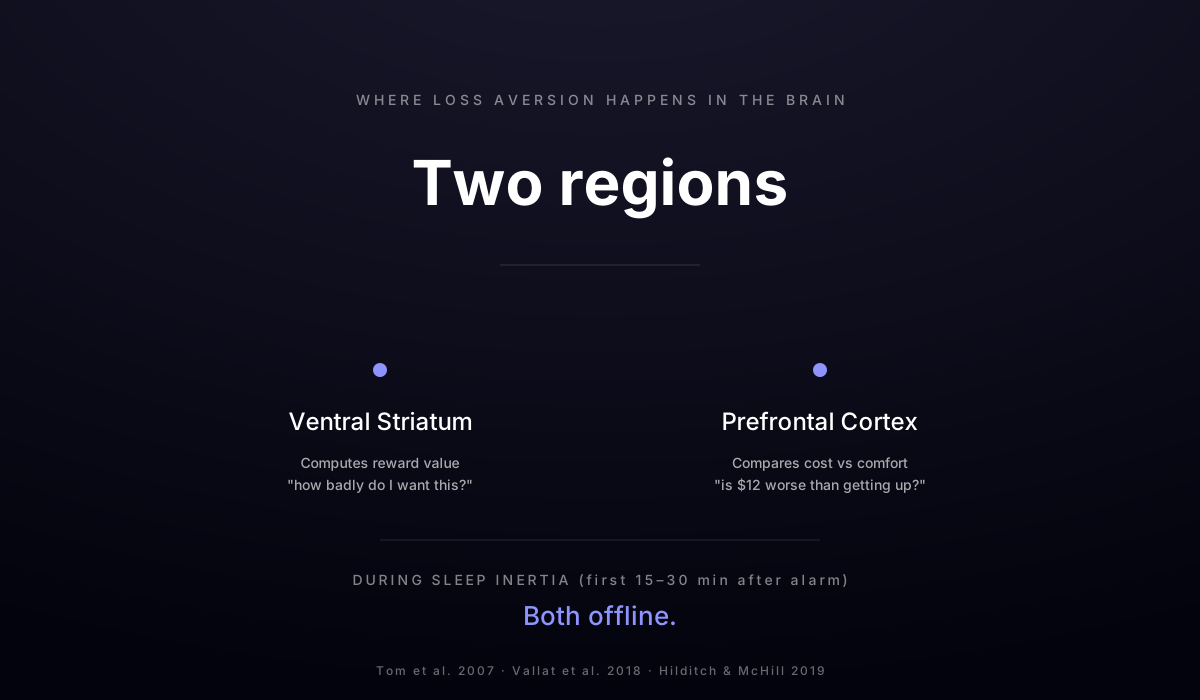
The fee didn't disappear. It just couldn't be priced by the part of you that was awake.
You-yesterday and you-now have different credit cards
There's a second mechanism stacked on top of the offline-cortex problem, and it's the one that explains the guilt asymmetry on r/orangetheory.
Loewenstein (1996) called it the hot-cold empathy gap. When you're in a "cold" state (calm, fed, rested, on your couch at 9 PM) you systematically underestimate how powerfully a "hot" state will hijack your decision-making. You-at-9-PM genuinely thinks $12 will be enough. You-at-9-PM is not the one making the call.
David Laibson formalized the math side of this in 1997 with hyperbolic discounting: humans don't value future costs and present rewards on the same curve. Sleep right now is enormous. $12 charged tomorrow on a card statement you'll see in three weeks is rounding error.
Stack the two and you get the structure of what happened to me at 4:55 AM:
- Future-me at 9 PM, cold and rested, priced the fee at $12 and the workout at +∞.
- Now-me at 4:55 AM, hot and exhausted, prices the bed at +∞ and the fee at, charitably, zero.
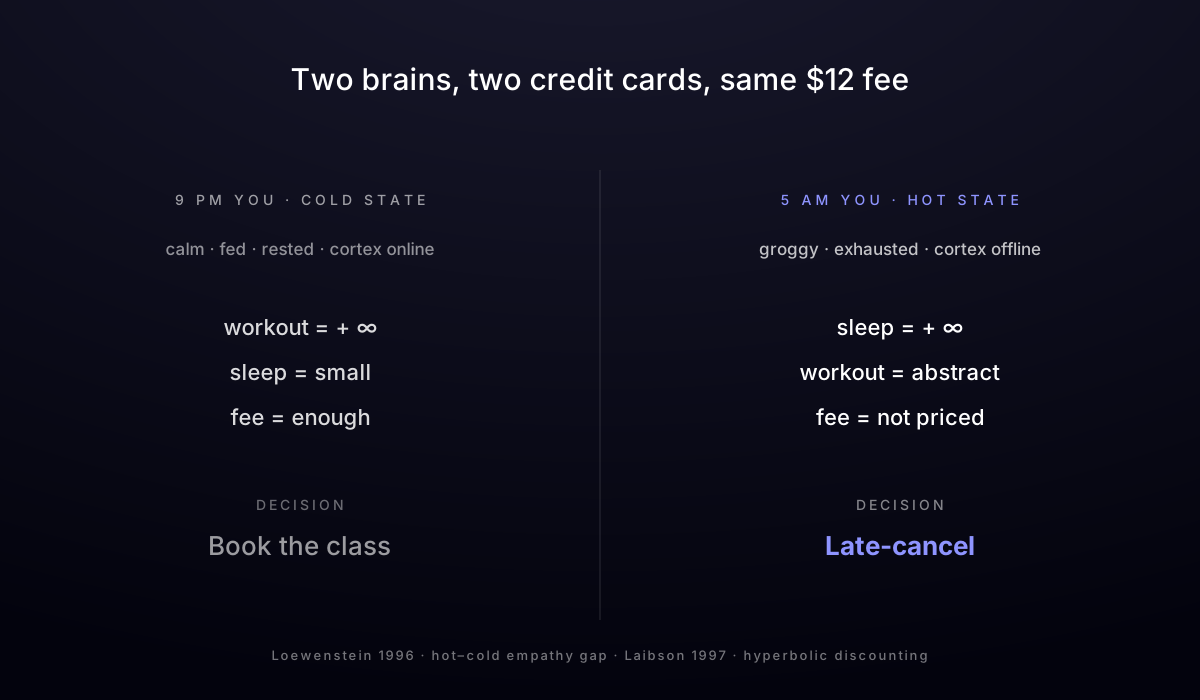
The booking happened on future-me's credit card. The cancellation happens on now-me's. They're two different brains making two different math problems on what they think is the same incentive.
The fee isn't bad design. It's a commitment device aimed at the brain that booked the class. That brain isn't the one in the room when the alarm rings.
What actually works isn't a stronger fee. It's a different brain region.
The conclusion behavioral economists kept reaching for (make the fee bigger!) is wrong, or at least incomplete. If $12 doesn't price-evaluate at 5 AM, $50 doesn't either. Loss aversion is offline. You can't make an offline circuit fire by giving it bigger inputs.
What you can do is shift which part of the brain has to be online to dismiss the alarm.
Sound alarms don't engage the prefrontal cortex. You can dismiss a beep with the same procedural-memory loop you use to swat a fly. Your finger finds the snooze button. Your cortex isn't involved. This is why "I have no memory of turning it off" is so universal. You didn't need a memory, because the part of the brain that forms memories wasn't asked.
A conversation is different. Generating language, answering an actual question, finishing a sentence, holding a thread for thirty seconds: that work recruits Broca's area, the left dorsolateral prefrontal cortex, and the motor cortex (Indefrey & Levelt 2004; Hickok & Poeppel 2007). The same prefrontal real estate that does loss-aversion math. The same region that's suppressed during sleep inertia.
The trick isn't to appeal to your prefrontal cortex with a bigger penalty. It's to load your prefrontal cortex with input that requires response.
This is why I wrote Rouse. The alarm fires, a voice asks me how I'm feeling, what I'm planning to do this morning, why I set this alarm at all. I can't dismiss it by tapping a button. I have to talk back. Talking back boots the cortex. Booting the cortex makes the $12 fee, the 6 AM class, the version of me that booked it last night, all of that, visible again.
I'm not negotiating with my bed anymore because the part of me that does the negotiating is finally in the conversation.
It also closes the credit-card gap. Now-me and yesterday-me are no longer two different brains running two different math problems. They're the same brain, both online, both invited to the table at the moment the decision actually gets made.
You don't beat the bed with a bigger fee. You beat the bed by being awake enough to remember why you booked the class.
If this maps to you
If you've already laid out the clothes, paid the fee, set the three alarms, and you're still losing to the duvet four mornings a week, the lever you're missing isn't a heavier penalty. It's a louder cortex.
Set Rouse for tomorrow morning. Book the class. See what happens when the part of you that priced the fee is actually in the room when the alarm rings.
I'd love to know if it lands.
Related reading:
- You Laid Out Your Gym Clothes. You Walked Past Them. Here's What Friction Removal Can't Fix. (the positive-incentive version of the same brain-regions-offline problem)
- Your 9 PM Self Sets the Alarm. A Stranger Wakes Up to It. That's Why the Gym Loses. (the temporal-self side of the two-credit-cards problem)
- Your 5 AM Brain Is a World-Class Excuse Generator. The Part That Catches Excuses Isn't Online Yet. (why the DMN runs the argument when the DLPFC is offline)
FAQ
Doesn't loss aversion work for some people who never cancel? Yes. Read the r/orangetheory threads and you'll see two groups: people who never late-cancel, and people who do it once a month without guilt. The difference correlates with how much of their prefrontal cortex is online at alarm-time, which is partly genetic, partly chronotype, partly sleep debt. The fee isn't useless. It's load-bearing for the people whose cortex boots fast. For everyone else, it's a $144/year tax on the brain region the studio's commitment device assumed they had.
Wouldn't a bigger fee fix this? Past a certain threshold, fees become reasons to never book at all. The top comment in the r/orangetheory thread on cancellation policy: "Don't pre-book and you can't get charged is my motto lol." You can't make the lever stronger without losing the people you wanted to commit. The lever itself is the wrong shape.
Isn't this just willpower? Willpower is what you call loss aversion when it works. When it doesn't, you call it laziness. Neither label tells you anything about which brain region is online. The fee doesn't ask whether you have willpower. It asks whether you have a functioning prefrontal cortex at 4:55 AM. That's a neurology question, not a character one.
Does Rouse have a fee for skipping? No. Rouse engages the cortex at alarm-time so the decision happens in the brain that booked the class, not the brain that wants to stay in bed. Skipping is the symptom. The brain offline is the cause. Fix the cause and the symptom doesn't need a fine.