Your ADHD Brain Forgot You Needed to Get Up. Mid-Dismiss.
ADHD adults dismiss the alarm and forget the plan in the same motion. The mechanism is working memory, and the fix is a conversation.
April 29, 2026

Your ADHD Brain Forgot You Needed to Get Up. Mid-Dismiss.
The plan didn't survive the four seconds it took to swipe.

A few weeks ago I dismissed the alarm, set the phone face-down on the nightstand, and reached for the lamp. Reaching for the lamp was the plan. The lamp was step one. By the time my fingers found the cord, I had no idea why my hand was on it.
The alarm had survived in my head. The wake-up plan had not survived the swipe.
Turns out there's a name for this.
ADHD working memory can't hold the "get up" intention through the dual-task load of dismissing the alarm. The alarm itself flushes it.
In this post, you'll learn:
- Why "get up" is one of the most fragile pieces of information your brain handles all day, and why ADHD working memory holds less of it than neurotypical working memory by default
- Why dismissing the alarm is itself a competing task that empties the working memory slot the wake-up plan was sitting in, before your hand even leaves the screen
- Why a conversation works where every sound alarm has failed: the verbal output IS the rehearsal scaffold ADHD working memory needs
8 min read
The "get up" plan lives in working memory. ADHD working memory is already running on a smaller tank.
Quick brain primer, because the mechanism is the whole point.
When you set an alarm at 11 PM and the plan is "get up at 7 AM, shower, be at the desk by 8," that whole little plan goes into a place called working memory. Working memory is the brain's notepad. It holds a few items, briefly, while the rest of the brain decides what to do with them.
The classic model is from Baddeley and Hitch in 1974, updated by Baddeley in 2003. They split it into a few slots. There's a phonological loop, which holds verbal stuff (your inner voice saying "get up, shower, desk by 8"). A visuospatial sketchpad for images and locations. A central executive that decides what gets attention. A few smaller pieces.
The "get up" plan is verbal. It lives in the phonological loop. The phonological loop keeps things alive by rehearsing them in your head. That little subvocal voice that repeats a phone number to yourself before you write it down. Stop rehearsing, the item drops.
Here's the part that matters for ADHD.
Alderson, Kasper, Hudec and Patros published a meta-analysis in 2013 in Neuropsychology, pulling together 38 studies of working memory in adults with ADHD. They found a verbal working memory effect size of d=0.55 between ADHD adults and neurotypical controls. That's a moderate-to-large gap. Translated out of statistics: if you line up an ADHD brain and a neurotypical brain and ask both to hold the same chunk of verbal info, the ADHD brain reliably holds less, for less time.
There's an even more specific finding underneath it. Karatekin and Asarnow in 1998 showed that the covert articulation piece is impaired in ADHD specifically. The little inner voice that's supposed to keep "get up" alive by repeating it to itself? That mechanism is the one that's running quieter than baseline.
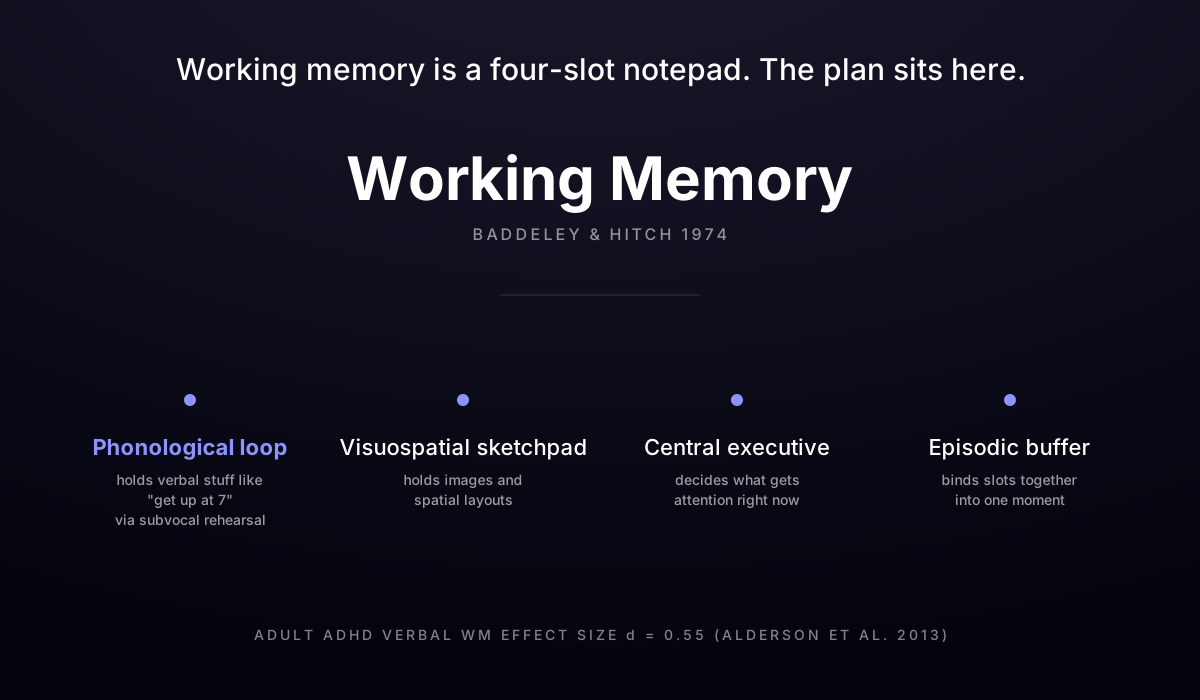
So at 11 PM, you put "get up at 7" into the phonological loop. You go to sleep. Eight hours later the alarm fires. The rehearsal mechanism that was supposed to keep the plan alive (already weaker than the average brain has) has just been asked to wake up and start rehearsing again, while doing something else at the same time.
The something else is the part nobody talks about.
I've written about a related mechanism in why your ADHD brain was asleep when you turned off the alarm. Local sleep is the cortex-offline cousin of this. The working-memory drop is what happens when the cortex IS online but the rehearsal slot has been overwritten. Two different breakdowns. Same kitchen-confusion symptom.
Dismissing the alarm is itself a competing task. Working memory loses every time.
Think about what your hand has to do when an alarm fires. Find the phone. Pick it up. Unlock it. Find the dismiss button. Swipe it. Set the phone down. Anywhere from four to eight seconds of motor sequencing, depending on whether you've fumbled.
That entire sequence is itself a task. It needs the central executive. The same central executive that's supposed to be holding "get up" in active rehearsal.
This is dual-task interference, and it has a canonical paper. Pashler 1994 in Psychological Bulletin is the load-bearing review. When you ask the central executive to do two things at once, both suffer. The "harder" or more novel task wins the resources. The other one gets dropped.
Now stack what's actually happening at 7 AM.
Sleep inertia is suppressing your prefrontal cortex. Wertz, Ronda, Czeisler and Wright 2006 in JAMA showed cognitive performance immediately after waking is worse than after 24 hours of sleep deprivation. Hilditch and McHill 2019 is the broader review on what specifically gets suppressed in that window. It's the same brain regions working memory depends on. Vallat and colleagues 2018 put it under fMRI: the Default Mode Network is dominant in those first minutes after waking, and the dorsolateral prefrontal cortex (the seat of working memory) is offline relative to the rest of the brain.
So at the moment your alarm fires:
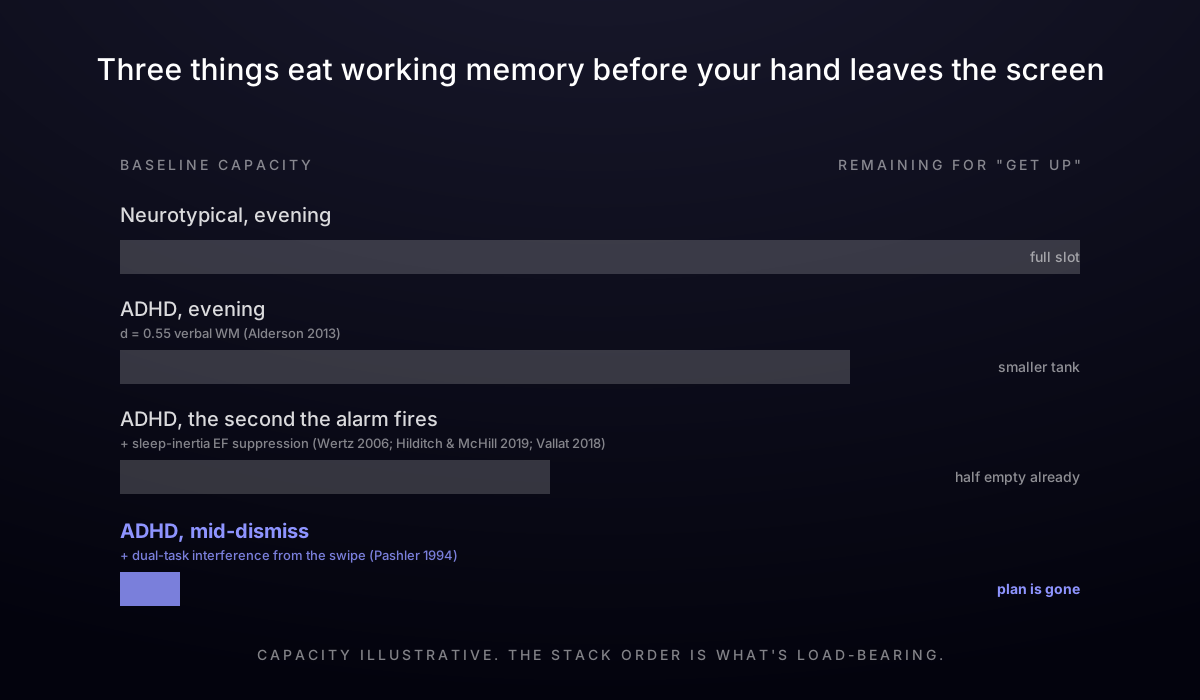
- Your ADHD baseline working memory is already running about half a standard deviation below the neurotypical average.
- Sleep inertia has suppressed the working memory regions further, transiently.
- The motor task of dismissing the alarm is now actively pulling central-executive resources away from "get up" rehearsal.
Three things stacked. The math does not work in your favor. The "get up" plan was never going to survive the swipe.
I owned a Sonic Bomb for two months. Bed shaker the size of a hockey puck, 113-decibel siren, the works. Every morning the same loop: alarm goes off, I throw the thing across the room, I lie back down. Some mornings I had a fragment of memory of the throw. Most mornings I didn't. The bed shook. I did not. And the few times I did remember, what I remembered was the throwing, not the plan I'd had ten seconds before about getting up. That part had vanished.
I used to think this meant I lacked discipline. Then I learned the mechanism, and I felt about 30% less like a fraud.
What the research actually says is narrower and more useful: ADHD working memory has a smaller capacity, the rehearsal mechanism is weaker, sleep inertia stacks on top of it, and asking that combined system to also execute a complex motor task is asking it to fail.
The fix is not "have a stronger plan." A stronger plan still has to live in the same fragile slot. The fix is external scaffolding. Something outside your head that keeps the plan alive while your hand does the dismissing.
A conversation works because answering IS the rehearsal scaffold.
Here's the part that finally made sense of why sound alarms keep failing me and one specific format doesn't.
The phonological loop wants verbal rehearsal. ADHD's compensation strategy, well-established in the working memory literature, is external verbal rehearsal. Saying things out loud. Having someone else say them back. Anything that takes the rehearsal load off the impaired internal mechanism. The body-doubling effect I wrote about in why ADHD brains need presence to wake up, not sound is one version of this. A study buddy reading their notes out loud is another. Your therapist asking you to verbalize your plan is a clinical version.
A conversation is the same trick.
When something asks you "how did you sleep?" and waits for an actual verbal answer, three things have to happen for you to produce a coherent reply:
- You have to comprehend the question (auditory cortex + language network online)
- You have to retrieve a relevant answer (semantic memory + working memory holding the question while you search)
- You have to assemble and produce the reply (Broca's area + motor speech)
That's a near-total wakeup of the cortical regions that were just suppressed. It's not subtle. You can't generate a coherent reply to a question while your prefrontal cortex is offline. You either say the right thing or the system on the other side notices the answer doesn't make sense.
And here's the second thing. Once the conversation is going, the wake-up theme stays alive in your working memory not because you're holding it there with effort, but because it's the topic of the conversation. The next question is "what's first today?" and your answer is whatever was actually on your morning list. The plan you set last night is being externally rehearsed by the alarm itself, in real time, with you as the second voice.
That's the design constraint that led me to build Rouse. The alarm doesn't just play a sound. An LLM holds a voice conversation with you and won't dismiss until you can hold up your end of it. There is no swat-the-snooze pathway. The dismissal IS the conversation. And the conversation is exactly the kind of external verbal rehearsal that compensates for the weak internal rehearsal that just lost the plan.
I'm not claiming this fixes ADHD working memory at the neural level. The Alderson meta-analysis is about the deficit, not how to repair it. What I'm claiming is narrower. A conversation alarm is the only alarm format that can't be dismissed during a working-memory drop, because it requires the rehearsal slot the drop just emptied. If you can answer the question, the slot is back online. The answer is the proof.
A test you can run this week
If "I dismissed the alarm and the plan was gone by the time I sat up" is a phrase that maps to your mornings, the cleanest experiment is one night.
Set Rouse for tomorrow's actual wake-up time. Don't try harder. Don't visualize. Don't psyche yourself up the night before. When the alarm fires, just answer.
Then check what survived. If you sat up holding your plan, the external rehearsal worked. If you got up but the plan still felt fuzzy until coffee, you've separated two problems that probably looked like one. The "I dismissed it and the plan was gone" problem is working memory. The "I'm awake and oriented but I cannot move" problem is post-wake executive freeze, which is a separate mechanism. I wrote about that in why ADHD morning paralysis hits AFTER the alarm. Different freeze. Different fix.
The win condition isn't that you become a morning person. The win condition is that the plan you made at 11 PM still exists at 7:01 AM.
Closing
Sound alarms ask your working memory to hold the plan. Conversations rehearse it for you.
If you have spent years setting alarms that worked for two days and then evaporated, set Rouse for tomorrow morning. The conversation is the test. If your brain is there, you can answer. If it isn't, the alarm doesn't go away. I'd love to know if it lands.