Your ADHD Brain Was Asleep When You Turned Off the Alarm. You Were Awake the Whole Time.
New 2026 brain research explains why ADHD adults dismiss the alarm and have no memory of doing it. The cortex is in sleep mode.
April 28, 2026
Your ADHD Brain Was Asleep When You Turned Off the Alarm. You Were Awake the Whole Time.
A 2026 brain scan finally explains the morning blackout.
A few weeks ago I set an alarm for a 6 AM call with someone in Sydney. I woke up at 6:34 to fifteen Slack pings asking where I was. My phone said the alarm had gone off, and stopped, at exactly 6:00. I have no memory of that.
Turns out a paper came out last month that finally explains what happened.
My cortex was in sleep mode while I was sitting up swiping at my phone.
In this post, you'll learn:
- Why "did I turn off my alarm?" is a real, measurable neurological event in ADHD brains, not a memory glitch
- What "local sleep" is, and why a March 2026 study showed ADHD adults have more of it than neurotypicals (even when wide awake)
- Why a sound alarm is exactly the wrong tool for a brain in local sleep, and what kind of stimulus the asleep patches can't ignore
8 min read
I dismissed it. I just wasn't there for it.
So back to the 6 AM call.
What's wild isn't the missed call. What's wild is the timeline. The phone screen is unlocked. The alarm is dismissed. The notification shade is open. None of that happened by itself.
Some part of me did all of that. Some other part of me was not online to witness it.
If you have ADHD you have probably had the version of this where you walk into the kitchen at 7:15, holding a phone you don't remember picking up, and ask out loud: did I turn off my alarm? You also wonder, briefly, whether you're losing your mind. You're not. You ran into something that didn't have a name in consumer-facing health writing until a few weeks ago.
The name is local sleep. And there's a brand new ADHD study about it.
What "local sleep" actually means (and why ADHD brains do more of it)
Quick neuroscience setup, because the mechanism is the whole point.
Your cortex doesn't fall asleep all at once like a light switch flipping. It goes patch by patch. There's a body of work going back to Vyazovskiy et al. 2011 in Nature on rats showing that small regions of cortex can drop into sleep-like slow-wave activity while the animal is behaviorally awake. Eyes open. Moving around. One little patch of brain, asleep. The phenomenon got a clean review in humans by Andrillon and colleagues in 2019, who called it local sleep in wakefulness, and tied it to attention lapses, mind-blanking, and microsleeps.
OK, so that's the foundation. Local sleep is real. Everyone has some.
The new piece is what last month's paper showed.
Pinggal et al., March 2026, The Journal of Neuroscience: a Monash University team ran 32 unmedicated ADHD adults and 31 neurotypical adults through a sustained-attention task while recording EEG. The ADHD group had significantly more sleep-like slow-wave episodes during wakefulness. Those episodes correlated with their attention lapses, slower reactions, and errors. Pinggal's quote in the press release is the cleanest way to put it:
"Sleep-like brain activity is a normal phenomenon that happens during demanding tasks… In people with ADHD, however, this activity occurs more frequently."
So the ADHD brain is not "broken." It is doing a normal thing more often. Patches of cortex slip into slow waves while the rest of the brain is up and running. The attention lapse in the lab task and the "I dismissed the alarm and I don't remember" in your kitchen are probably the same neural event happening at different times of day.
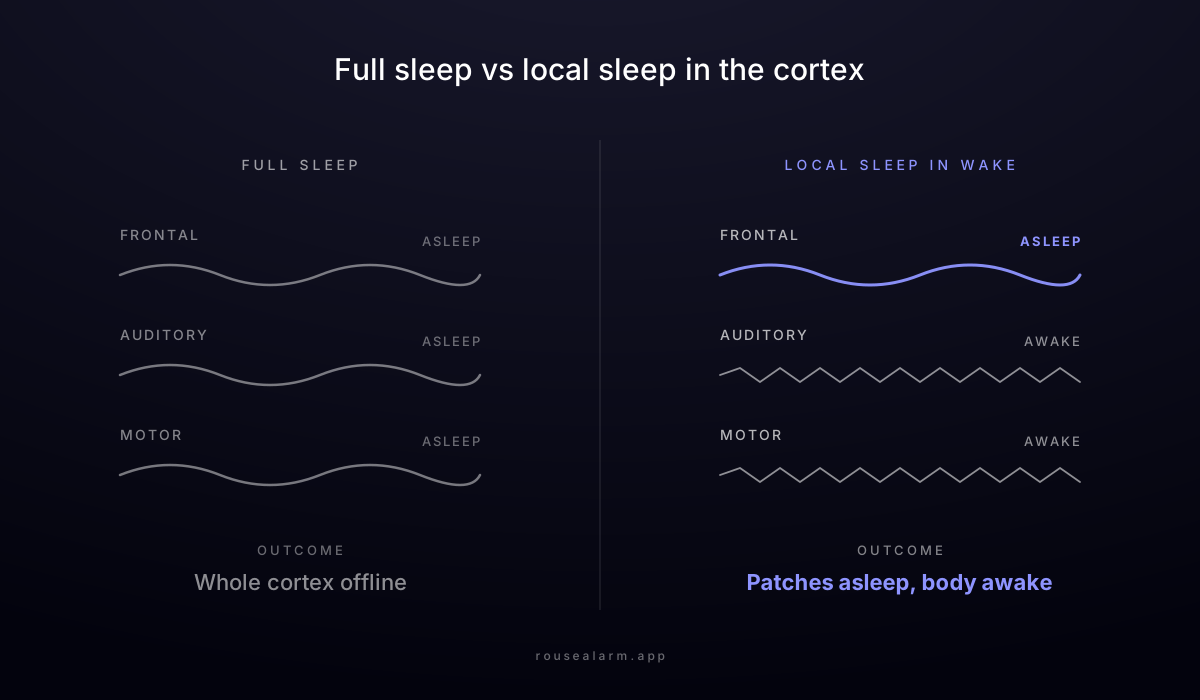
A note on what this isn't. This is not normal sleep inertia. Sleep inertia is the 15 to 30 minute fog where your prefrontal cortex is slow to come back online after waking (Tassi & Muzet 2000; Hilditch & McHill 2019). Everyone has that. Local sleep is different. It's slow-wave activity in specific cortical patches, on top of whatever sleep inertia you already had. ADHD brains, per Pinggal, get extra. So the morning is a stack: sleep inertia plus local sleep plus, often, the multi-alarm vigilance fatigue you set up the night before.
If you have ever read a comment on r/ADHD that said "I don't fully wake up until early afternoon," now you have a name for the mechanism. It's local sleep persisting past the wake transition.
Why a sound alarm is exactly the wrong tool for a brain in local sleep
This is where the alarm conversation gets interesting.
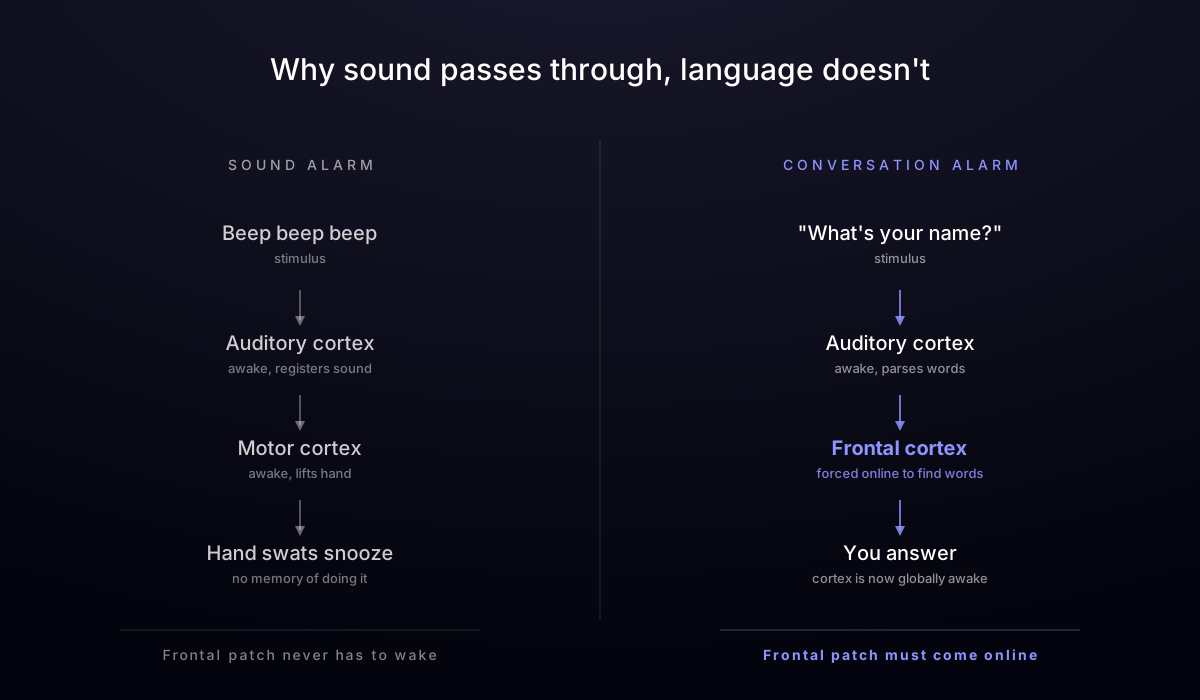
Think about what your phone is asking your brain to do when a sound alarm fires. It's playing a noise. Your auditory cortex registers it. A motor pathway lifts your hand. Your thumb finds the snooze button. Done.
Notice what's missing from that loop. Frontal cortex. Working memory. Language. Decision-making. None of it has to be online for the swat to happen. The hand can move while the prefrontal patch of cortex is still in slow-wave activity, because the swat doesn't need the prefrontal patch.
This is the part nobody thinks about. The dismissal of the alarm is a sub-cortical task. You don't need to be conscious to do it. You just need a hand and a phone within reach.
Then there's habituation, the other reason alarms decay. The orienting response to a repeated sound flattens fast (Sokolov 1963; Thompson & Spencer 1966). I've written about this in why every alarm stops working after seven days. By day four your brain has filed the alarm sound under "background noise we tune out, like the fridge." So now you have:
- A patch of cortex in local sleep
- A motor pathway that can dismiss the alarm without that patch being involved
- A sound stimulus that, on top of all this, has been habituated to the background
Three locks. The dismiss-and-don't-remember morning is not a willpower failure. It's the mechanically expected outcome of those three things stacked.
I owned a Sonic Bomb for two months. The thing has a bed shaker the size of a hockey puck and a 113-decibel siren. I'd wake up in the morning to find it on the floor across the room, off, with no recollection of getting up to throw it. The bed shook. The siren wailed. I did the thing I'd been doing for years. I just wasn't there for it.
Louder is not the variable. Bigger stimulus, same passive-processing pathway. The asleep patches don't care how loud the sound is. They're not processing it.
So what does break local sleep?
The honest answer from the literature is: forcing the asleep patches to come online. You do that by demanding a task that requires those specific regions. Language generation is the cleanest example I've found. Speaking sentences out loud is not a sub-cortical task. It pulls in Broca's area, working memory, semantic retrieval, the whole frontal-cortical orchestra. You can't generate a coherent reply to a question while your frontal lobe is in slow-wave sleep. The answer either comes out as garbled gibberish or doesn't come out at all, which the system on the other end notices and refuses to accept.
That's the design constraint that led me to build Rouse. The alarm doesn't just play a sound. An LLM has a voice conversation with you and won't let you dismiss it until you can hold up your end. There is no swat-the-snooze pathway because there is no snooze button to swat. The dismissal IS the conversation. And the conversation requires the cortical regions that local sleep is currently sitting on.
I'm not claiming this fixes local sleep at the neural level. The Pinggal paper is about how often ADHD brains do this, not how to suppress it. What I'm claiming is narrower. A conversation alarm is the only alarm format that can't be dismissed during a local-sleep episode, because it requires the exact neural machinery that local sleep is offline. If you can answer, you've already woken the patch.
A test you can run this week
If "did I turn off my alarm?" is a thing that happens to you, the cleanest experiment is one morning.
Set Rouse for tomorrow's actual wake-up time. When it fires, just talk back. Don't engineer the experience. Don't try harder. See whether the pattern of dismissing-and-forgetting still happens, or whether the act of having to say words out loud snaps the rest of the cortex online with it.
If your bed paralysis kicks in once the local-sleep window clears (and it will, that's a separate problem worth knowing about, I wrote about that in why ADHD morning paralysis hits AFTER the alarm), you'll have separated two things you've been confusing. The "I don't remember dismissing it" problem is local sleep. The "I'm awake but I can't move" problem is post-wake executive freeze. Different mechanisms. Different fixes.
Closing
A sound alarm is the alarm format that asks the least of your cortex. That's not a feature, that's the bug. For an ADHD brain doing extra local sleep through the wake transition, "least demanding" is the worst possible design.
If "did I turn off my alarm?" sounds familiar, set Rouse for tomorrow morning. The conversation is the test. If your brain's there, you can answer. If it isn't, the alarm doesn't go away. I'd love to know if it lands.