You Set 8 Alarms. Half Your Brain Stayed Up to Watch the First One.
The reason you slept through six alarms isn't volume. It's that half your brain was on alarm watch since 11 PM. Here's the ADHD vigilance loop nobody warned you about.
April 26, 2026
You Set 8 Alarms. Half Your Brain Stayed Up to Watch the First One.
The night before my first big work trip I set six alarms. 5:50, 5:55, 6:00, 6:05, 6:15, 6:30. Phone, iPad, kitchen, smart speaker, second phone, smart speaker again. Belt and suspenders and a third pair of suspenders.
I slept through all of them.
Got up at 7:48 to my Uber driver calling from the curb. Made the flight by sprinting the security line, sweat-soaked, no shower, no breakfast, half-tied shoes.
For years I thought the lesson was I need a seventh alarm. Or louder. Or weirder. Or further from the bed. The strategy was always: add another safety net.
It took me embarrassingly long to figure out the safety nets were the reason I was falling.
Turns out there's a name for what was happening that night. It's called the first-night effect, and once you read the actual paper, every multi-alarm morning of your life starts to make sense in a way that is honestly a bit upsetting.
I've been reading r/ADHD daily for a year while building Rouse, and the multi-alarm pattern is everywhere. u/jpasuncowboy posted a whole thread asking for advice, 227 upvotes, 445 comments, listing the strategies they'd already tried:
I have tried multiple alarms set differing intervals apart; I've tried putting my alarm across the room; I've tried the alarm apps that make you solve puzzles to turn them off; I've tried a lamp that mimics the sunrise. But every time, I snooze them/turn them off and am almost always getting in to work at the later end.
Every one of those strategies adds a stimulus. None of them addresses what happens to your sleep on the night before they all fire.
In this post, you'll learn
- What the first-night effect actually is, and why it isn't only about hotel rooms
- Why setting 5+ alarms makes your ADHD brain sleep worse, not safer
- How anticipatory vigilance fragments deep sleep, then amplifies sleep inertia in the morning
- Why an eight-alarm stack collapses into acoustic wallpaper your brain learns to filter
- What "an alarm you can trust" actually does to your sleep architecture
8 min read.
Half your brain stays awake when it's expecting trouble
In 2016, Tamaki, Bang, Watanabe & Sasaki published a paper in Current Biology called "Night Watch in One Brain Hemisphere during Sleep Associated with the First-Night Effect in Humans."
The setup is simple. Put people in a sleep lab. Record both brain hemispheres separately. Compare night one (unfamiliar) to night two (familiar).
Night one looks like this: the left hemisphere has measurably less slow-wave sleep than the right. It responds faster and more strongly to deviant external sounds. The participants wake up more often, and when they do, the wake-up is faster on the left side. The brain isn't fully asleep. Half of it has stayed up to listen for danger.
The researchers called it night watch. One hemisphere keeps an eye on the room while the other actually rests.
That alone is interesting. Where it gets brutal for ADHD adults is the follow-up study from 2024, which showed the same effect occurs in familiar environments under anticipatory load, not just on the first night in a new place. The brain doesn't actually care whether the room is new. It cares whether the next morning is high-stakes.
A morning where you absolutely, no-flexibility-allowed have to be up by 5:50? That's a high-stakes morning. That's an unfamiliar-environment-equivalent. Your brain stands night watch in your own bedroom.
Now layer the ADHD piece on top. The Sleep Foundation summary puts this baseline at 80%+: "More than 80% of adults with ADHD experience multiple awakenings throughout the night, and many describe finally falling into a deep sleep around 4 a.m." Your sleep is already fragmented as a baseline. Stack anticipatory vigilance on top, and you don't get a single coherent block of slow-wave sleep before the first alarm fires.
The cost shows up in the morning, not the night
Here is the part that ties it all together.
Tassi & Muzet's 2000 review in Sleep Medicine Reviews is the canonical reference on sleep inertia. That's the 15 to 30 minute window after waking where prefrontal cortex activity is suppressed and executive function is offline. Hilditch & McHill's 2019 update sharpens it: sleep inertia is dose-dependent. Worse sleep architecture beforehand = longer, deeper inertia after.
This is the bit nobody is connecting in the alarm content space. If anticipatory vigilance fragments your sleep, the morning version of you is starting further down the executive-function curve than they would have if you'd slept normally. The window where you can make decisions is delayed and shallower. Your reflexive snooze-and-dismiss is happening in a bigger executive-function deficit than usual.
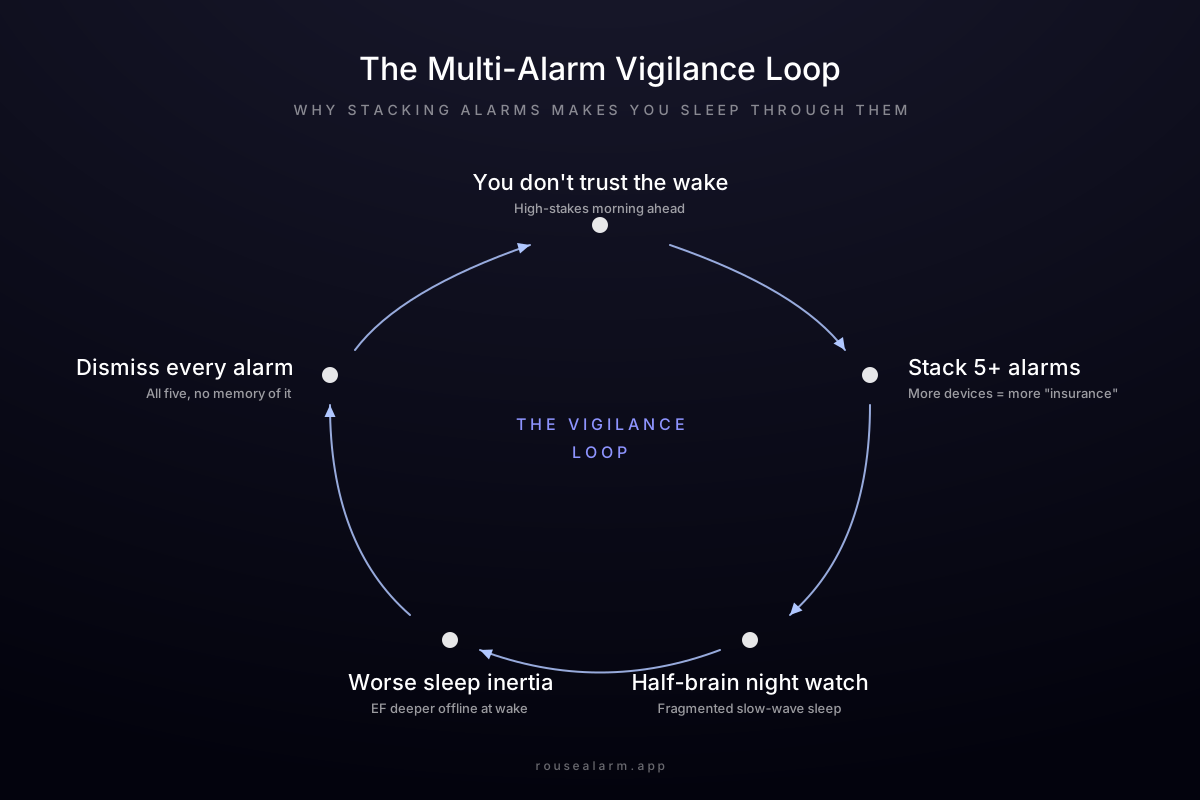
So the chain looks like this:
- You don't trust yourself to wake up.
- You set six alarms as insurance.
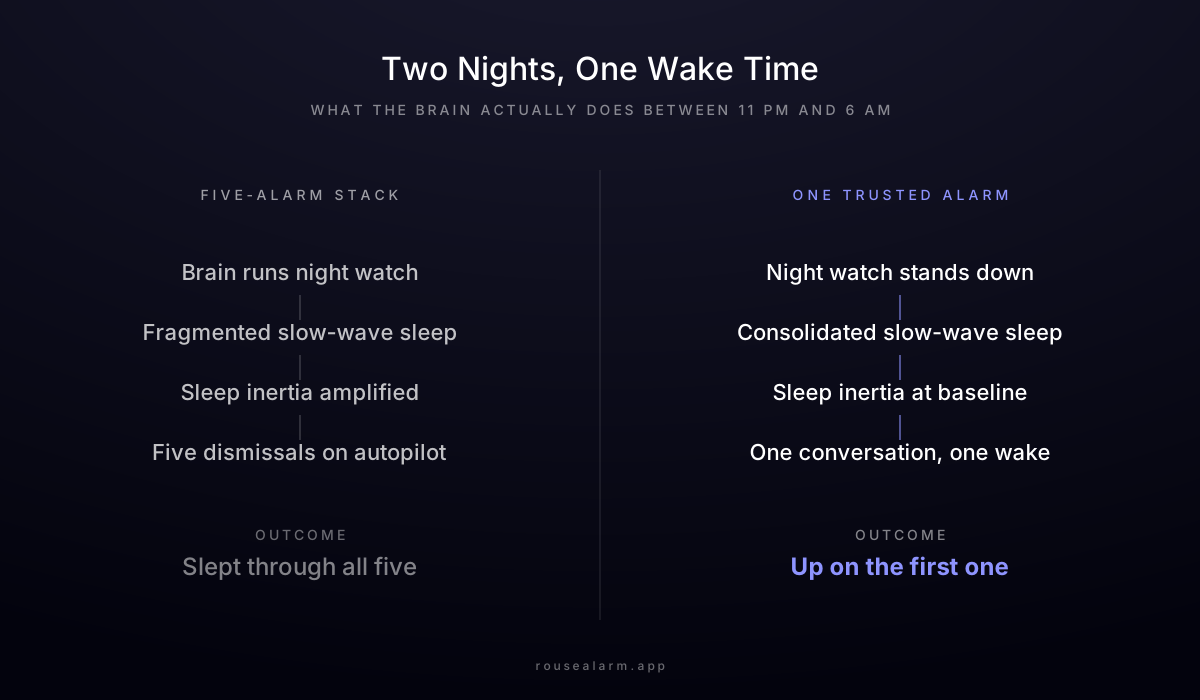
- Your brain reads "high-stakes morning ahead" and runs night watch.
- You sleep shallowly all night, with multiple half-arousals.
- The first alarm fires. Your sleep inertia is worse than baseline because your sleep was worse than baseline.
- You dismiss it on autopilot in 0.4 seconds. You don't even remember dismissing it.
- The other five alarms fire into a brain already in dismissal mode. Each one is faster to silence than the last.
- You wake up at 7:48 to the Uber driver.
You didn't sleep through six alarms because they weren't loud enough. You slept through them because step 3 already broke the morning before you'd even tried.
Eight alarms in a row is acoustic wallpaper
Even if you somehow slept through the night fine, the multi-alarm strategy has a second failure mode the loop diagram only hints at.
The orienting reflex, described by Sokolov in 1963 and made foundational by Thompson & Spencer's 1966 paper on habituation, models the brain as a pattern-matcher. Each repeating stimulus gets compressed into a "model." The closer the next stimulus matches the model, the smaller the orienting response, the deeper the filter. This is the same mechanism I unpacked in why every alarm stops working after about seven days.
A single alarm habituates over days. A stack of alarms habituates over the duration of the stack. Five alarms in twenty minutes becomes five instances of "the alarm thing." Your sleeping brain catalogs them as one event, not five. By alarm three, the dismissal is automatic. By alarm five, you're not even surfacing to consciousness for it.
Two alarms set ten minutes apart aren't twice as much insurance as one. They're one alarm with a slightly fatter envelope, after which you've taught your brain that "alarms come in waves and waiting them out is fine."
The folk strategy of stacking alarms is, in mechanism terms, training yourself to ignore alarms.
I will tell on myself here. I once set my phone alarm, my old iPhone (still working, on the desk), my Apple Watch, my kitchen smart speaker, and a $40 bedside clock with a backup-battery siren. Five separate devices for one 6 AM wake. I genuinely believed that no human being could sleep through that. The next morning my partner woke me at 7:30 by physically shaking my shoulder. I had no memory of any of the five firing. The clock had run its full siren and reset itself.
The brain does not care how many devices you own. It cares whether the content of the next thing is something it can pattern-match.
Why "trust the alarm" is a specific neural mechanism, not a feel-good phrase
The first-night effect literature suggests the inverse is also true: when the brain trusts the wake mechanism, the night watch can stand down. Vigilance is metabolically expensive. The brain doesn't run it for free.
This is the angle no alarm app talks about, because most alarm apps are sold on louder/harder/smarter. By the FNE logic, those properties should increase your nightly vigilance, not decrease it. A more aggressive alarm advertises a higher-stakes morning. Your brain reads the advertisement and stays up later to watch for it.
What actually breaks the loop is reducing the perceived stakes per individual wake event. If you genuinely trust that one alarm will get you up, not because it's louder or weirder but because it's trustable, the brain gets to file the morning as "handled" and run normal sleep architecture.
Reducing alarm count from six to one only works if the one is actually trustable. A single Sonic Bomb is more trustable than six normal alarms. Some people get there with that. The ADHD brain, with its pre-existing habituation rate and its tonic dopamine deficit, doesn't usually. After a week the Sonic Bomb is wallpaper too. Then you're back at zero alarms you trust, and the vigilance loop fires up again.
This is the design constraint I built Rouse around. It's an iOS alarm that fires, starts a real voice conversation with an LLM, and refuses to dismiss until you're holding a coherent back-and-forth. The conversation is different every morning because the LLM responses are generative. Your brain can't compress it into a pattern by Wednesday. The dismissal isn't a button. It's a multi-turn exchange you have to actually be conscious for.
The point isn't volume. The point is that the conversational alarm doesn't habituate, which means after one week you still trust it, which means your brain doesn't have to run night watch on it. That's the lever. Not a louder alarm. An alarm you can stop scheduling redundancy for.
This isn't theoretical. It's the same mechanism that lets you sleep peacefully when your partner has agreed to wake you, or when you have a hotel front-desk wake-up call set with a real human who knocks. You stop guarding the alarm because you trust the alarm. The body does the rest.
What to actually do this week
If this maps to you, here's a low-effort experiment.
Tonight, before bed, count how many alarms you currently have set for tomorrow. Multi-device, multi-time, anything that's going to make a sound. Write the number on a piece of paper next to the bed.
Now in the morning, before you do anything else, write down two things:
- How many of those alarms you remember consciously hearing.
- How many times you remember waking up during the night.
Most people are shocked at #1. The number is almost always 1 or 2, even when the count was 5+. The rest fired and got dismissed below the threshold of episodic memory.
#2 is the harder number to estimate, because most fragmented arousals don't get encoded. If you have a sleep tracker (Oura, Apple Watch, even iPhone bedtime tracking), look at it. If your "awake" minutes are double-digit on nights with high-stakes mornings and single-digit on weekends, you've just self-confirmed the FNE pattern.
Then try the inverse. Set one alarm. Just one. The one you trust most. If you don't trust any of them, pick one that requires conversational engagement to dismiss. See if the night before feels different.
If you want to test the conversational angle, set Rouse for tomorrow morning. One alarm. No backups. Tell it before bed what you're trying to wake up for. See whether you sleep deeper because the brain has nothing to stand watch over.
I'd love to know whether the night feels different, even before the morning does.
FAQ
Wait, isn't the first-night effect only about hotels? That was the original framing in the 2016 paper. The 2024 follow-up showed the same vigilance asymmetry occurs in familiar environments under anticipatory load. High-stakes mornings, important wakes, and yes, multi-alarm setups. The brain doesn't care if the room is new. It cares if the wake is high-stakes.
My partner doesn't sleep badly the night before a flight. Is this an ADHD thing? The first-night effect is a general human mechanism. ADHD amplifies it because of the pre-existing baseline of fragmented sleep and the more reactive autonomic nervous system. Same mechanism, worse hit.
I have to take an early flight tomorrow. Should I set fewer alarms? This is a longer conversation, but in mechanism terms: yes, if you can find one wake mechanism you trust. The redundancy isn't free. It's actively making the night worse. If your trust is in your partner waking you, that often beats six phone alarms.
Why doesn't this happen on weekends? Because there's no anticipatory load. Your brain has nothing to stand watch over. This is also why "I sleep great when I don't have to be up" is reported by basically everyone with ADHD. Same brain. Different stakes. Different sleep.
Does this only apply to diagnosed ADHD? No. The FNE is a general mechanism. ADHD makes the consequences worse on both ends. The night-watch fragmentation and the morning sleep inertia hit harder. But the loop applies to anyone who sets multiple alarms because they don't trust themselves.
How is this different from just "racing thoughts at bedtime"? Racing thoughts happen at sleep onset and are conscious. The FNE happens during sleep, in the architecture itself, and is unconscious. You can fall asleep fine and still wake up six times because the night watch is firing arousals you don't remember.
Kuba builds Rouse, an iOS alarm that wakes you by holding a real conversation until you're actually awake. If you've spent the last decade adding alarms instead of subtracting them, set Rouse for tomorrow morning. One alarm, no backups. Tell me whether the night before feels different. I read every reply.