Your Alarm Tells You What You Already Know. ADHD Has Never Been a Knowing Problem.
ADHD is a disorder of doing what you know. Every alarm in the App Store delivers knowledge. They have been solving the wrong half for fifty years.
May 3, 2026
Your Alarm Tells You What You Already Know. ADHD Has Never Been a Knowing Problem.
The disorder is doing what you know. Your alarm is information. The two have never met.
I have set 7 AM alarms for my entire adult life. I know what 7 AM is. I know why I'm getting up at 7 AM. I know the cost of not getting up at 7 AM. I have sat in bed at 7:04 AM with the alarm still ringing, fully aware of every one of those facts, and not gotten up.
Thinking I had a knowledge problem was the longest mistake of my twenties.
Turns out there's a name for the gap I was actually staring at.
ADHD is a disorder of doing what you know. Every alarm in the App Store is a tool for knowing what to do. They have been solving the wrong problem for fifty years.
In this post, you'll learn:
- Why Russell Barkley's "ADHD is a performance disorder, not a knowledge disorder" framing is the most-quoted line in the ADHD canon, and why your alarm has never accounted for it
- Why the "activation" cluster Thomas Brown described in 1993 is the part of ADHD that's most active at 7:04 AM, and why no notification-based tool can compensate for it
- Why a conversation works where every reminder has failed: the answer-out-loud IS the action, not a signal pointing at one you have to perform alone
8 min read
ADHD is a performance disorder. Your alarm is a knowledge product.
Russell Barkley has been giving the same talk for thirty years. The line that keeps surfacing in r/ADHD threads, in coach blogs, on the back of every diagnosis flier, is this one:
ADHD is a disorder of doing what you know. It's not a disorder of not knowing what to do.
Read it twice. The first read sounds like a slogan. The second read tells you what tools you've been buying for the wrong reason your whole life.
A reminder is information. 7:00 AM, gym day, you have a meeting at 9. The information was never the bottleneck. You went to bed knowing all of it. You set the alarm knowing all of it. You woke up to the alarm still knowing all of it. You sat there for 14 minutes still knowing all of it. The thing that didn't happen is the doing.
The ADHD literature is unusually clean on this point. Barkley's 1997 Psychological Bulletin unifying theory reframes ADHD around behavioral inhibition and executive self-regulation. His executive function fact sheet puts it in one sentence: "ADHD creates disorders mainly of performance rather than of knowledge or skills."
There's a corollary in the same fact sheet that should be tattooed on the inside of every alarm-app founder's wrist:
Conveying more knowledge does not prove as helpful as altering the parameters associated with the performance of that behavior at its appropriate point of performance.
The point of performance for waking up is the moment your alarm fires. If your alarm is a notification, you've put a knowledge tool at a performance bottleneck. The reader on r/ADHD who said "my best wasn't the problem, the 'doing' was the problem" was telling you exactly what every alarm app keeps missing.
It's not laziness. It's not low willpower. It's the tool category being wrong.
Sleep inertia hits the part of ADHD that's already broken: the activation engine.
Thomas Brown described an "activation" cluster of executive function in his work on ADHD without hyperactivity. Activation is the bridge between intention and action. Knowing you should start and actually starting are wired separately, and ADHD specifically degrades the bridge between them.
The Reddit thread that went around in 2020 quoted Sari Solden quoting Brown:
Adults who do not have hyperactivity often have severe difficulty activating enough to start a task and sustaining the energy to complete it. Often it means that they can't think of what to do so they might not be able to act at all, or, as Kate Kelly and Peggy Ramundo say in You Mean I'm Not Lazy, Stupid or Crazy?!, they might experience a "paralysis of will."
That thread sat at 6,377 upvotes and 591 comments on r/ADHD because thousands of people read "paralysis of will" and felt diagnosed twice in one sentence.
Now stack what happens to the activation engine in the first 15 minutes after the alarm fires.
Tassi & Muzet 2000 is the canonical sleep-inertia paper. The cognitive impairment in the first ~15 minutes after waking is severe. Hilditch & McHill 2019 is the modern review. Vallat and colleagues 2018 ran fMRI on the window and found the Default Mode Network dominant while the dorsolateral prefrontal cortex sits relatively offline. The DMN is the brain's internal-monologue, mind-wandering mode. The dorsolateral PFC is the seat of executive control. The activation engine.
The system that's already structurally weak in ADHD is, for the first 15 minutes after the alarm fires, doubly offline.
Predictable = no engagement. Reminder = no doing.
So at 7:04 AM:
- You know exactly what to do (knowledge: intact).
- The bridge from knowing to doing (activation: structurally weak in ADHD).
- The bridge has been temporarily knocked further offline by sleep inertia.
- Your alarm is a notification system delivering a fact you already had.
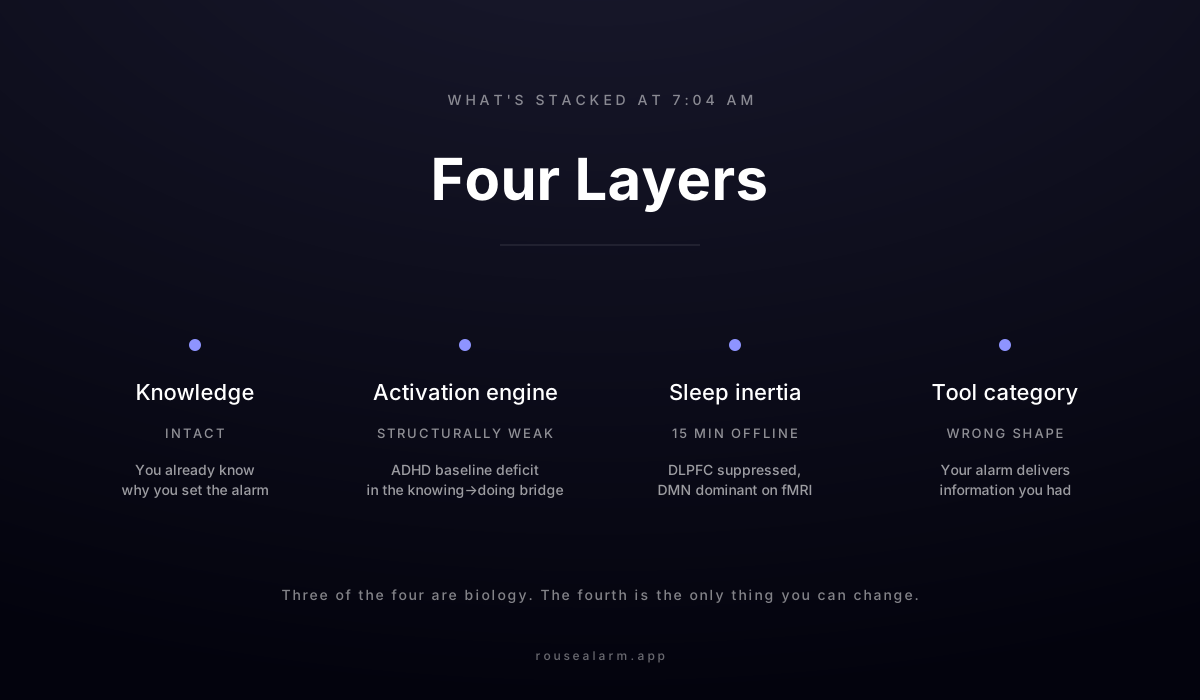
Three of those four things were already true before you bought the alarm. The alarm is the only thing on the list you can change. And you keep changing the sound of it instead of the category of it.
I owned an Alarmy subscription for a year. The math puzzle alarm, the barcode-scan alarm, the photo-of-the-bathroom alarm, the QR-code-stuck-to-the-fridge alarm. I solved every variant with my eyes closed within a week, then went back to bed. Alarmy thought my problem was that the dismissal was too easy. The actual problem is that the dismissal didn't require the part of my brain that does the getting up. The puzzle is more knowledge work. Knowledge has never been my bottleneck. (For the same reader on r/ADHD who said "I should be able to JUST DO IT. But I can't.", the puzzle is just one more "should.")
The closely related mechanism is what I wrote up in why ADHD morning paralysis hits AFTER the alarm. That post was about the freeze itself. This one is about why every reminder-shaped tool you've ever bought was structurally incapable of unsticking it.
The fix is a doing-scaffold, not a louder reminder.
If ADHD is a performance disorder, the question shifts. Not "how do I get a more attention-grabbing alarm?" but "what tool category turns the alarm itself into the action of getting up?"
The clinical name for the answer is scaffolding (Wood, Bruner & Ross, 1976), and the working ADHD-specific cousin is body doubling, which I wrote up in why ADHD brains need presence, not sound. A body double doesn't tell you what to do. The body double is doing it with you. That's the difference between information and scaffolding. Same task, different category of tool.
A conversation is a scaffold you can put on your nightstand.
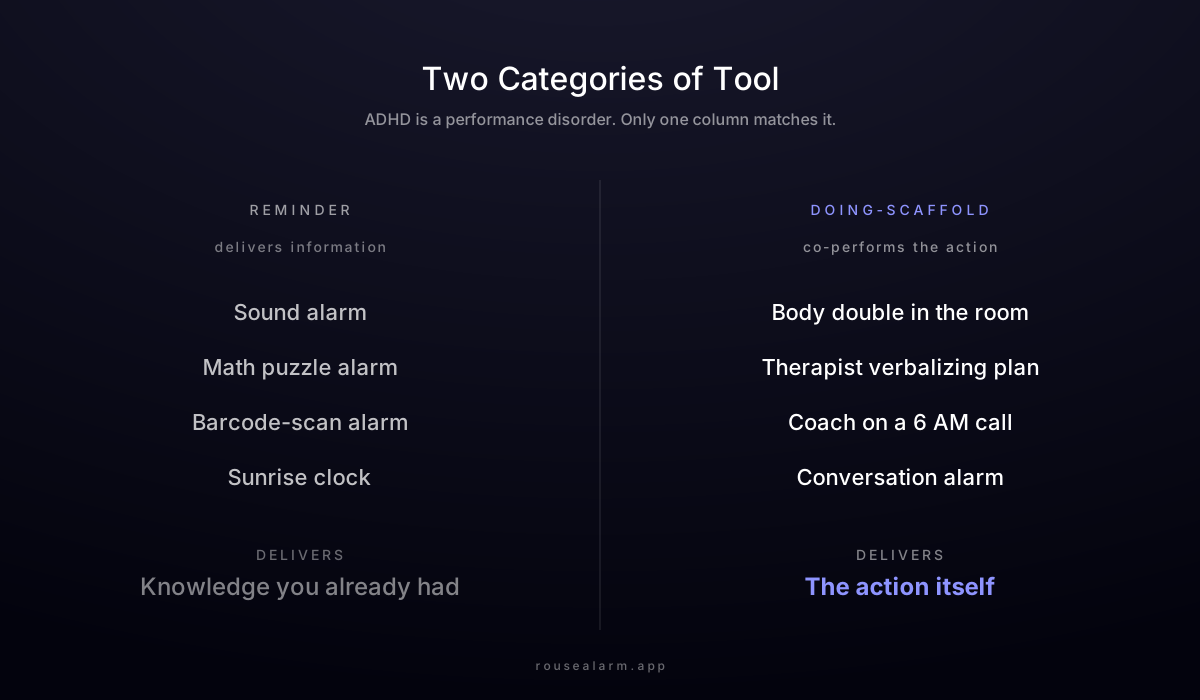
Here's what happens when an alarm asks you a question and won't shut off until you answer it back. The activation engine isn't being asked to initiate a task with no support, which is the thing it's worst at. It's being asked to complete a turn in a conversation that's already happening, which the language network does almost effortlessly, even at 7:04 AM. The first action of the day isn't get up out of bed. It's answer the question. That's a much smaller activation step. And once you've taken one, behavioral activation theory (Jacobson, Martell & Dimidjian 2001) says the next one gets cheaper, then the next one. Action precedes mood. Speaking precedes wanting to speak. The first sentence is the lever the rest of the morning rotates on.
This is also why a conversation alarm doesn't run into the same habituation cliff every sound alarm runs into. (If you haven't read why every alarm stops working after a week, that's the other side of this coin: predictability is the problem with sound; predictability is impossible in a conversation that's different every morning.) Habituation breaks predictable stimuli. Conversations are categorically not predictable. Two failure modes solved by the same shape of tool.
That's the design constraint that led me to build Rouse. There is no swipe. There is no math puzzle. The alarm is an LLM holding a voice conversation with you, and the dismissal IS the conversation. The activation step is the tiniest possible one (answer one question), the rehearsal scaffold is external (the alarm is the second voice), and the dismissal can't be performed by the dissociated, sleep-inertial, activation-offline part of you that swipes Alarmy puzzles in your sleep.
I'm not saying this is the mechanism for everyone. I'm saying it's the only alarm shape I've found that doesn't fail the category test for an ADHD adult. It stops trying to deliver information you already had. It starts being the doing.
By the way, if this maps to you, you can try Rouse for a week and see. I'd love to know if it lands.
Closing
The shortest possible version of this whole post: alarms are knowledge products. ADHD adults don't have a knowledge problem. Every minute you spend looking for a louder, weirder, harder-to-dismiss reminder is a minute you're spending optimizing the wrong category of tool.
If you've already tried the usual suspects (Alarmy puzzles, Sonic Bomb, two-alarm stacks, sunrise clocks), set Rouse for tomorrow morning and see what happens when the alarm asks you to do, not to know.