You Dreamed You Turned Off the Alarm. The Alarm Just Got a Cameo in Your Dream.
That dream where you swore you turned the alarm off? The alarm got a walk-on part in your dream. Here's the neuroscience of why ADHD brains do this more.
May 11, 2026
You Dreamed You Turned Off the Alarm. The Alarm Just Got a Cameo in Your Dream.
I once woke up forty minutes late, certain I'd dismissed the alarm at 6:30 like a responsible adult. I had a clear memory of reaching out, swiping it off, and lying back down for "five more minutes."
That memory was a dream.
The alarm rang. My brain wrote it into the script. My dream-self handled it. My body never woke up.
If you've had this morning more times than you can count, you already know the texture. You don't think you slept through the alarm. You think you turned it off and went back to sleep. The two feel completely different. One is a failure of the alarm. The other is a failure of you.
Turns out it's neither. It's a casting decision your dreaming brain made without consulting you.
In this post, you'll learn:
- Why your dreaming brain can hire your alarm as a prop instead of waking you up to it
- The specific reason ADHD brains are more vulnerable to this trick of sleep architecture
- Why a conversation can't get cast in your dream the way a beep can
7 min read
The "I turned it off" memory that never happened
There's a 1958 paper that should be more famous. Two researchers named Dement and Wolpert spent months sneaking up on sleeping subjects in REM and spraying water on their exposed skin. Sounds cruel. Was probably hilarious to watch. (Dement & Wolpert 1958, Journal of Experimental Psychology 55, 543-553.)
What they were measuring: when you poke a sleeping brain with a real-world stimulus, where does it go?
In the trials where the subject didn't wake up, 42% of the dream reports incorporated the water. People dreamed it was raining. The roof was leaking. Someone was squirting them. The water came in through the dream wall and got assigned a part. Pure tones got woven in 9% of the time. Visual flashes 23%.
The dreaming brain isn't a sealed room. It's a writers' room with a screenwriter who'll take any prop you slide under the door and find something for it to do.
Now picture your alarm. It's not a one-shot pure tone in a sleep lab. It's a sound your brain has been listening to for months. It's repetitive. It has emotional weight. It's tied to a known character in your daily life (you, the morning, the job). When that sound enters a dream, your screenwriter doesn't have to invent a context for it. There's already a folder labelled "alarm" with twenty cued associations.
So the alarm walks into your dream and gets handed a script.
It becomes a phone ringing on your kitchen counter, which you walk over and answer. It becomes the smoke detector you "fix" by climbing on a chair. It becomes the doorbell, the car alarm two streets over, the buzzer at the lab in the dream you're having about a job you don't actually have. The dream finds it a part.
And here's the part that messes with your head the most: when you "answer" it inside the dream, the dream gives you the satisfying sensation of having dismissed it. The cognitive close. The little click of "handled." That's why you wake up forty minutes later with a clear, vivid memory of having gotten up at 6:30 and turned it off. You did. In a dream.
You're not lying to yourself when you say "I'm sure I turned it off." You're remembering accurately. You just remembered fiction.
Why ADHD brains catch more REM at alarm time
Three things stack to make ADHD brains uniquely good at this trick. Each one is well-documented on its own. Stacked, they explain why "I dreamed I turned it off" is a near-universal r/ADHD story.
One. The DLPFC is asleep on the job.
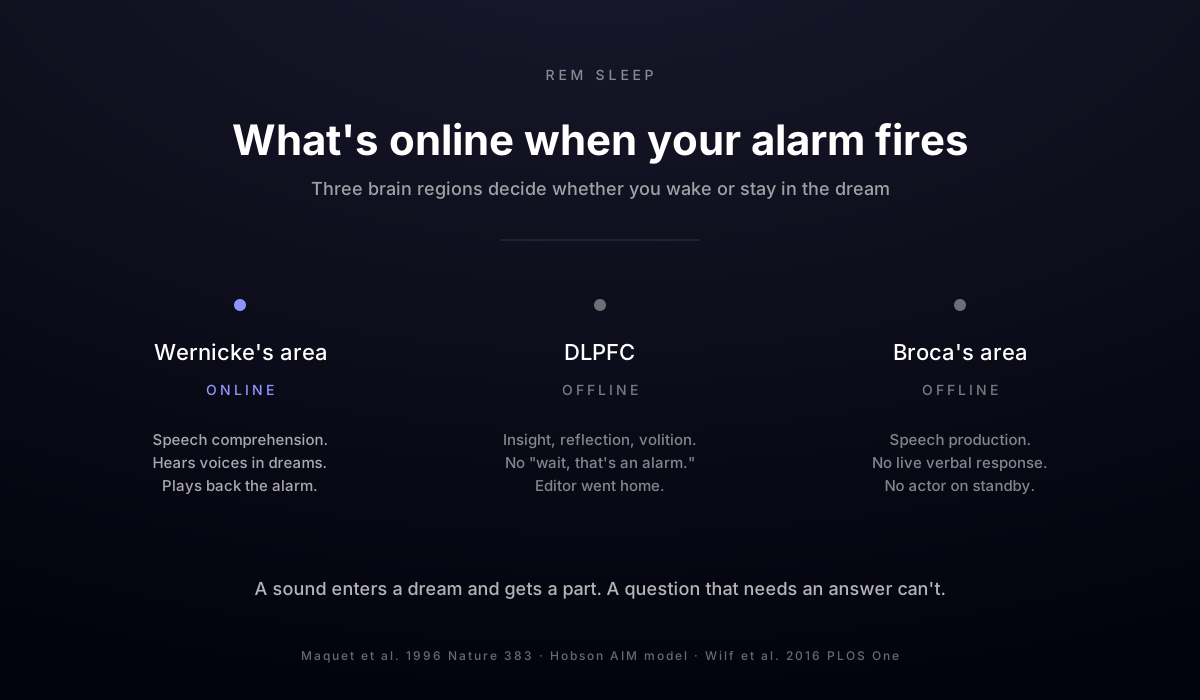
REM sleep takes the dorsolateral prefrontal cortex offline. This is the front-of-the-brain region responsible for insight, reflection, and the ability to step back and ask "wait, is this actually happening?" When Maquet and colleagues did PET scans of REM sleep in 1996 (Nature 383), they found this region's blood flow drops sharply, along with the parietal cortex and the posterior cingulate.
The Hobson AIM model has been the standard frame ever since: when DLPFC is offline, dreams feel real because the part of you that would notice they're absurd is asleep. You're a dinosaur surgeon late for the bus. Sure. Why not. Your screenwriter has full creative control because the editor went home. (Hobson 2009, Nature Reviews Neuroscience.)
That means in REM, the part of your brain that would say "wait, that's an alarm, get up" is the exact part that's not online to say it. The script gets written. You sign off because you can't read it.
Two. ADHD adults catch more REM at the wrong end of the night.
About three quarters of adults with ADHD have a delayed circadian phase. The biology runs late. The clock on the wall says 7 AM, but your brain is still operating like it's 4 AM in a normal-circadian person. (Van Veen et al. 2010, Biological Psychiatry 67(11), 1091-1096; corroborated by Bijlenga et al. and Kooij & Bijlenga's circadian work.)
This matters because REM density isn't evenly distributed across the night. Most of your REM happens in the second half. If you're going to bed at 1 AM and an alarm fires at 7 AM, your alarm is landing right in the densest REM stretch of your night. That's where dream incorporation lives. That's where you're most vulnerable to the casting trick.
A neurotypical person whose circadian phase aligns with their alarm time is more likely to wake from lighter sleep. Their alarm rings during a transition out of REM, not deep inside one. They get the wake. You get the dinosaur.
Three. ADHD wake-state instability blurs the threshold itself.
Sergeant's cognitive-energetic model (Biological Psychiatry 2005) describes how ADHD brains regulate arousal differently. The wake/sleep boundary is less sharp. You can be technically "awake" without your full cortex being online. You can be "asleep" with whole regions still firing. The transition that should happen cleanly when an alarm rings happens muddier, slower, and easier to mistake for something else.
Stack the three. DLPFC offline so dreams feel real. More REM at alarm time so the dream is bigger. Wake threshold blurred so the alarm can slip across without crossing it. That's not bad luck. That's structural vulnerability.
The procedural-memory version of this lives in the post about turning off your alarm in your sleep. The local-cortex version (parts of your brain awake, others not) lives in the local sleep post. This one, dream incorporation, is the third sister. Same family. Different organ.
Why a conversation can't get hired as a prop
Here's where it gets useful.
Dreams can play back almost anything. Sounds, voices, faces, places, smells. You can hear your dad on the phone in a dream. You can hear the radio. You can hear a stranger ask you a question. The brain regions for hearing speech (Wernicke's area, the auditory cortex) stay active during REM and can be recruited into dream content. (Siclari et al. 2017 on the dreaming "posterior hot zone"; Wilf et al. 2016 on the language hierarchy during sleep.)
But there's something dreams can't do.
They can't generate novel verbal output in real time.
The brain regions you need to actually speak a sentence (Broca's area, the inferior frontal cortex, the motor coordination required to produce articulated phonemes) are part of the same frontal network that REM has shut down. You can dream you're talking. You can dream you said something. But the words inside the dream are stitched together from memory and association, not produced live by the speech-production network. That's why dream conversations have a strange, half-remembered quality when you wake up. They weren't generated. They were assembled.
The proof of this is in lucid dreaming. The rare moments when a dreamer realizes they're dreaming are associated with the frontal lobe coming back online. Voss and colleagues showed in 2009 (Sleep 32) that lucid REM has frontal EEG signatures that look more like waking than like normal REM. Insight returns when the frontal circuits return. When they're offline, you're a passenger.
Now apply that to alarms.
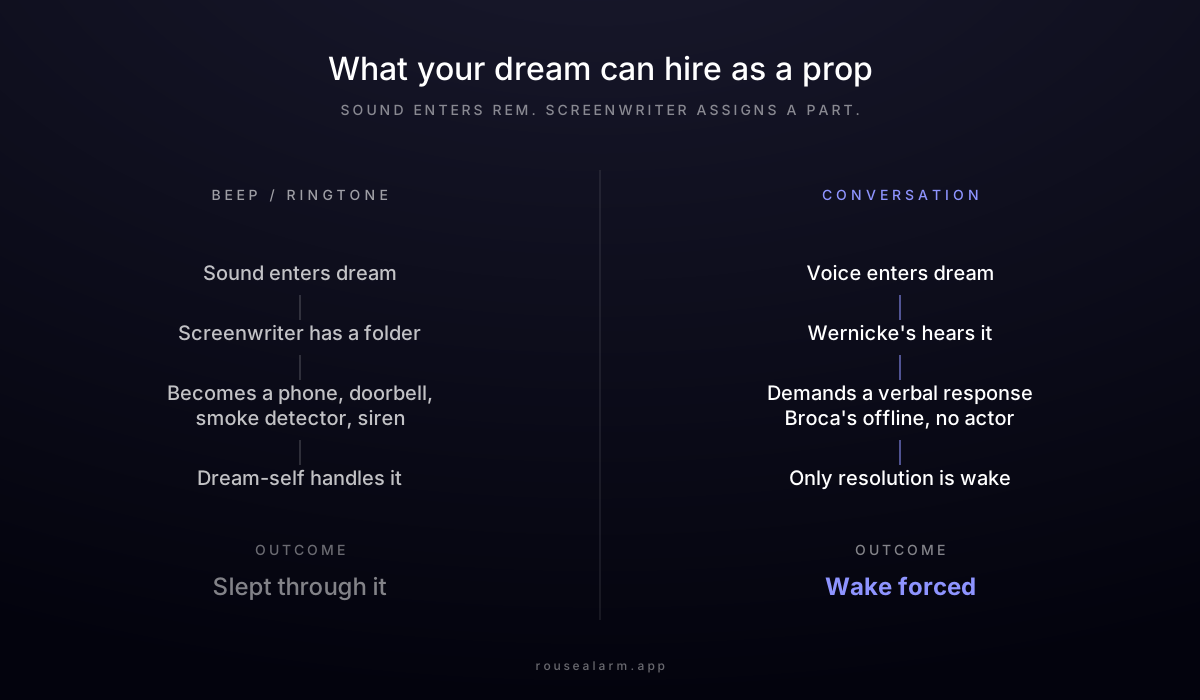
A beep enters a dream and gets assigned a part. Easy. The screenwriter has decades of experience finding things for sounds to do.
A ringtone enters a dream and gets assigned a part. Also easy. Phones in dreams are extremely common. Your brain has the prop in its inventory.
A voice enters a dream and gets played back as a character speaking. Still works. You can hear it. Wernicke's is online.
A voice asking you a question and waiting for you to actually answer in real time, out loud, with novel words?
There's no actor available. The screenwriter can't fake it. The production circuits required to generate the response are exactly the ones REM has switched off. The dream can't write a part for "you saying something useful right now" because writing that part requires you to actually say something useful right now, and you can't, because you're asleep.
The only way to deliver the line is to wake up and be the actor.
That's why Rouse uses conversation. It's the one stimulus your dreaming brain can't hire as a prop. There's no Broca's area on standby to deliver the line, so the only resolution is the wake state. (You can stack eight alarms and the screenwriter will write parts for all eight. Good luck.)
What this means tomorrow morning
If you've spent years setting more alarms, louder alarms, smarter alarms, you've been escalating along the wrong axis. The problem isn't volume. It isn't urgency. It isn't even your discipline. It's that the entire category of alarms you've been buying are made of materials your dreaming brain knows how to build with.
A sound is a prop. A vibration is a prop. A puzzle you have to solve to dismiss is a slightly more elaborate prop, and your screenwriter is happy to write a "puzzle on a screen" scene into the dream where you tap things and the alarm goes away. Every escalation along this axis is a bigger budget for the same screenwriter.
The escape isn't a louder alarm. It's a stimulus the screenwriter can't write a part for.
If you've had the "I dreamed I turned it off" morning more times than you can count, set Rouse for tomorrow. I'd love to know if anyone has had a Rouse conversation cast in their dream. So far, nobody has. The screenwriter has tried. The screenwriter has had decades of practice. The screenwriter is brilliant. The screenwriter just doesn't have the actor.