The Walk to the Office Was Doing Four Jobs. Your Alarm Is Built for One.
Office workers don't wake up better. Their commute did four things yours can't. Here's the four-function decomposition, and the one stimulus shape that recovers three of them.
April 28, 2026
The Walk to the Office Was Doing Four Jobs. Your Alarm Is Built for One.
The first morning after I quit, I sat at my kitchen table at 7:42 AM, fully dressed, coffee made, laptop open, and could not start working. I had nothing in my way. No commute. No standup. No Slack interrupting me before 9. The exact conditions every productivity blog promised would unleash deep work. I read the same email subject line for fourteen minutes.
I thought I was being soft.
It took me about eight months to figure out the commute was doing four jobs at once, and I had only replaced one of them.
The one I'd replaced was waking up. The other three I didn't even know were jobs. They were so embedded in the structure of having a regular job that I'd mistaken them for the day starting on its own. They weren't. They were a system. I had walked away from the system and kept the alarm.
This is also the Reddit post that finally put it in language I recognized, 363 upvotes from u/TopJobMaker on r/workfromhome:
"Today's commute from bed to desk in 73 seconds. The line between 'at work' and 'at home' basically disappeared, and I catch myself checking emails at midnight or realizing I've been in the same shirt for three days straight."
The 73 seconds isn't the win. The 73 seconds is the missing 30 minutes.
In this post, you'll learn:
- The four functions your commute was running in parallel that you never had to think about
- Why your alarm now has to do all four jobs at once, in the worst possible cognitive state
- The single stimulus shape that takes back three of the four in the dismissal window itself
7 min read.
What the commute was actually doing while you weren't paying attention
Pull up a default office worker's morning. Alarm at 6:30. Shower. Dress. Coffee. Walk to the car or the train. 30 minutes of driving or scrolling on a packed bus. Park. Walk through the lobby. Elevator. Hallway. Desk. Coffee #2. First Slack message at 9:04.
Now strip the steps to their cognitive functions. Four of them are happening at the same time, and three are invisible.
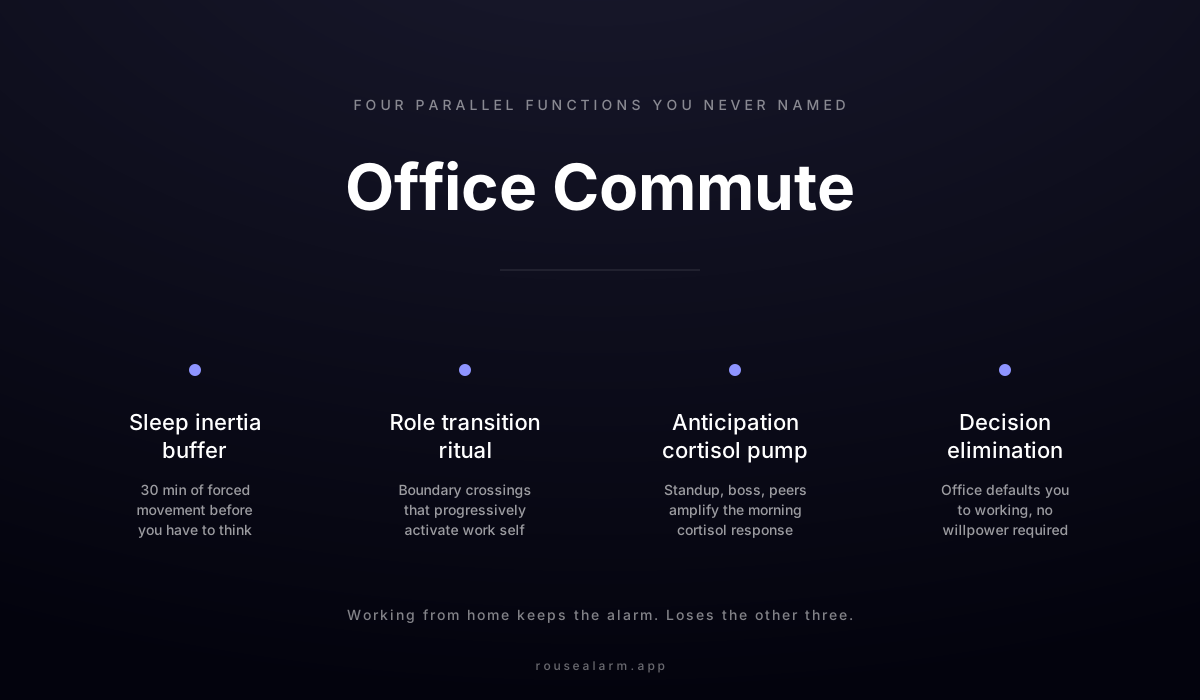
Job 1: Sleep inertia decay buffer. Your prefrontal cortex (the part that triages threats, decides what's urgent, and tells you which of the seven things on your mind actually matters) takes 15 to 30 minutes to come fully online after waking, sometimes longer. Tassi and Muzet's 2000 review in Sleep Medicine Reviews is the canonical reference, and Hilditch and McHill 2019 measured it cleanly in field conditions. The commute is a 30-to-60 minute window during which you have to be vertical and moving but you're not yet expected to think. By the time you sit at your desk, the EF lag has run its course in the background.
Job 2: Role-transition ritual. Boundary theorists Ashforth, Kreiner and Fugate's foundational 2000 paper in Academy of Management Review makes this explicit. They call them "micro role transitions": frequent, ritualized boundary crossings between life domains. Door, car, freeway, exit, parking lot, lobby, elevator, desk. Each step is a physical anchor that progressively activates the work self. The reason putting on a tie used to feel different from a sweatshirt was never about the tie. It was about the fifth of seven boundary crossings in a sequence that was rehearsing your work identity into existence.
Job 3: Anticipation pump for the cortisol awakening response. Cortisol spikes 30 to 75 percent in the first 30 to 45 minutes after waking. This is the cortisol awakening response (CAR), and it is not a fixed biological reflex. Powell and Schlotz 2012 in PLoS ONE tested this directly: people who anticipated demanding events in the morning had measurably larger CARs that day. People with empty calendars had blunted ones. The standup at 9, the boss's calendar invite, the colleague who'll notice you're late, all of them quietly amplified your morning cortisol pulse without you doing anything.
Job 4: Decision elimination. When the office exists, you don't decide whether to start working today. The 9 AM existence of other people in a room makes that decision for you. Samuelson and Zeckhauser 1988 in Journal of Risk and Uncertainty named this status quo bias: when a default exists, executive function preserves it. Office defaults to "you start working." Bedroom defaults to "you're in bed." A commute structurally moved you from the second default to the first without you ever spending a decision token on it.
Four jobs. One alarm. None of you noticed because the system worked.
What happens when all four collapse onto the alarm
You quit, or you went freelance, or you started a company. The 73-second commute happens. Your alarm now has to deliver all four functions inside the dismissal window, in the cognitive state where you can deliver least.
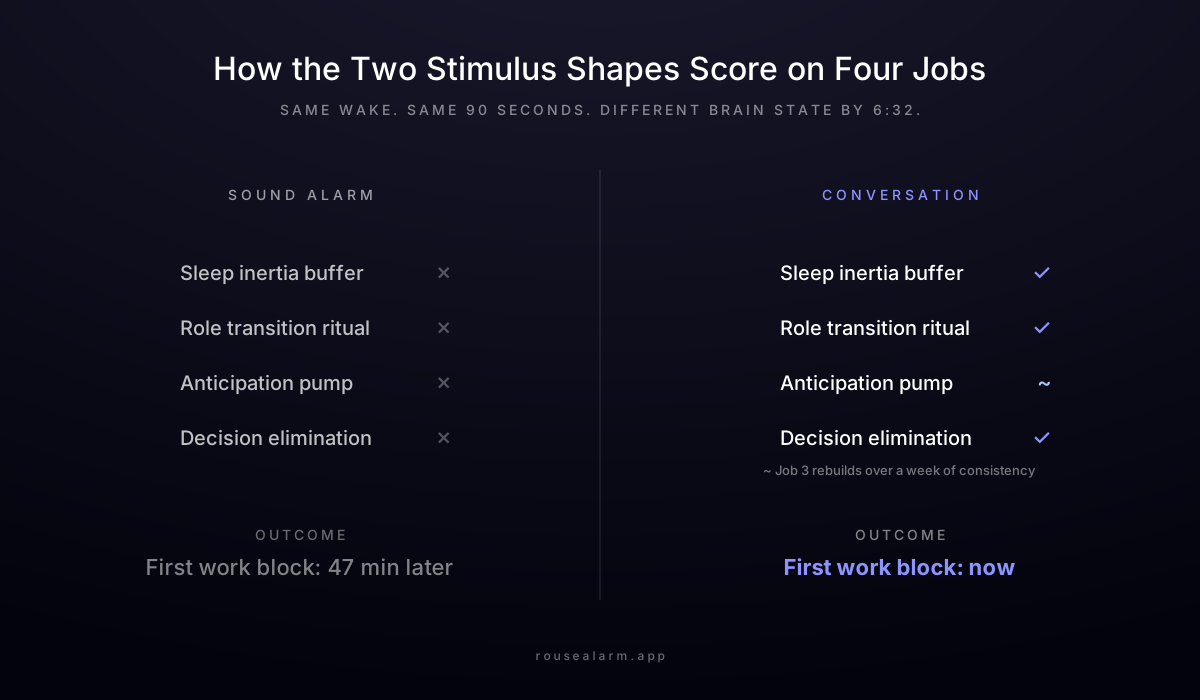
A sound alarm does none of them.
No EF buffer. It just signals time, and you're expected to start triaging at 6:31. Reading email at 6:33 with a half-online prefrontal cortex isn't reading, it's drifting through letters. (I went deeper on the body-online-brain-offline gap in Your Body Wakes at 6. Your Brain Wakes at 7:30.)
No role transition. The chair you slept in dreams about is the chair you're answering Slack from. Identity activation has nothing to anchor to. u/Frequent-Football984 put it cleanly on r/Entrepreneur:
"A client email at 9am kills SaaS focus for the rest of the morning. A bug report Tuesday night means Wednesday morning is support, not the feature I planned. Context doesn't respect the boundaries you try to set up in your calendar."
No anticipation pump. The CAR pulse fires anyway, but it fires undirected. Powell and Schlotz's anticipation effect is muted to flat. Energy with no target is just buzzing.
No decision elimination. Every morning starts with the same question: should I start working now? Status quo bias pulls you toward the default, and the default in your bedroom is "stay in bed." (The closely-related pattern around external accountability is what I covered in You Fired Your Alarm Clock When You Quit Your Job.)
Solopreneurs reach for fixes that handle one job each. Putting on real clothes touches Job 2 a little. The "fake commute" walk touches Job 1 partially. A 9 AM standup with a co-founder borrows Job 3 back. None put all four together because they're addressing symptoms of a system collapse, not the system.
You can't replace four parallel rituals with one serial habit, especially not one you're stacking onto a sleep-inertial brain.
The one stimulus shape that takes back three of the four
Exactly two things can run all four jobs in the dismissal window.
The first is another human. A partner, a kid, a roommate, a 6 AM co-founder call. Each does Job 1 (their voice forces EF online), Job 2 (the relationship is a role anchor), Job 3 (anticipated audience), and Job 4 (the conversation is the start of the day). They work. Most solopreneurs don't have one at 6 AM.
The second is anything that behaves like a person at the alarm. Same four functions, no other human required. The cognitive geometry needs four properties:
- Generated, not recognized, response. Tapping a green button is recognition. Saying "I'm going to write the onboarding flow today" is generation. Generation recruits left prefrontal language areas, working memory, and EF by definition.
- Novelty per turn. A static challenge becomes procedural within a week. A real conversation produces inputs you didn't model in advance. The brain can't habituate a moving target.
- Audience presence. The brain treats an audience as a real evaluator. The cortisol/anticipation circuitry doesn't fire for a notebook.
- A loop that closes only when the other side accepts your engagement. Tap-to-dismiss closes when you say it does. A real interlocutor closes the loop only when they think you're actually awake.
Run those four properties through the four-job decomposition:
- Job 1 (EF buffer): handled. Generated speech recruits the same prefrontal circuitry the buffer was warming up.
- Job 2 (role transition): handled. The first words of a conversation that uses your name and your project name activate work identity in seconds.
- Job 3 (CAR pump): partially handled. If you know an audience-shaped stimulus is coming, anticipation rebuilds over a week of consistency.
- Job 4 (decision elimination): handled. The conversation IS the start of the day.
Three out of four, with Job 3 catching up over a few days. That's why I built Rouse the way I did. The alarm fires. The LLM speaks first, using your name and yesterday's plan. You answer in actual sentences. The alarm only ends when the model judges your responses coherent enough to be from a brain that's online. The conversation doesn't replace the commute. It compresses three of its jobs into the 90 seconds you used to spend hitting snooze.
Run the diagnostic tomorrow morning
You don't have to take any of this on trust.
For the next seven mornings, write three timestamps in a phone note. The first is when your motor cortex says you're up. Feet on floor, kettle on, walking. The second is when you produce a sentence to another person that took more than four words to compose. (A Slack message you actually thought about, an email reply with a real opinion in it, a conversation with a partner about anything other than logistics.) The third is when you start the first piece of work you intended to do today, on the project you actually run.
The gap between timestamp 1 and timestamp 3 is the missing 30 minutes. The gap between timestamp 2 and timestamp 3 tells you which jobs are misfiring.
Under five minutes? You have a forcing function. A kid, a partner, a real 9 AM standup. Don't change anything. The system that's supposed to be doing this for you is doing it.
Twenty to ninety minutes? You're paying daily founder tax to a four-function collapse, and the fix isn't a louder alarm or another productivity app. The fix is the one stimulus shape that runs three of the four jobs simultaneously, in the dismissal window, while the bed is still warm and the prefrontal cortex hasn't booted yet.
Office workers don't wake up better. They have four wake-up rituals you lost when you quit. You're trying to do all four of them with willpower, and willpower at 6:30 AM is the resource your brain has the least of.
If your morning has been broken since you started working for yourself, set Rouse for tomorrow morning, and tell me whether the kitchen at 6:32 looks different. I'd love to know if it lands.
FAQ
My friends with regular jobs also struggle to wake up. Are you saying the office is magic? No. Sleep inertia is universal. Office workers also wake up sluggish. The difference is that their morning has 30 to 60 minutes of forced movement and ritualized identity activation built in before they have to think. Solopreneurs have to think the moment the alarm goes off. Same biology, different load distribution.
Couldn't I just set up a fake commute walk? You could and people do, and it helps. It addresses Job 1 (sleep inertia buffer) and partially Job 2 (role transition through movement and external scenery). It doesn't address Job 3 (no anticipated audience on a solo walk) or Job 4 (deciding to do the walk in the first place is the same decision you're trying to avoid). It's a partial fix. Better than nothing. Not the same as four parallel ritualized jobs.
Doesn't a calendar invite to a 9 AM call solve this? For Job 3 and Job 4, mostly yes. That's why founders who book early calls with co-founders, accountability partners, or coaches report immediate relief. The trade-off is that you've burned the most cognitively expensive part of your day on a meeting instead of deep work. The 9 AM call fixes the alarm by trading the morning.
Does Rouse claim to be an accountability partner or a therapist? No. Rouse is an alarm. It runs the four-job decomposition by being the one stimulus shape that requires generated speech in the dismissal window. If your morning issues are larger than the wake-up mechanics, an alarm app won't fix them, and I'm not pretending otherwise.
Kuba builds Rouse, an iOS alarm that wakes you up by holding a real conversation with you until your prefrontal cortex is actually online. If you've quit the office and your mornings stopped working at the same time, set Rouse for tomorrow morning and tell me how the first hour goes.