Your Brain Doesn't Close Tabs When You Sleep. Your Alarm Has to Fight Every One.
Solopreneurs blame snooze on willpower. The real culprit is unfinished cognitive loops your brain rehearses before you're awake. Here's the mechanism.
May 8, 2026
Your Brain Doesn't Close Tabs When You Sleep. Your Alarm Has to Fight Every One.
I closed my laptop at 11:47 PM with three browser tabs open and a half-finished investor reply.
I closed my eyes. The tabs did not.
By the time my alarm fired at 6:30, my brain had already spent six minutes drafting a paragraph I would never write, in a reply I had not sent, to a question I had already half-answered. The alarm wasn't waking me up. It was firing into a brain that had been rehearsing yesterday for the last seven hours.
That morning was the first time I noticed the alarm wasn't the first thing my brain did at 6:30. The first thing my brain did was reload an open loop.
If you're a solopreneur who can't get out of bed in the morning and you keep blaming it on willpower, this post is for you. There's a name for what's happening. There are three of them, actually. They stack into one bad morning, and once you can see the stack, the snooze button stops looking like a discipline problem.
In this post, you'll learn:
- Why the first thing your brain loads at 6:30 AM is yesterday's unfinished tabs, not today
- The three mechanisms that turn an open loop at 11 PM into a snooze cycle at 6:30
- Why bed becomes a refuge from the rehearsal, and why a sound alarm can't displace it
- The one stimulus shape that actually evicts an open loop from working memory
7 min read.
Yesterday's tabs don't close when you do
The first thing I had to accept was that the loops I left open at 11:47 PM didn't politely shut down because I was sleeping.
There's a study on this from 1927. Bluma Zeigarnik, a Russian psychologist, noticed that waiters in a Vienna café could perfectly recall the orders of the tables they were still serving and remembered almost nothing about the tables they had just settled the bill on. The unfinished orders occupied memory. The closed ones didn't. That's the Zeigarnik effect. Closed task, freed memory. Open task, persistent memory.
Masicampo and Baumeister replicated and extended this in 2011 in the Journal of Personality and Social Psychology, and the part that mattered for me was specifically about downstream cognition: unfulfilled goals intrude on later thought, impair concentration, and persist as repeated mental rehearsal. The mechanism your brain uses to remind you about an unfinished task is the same one that disrupts the next thing you try to do, including sleeping.
Solopreneurs run more open loops than almost anyone. Half-finished pitch deck. Three vendor emails in draft. A pricing decision that's been "ninety percent done" for two weeks. Slack thread you'll reply to "in the morning." When you close the laptop, none of those close. They go quiet.
David Allen calls these open loops in Getting Things Done. He's not wrong, he's just late. Zeigarnik was first by 75 years, and the underlying mechanism she described is why GTD's external-system trick works at all. The brain is bad at storing open loops, so you have to put them somewhere else. Mine were all live at 11:48 PM, and they were all still live at 6:30.
The three things stacking against you between 6:30 and 6:50
This is where the real damage happens. The open loop isn't just sitting in storage. There's a mechanical sequence that loads it into your conscious experience before your prefrontal cortex is online to do anything about it.
Three layers, in order:
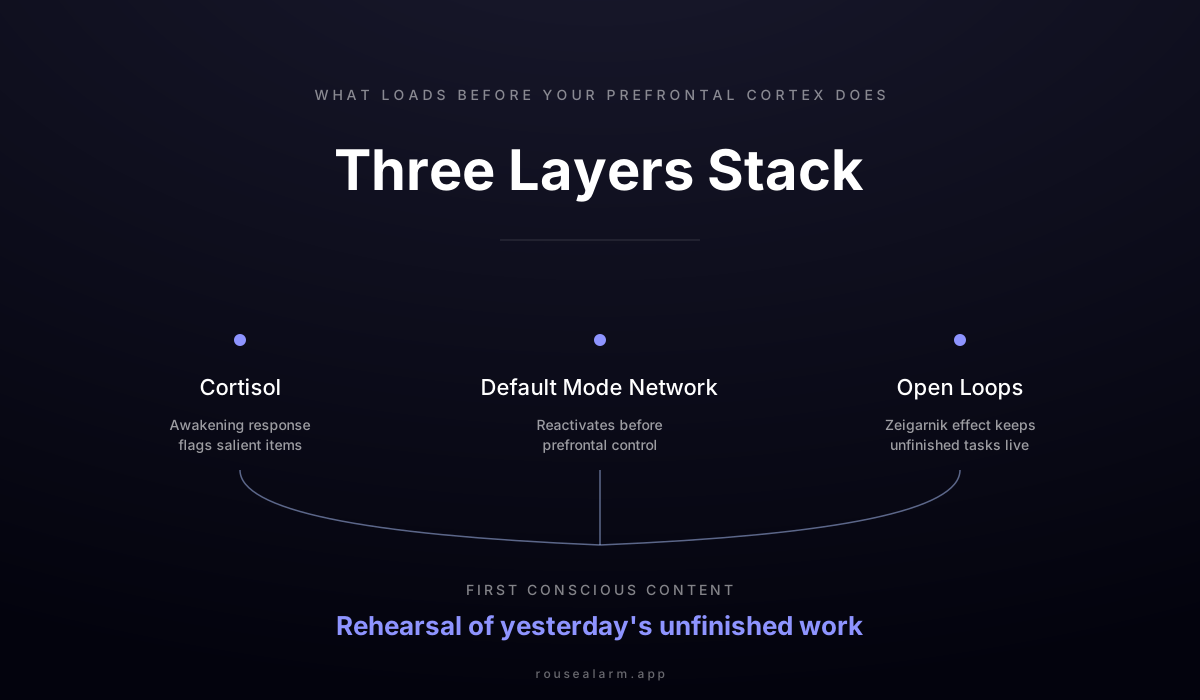
Layer one: cortisol. Within 30 minutes of waking, your cortisol levels rise sharply. This is the cortisol awakening response, first measured cleanly by Pruessner and colleagues in 1997. It's not pathological. It's a normal arousal signal. But cortisol increases the salience of items the brain has tagged as relevant or unfinished. It's the wakeful equivalent of sticking a flag on every open loop and turning the lights up on it.
Layer two: the default mode network. Before your prefrontal cortex is back online (sleep inertia is real, and the executive lag lasts roughly 15 to 30 minutes), the default mode network is what's running. Vallat and colleagues showed this in a 2018 NeuroImage study using EEG-fMRI through the wake transition. The DMN is the brain's mind-wandering, autobiographical-recall, rumination network. It's good at one thing: spontaneously generating internal narrative from whatever is most salient. It is bad at goal-directed task selection. So the DMN takes the stuff cortisol just flagged, and it starts narrating.
Layer three: the open loops themselves, primed by Zeigarnik. They're the most salient unfinished items. They're flagged. The DMN is online. The story writes itself. You wake up and the first thing you experience, before you've even decided whether to keep your eyes closed, is a continuation of the half-finished investor reply.
I've timed this on myself. Seven minutes from "alarm fires" to "I am mentally seventy percent of the way through a paragraph that doesn't exist about a deal that hasn't moved." That's the cold-start preview, and it's running on the cortex equivalent of a brownout.
I wrote about a related corner of this in the 30-minute window of founder dread, which is the same machinery generating anxiety content instead of unfinished-task content. Same DMN. Same cortisol bath. Same window. Different payload.
Why your bed becomes a refuge from the rehearsal
Here's the move I didn't see for a long time, even though I was making it every morning. Once your brain is rehearsing an open loop while you're horizontal, getting up means making the loop louder, because the moment you stand up you're committing to engage with whatever the DMN has been previewing. The bed is the only position where the rehearsal stays at half-volume.
If the preview is bad, you'll do almost anything to delay the commitment.
Snooze isn't a discipline failure. It's a request for nine more minutes of buffer between you and the open loop. Your brain isn't dodging the alarm. It's dodging the rehearsal that the alarm is about to make you act on. The alarm is the messenger.
That's why "louder alarm, alarm farther away, stack five alarms" fails for this specific pattern. None of those address the rehearsal. They make the messenger more annoying. The problem at 6:33 isn't that you can't hear the alarm. It's that you can hear the alarm and the unfinished thread and the cortisol is up and the DMN is in the driver's seat, all at once. The alarm is one signal in a four-signal chord, and volume doesn't change the chord.
Why employees inherit a shutdown ritual and solopreneurs structurally don't
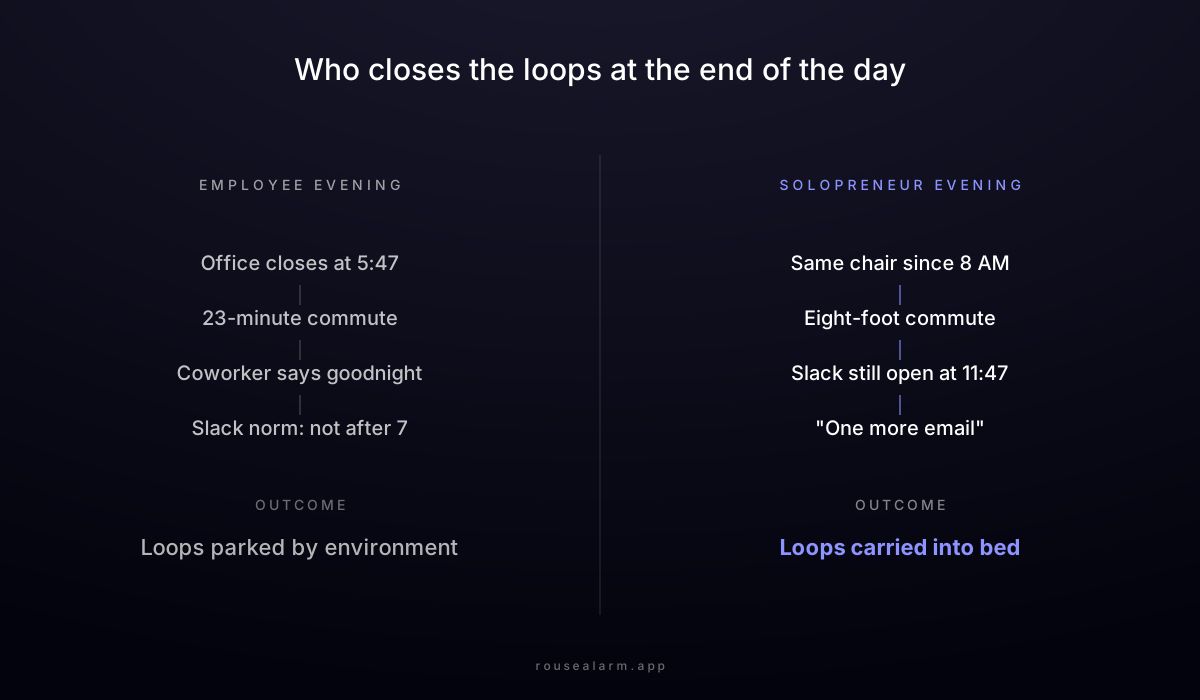
Pull up a default employee's evening. They close the laptop at 5:47 PM because the office is closing or they have to catch a train, walk out of the building, and have a 23-minute commute home. By the time they get to the front door, there's been a forced physical and contextual transition between work and home. The open loops haven't all closed, but they've been parked. The environment has been telling them "we're not at work anymore," repeatedly, for half an hour.
A solopreneur's evening looks like this: close the laptop at 11:47 PM in the same chair you've been in since 8 AM. Walk eight feet. Lie down. The loops are still on. They were on at 11:46. Nothing in the environment told them to power down.
Cal Newport calls the deliberate version of this a shutdown ritual. He's right that it works. The practical question for solopreneurs is what to put in place when nothing in the environment is closing the loops for you, because Rouse is the wake-up app and the bedtime side of this is a separate fight. The morning side is where I had something to add.
What actually evicts an open loop from working memory
If a sound alarm can't displace a rehearsing brain, what can?
The mechanism that works is forced active retrieval into language. Slamecka and Graf showed this in 1978 in what's now known as the generation effect: information you generate and speak out loud is encoded and retrieved more strongly than information you only read or think about silently. The mechanism cuts both ways. When an external prompt forces you to generate language, the prompt occupies the working-memory channel that the rehearsal was running on, and you can't rehearse a half-finished investor reply if your mouth is forming the answer to a different question.
Three things actually do this in the dismissal window:
- Verbalizing your top three priorities out loud, the moment you're conscious. Even if it feels insane. The generation effect doesn't care whether anyone hears you.
- A 6:35 AM call with another founder. Forced retrieval, externalized to a person. Works. Hard to schedule.
- An alarm that won't dismiss until you have a verbal exchange with it.
That third one is what Rouse is. The alarm fires, a voice asks you something, and you can't dismiss it without responding. The dismissal mechanism is the conversation. While you're answering, the rehearsal channel is occupied: the unfinished investor reply isn't running, the DMN isn't narrating yesterday, and the cortex is doing externally-paced retrieval, which is the only thing the brain at 6:32 AM can do that doesn't accidentally feed the rehearsal.
It's not a productivity hack. It's a way to evict the open loop long enough to get vertical. By the time you're up, the rehearsal has lost momentum and the loop is one item on the day, not the whole gravity.
This is the same family of fix I wrote about in why founders cold-start their working memory every morning, pointed at a different failure mode. Cold-start is about an empty cache. Open-loop rehearsal is about a cache pre-loaded overnight with the wrong content. Same dismissal window, same fix: forced verbal exchange in the first 90 seconds.
What to try this week
If you've been blaming snooze on willpower, swap the diagnosis. You don't have a wake-up problem. You have an open-loop problem your alarm is trying to fight with sound.
Try one of these tomorrow morning:
- The moment your alarm fires, say your top three priorities for the day out loud, in a full sentence, before you reach for the phone. Even if it feels stupid. Especially if it feels stupid.
- Schedule a 6:35 AM accountability call with one other person.
- If you've already tried every standard alarm trick on the planet and the snooze cycle keeps winning, set Rouse for tomorrow morning and let the conversation displace whatever your DMN is trying to load. I'd love to know if it lands.
The goal isn't to fix the bedtime side tonight. The goal is to make the first 90 seconds of consciousness about something other than the tab you left open at 11:47 PM. Once those 90 seconds are spoken for, the loop loses the morning. You get to spend the cortisol on the day you're starting, not the one you didn't finish.